
When I was a kid, I was absolutely sure quicksand was going to be one of the big challenges of my adult life. Looney Tunes taught me that. Some poor coyote would step off a perfectly solid path, sink up to his chin in brown glop, and wait for a branch that was always just out of reach, usually right before an ACME anvil landed on him for good measure. So I had a plan. Stay calm, don’t thrash, find a sturdy branch. I have lived an entire grown-up life since then and used that plan exactly zero times.
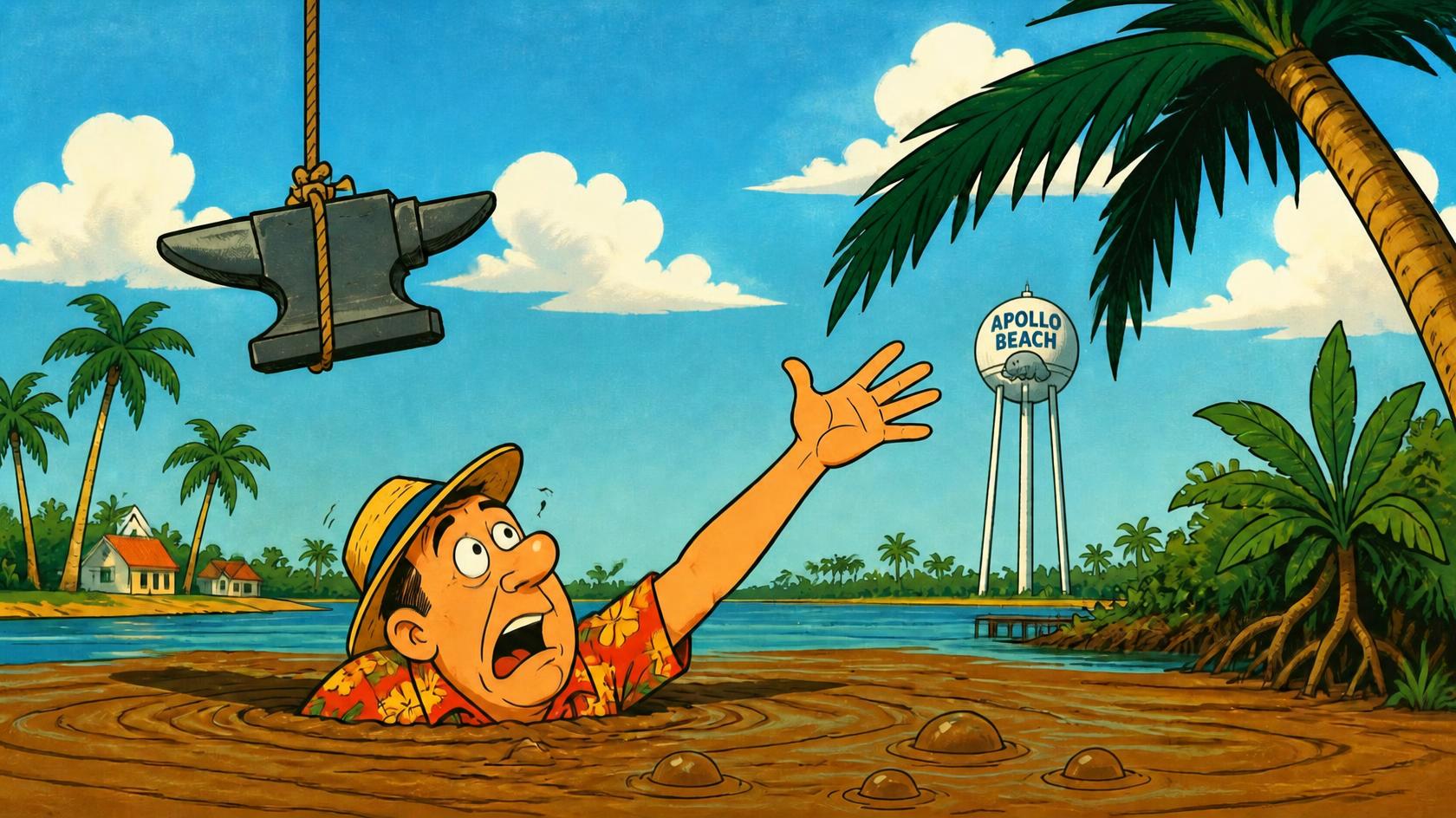
Nobody asks me about quicksand anymore. But right up there with “Are there alligators?”, the question I hear most from people moving here from out of state is “Are there sinkholes near here?” It’s a completely fair question. Florida is famous for them, and the news stories are scary. So here’s the honest answer for the South Shore, plus the difference between a sinkhole and plain old settlement, how each one gets fixed, and what it all means for your insurance.
What’s the short answer?
Sinkholes are very rare in Apollo Beach, Ruskin and the rest of the South Shore, and there’s a real geological reason for it. Most of what people call a sinkhole turns out to be ordinary settlement, which is common, usually cosmetic, and a completely different problem. Florida law also treats sinkholes very specifically when it comes to insurance and disclosure, and that’s worth understanding before you buy anywhere in the state.
Does Florida really have sinkholes?
Yes. The whole state sits on limestone, and groundwater slowly dissolves limestone over time. The Florida Geological Survey says technically there is no part of Florida with zero chance of a sinkhole, but some regions carry considerably more risk than others. The dramatic ones that make the news, like the 2013 Seffner sinkhole that opened beneath a bedroom or the 1981 Winter Park sinkhole that swallowed a house, a pool and a few cars before becoming a lake, happened north and east of Tampa. That area, which covers Pasco, Hernando and northern Hillsborough counties, is known as Sinkhole Alley.
Why are sinkholes so rare in Apollo Beach, Ruskin and the South Shore?
It comes down to which way the water underground is pushing. The U.S. Geological Survey explains that along the southern coast of this region, the deeper aquifers are well sealed, so the water pressure beneath us pushes upward instead of pulling downward. In plain English, the water under the South Shore is pushing up, not draining the sand down into the rock, and sinkholes rarely form under those conditions.
That doesn’t mean the South Shore has no ground questions at all. It means the questions worth your energy here are elevation, flood zones and flood insurance. I wrote a whole article on those: Is Apollo Beach in a Flood Zone?
What is the difference between settlement and a sinkhole?
Settlement is the great pretender. It’s the soil under a home compacting as it gets used to the weight of the house, and it usually shows up as hairline cracks in stucco, drywall or the garage slab. It tends to happen in a home’s first several years, and then it generally stops. The Florida Geological Survey lists plenty of other everyday things that can make ground dip and look like sinkhole activity, including pockets of clay or organic material that shrink as they dry, broken sewer or drain lines, soil that wasn’t compacted well during construction, and even buried debris.
A sinkhole is different. It’s the ground above a void in the limestone raveling down into it, or occasionally dropping into it all at once. And a crack doesn’t become a sinkhole just because someone says so. It takes testing by a licensed engineer or geologist to verify one. The easiest way I can put it: settlement is your house getting comfortable. A sinkhole is the ground leaving.
How is settlement repaired?
Most settlement is cosmetic. The cracks get patched, the wall gets painted, and life goes on. If a slab or foundation keeps moving, a structural engineer figures out why, and the fix can be as simple as repairing a leaking drain line or as involved as supporting part of the foundation. Either way, it’s a much smaller project than a sinkhole repair, and it’s the thing a good home inspection is designed to catch.
How is a sinkhole repaired?
Verified sinkholes are stabilized from below. The most common method is compaction grouting, where a stiff grout is pumped deep into the ground under pressure to fill voids and tighten up loose soil. Underpinning is often added next, with steel piers or pins that carry the weight of the house down to firmer material so it no longer depends on the soil near the surface. A licensed engineer monitors the work and certifies it when it’s complete. The Florida Geological Survey says a repair certified by a licensed engineer and completed to the insurance company’s satisfaction is likely safe, while noting honestly that nature doesn’t come with guarantees. The upside is that a properly repaired home often sits on some of the most thoroughly tested ground in the neighborhood.
How can I check a home’s sinkhole history?
There are a few good places to look, and I’m happy to help you with any of them. The most reliable is the county record. Under Florida Statute 627.7073, when a verified sinkhole is repaired, the engineer has to record the repair report with the county Clerk of Court, so it becomes part of the public record for that property. The same law requires a seller who was paid on a sinkhole claim to tell you before closing, including whether all of the money went into the repair.
You can also ask the seller for a copy of the home’s CLUE report, which is its insurance claims history. The homeowner can request it for free, and it will show any past sinkhole or water claims. Finally, the Florida Geological Survey keeps a free statewide map called the Subsidence Incident Reports. Just read the fine print before that map ruins your weekend. Most of the reports in it were submitted voluntarily and never checked by a geologist, so a dot on that map might be a real sinkhole, or it might be a broken drainpipe someone called in.
Does a sinkhole or settlement history affect homeowners insurance in Florida?
It can, so it helps to know what you’re actually buying. Under Florida Statute 627.706, every homeowners policy in Florida has to cover something called catastrophic ground cover collapse, but that coverage is narrow. It only applies when the ground collapses abruptly, the hole is clearly visible, the home has structural damage, and a government agency condemns the house and orders it vacated. All four have to happen.
Full sinkhole coverage is a separate option you can buy for an added premium. The insurance company may want to inspect the home first, and the deductible for a sinkhole loss can be set at 1, 2, 5 or 10 percent of your dwelling coverage. Whether that extra coverage is worth it in an area where sinkholes are this rare is a great conversation to have with your insurance agent. One important note: ordinary settlement cracks aren’t a sinkhole claim, and standard homeowners policies typically don’t cover normal settling at all.
Can I insure a home that had a sinkhole repaired?
Often, yes, but expect the process to take a little more work. Fewer insurance companies are willing to write a home with a past sinkhole claim, and the ones that will usually want to see that engineer’s completion report. My advice is to get insurance quotes during your inspection period, before you’re committed, so you know exactly where you stand while you still have choices.
So should sinkholes worry me if I’m moving to the South Shore?
Honestly, about as much as quicksand should have worried me as a kid. Sinkholes are worth knowing about and worth checking on for the home you love, and then worth setting down so you can put your attention on the things that really shape life here, like elevation, flood insurance and which neighborhood fits the way you want to live. Are you picturing a boat tied up in your own backyard, or a quiet street close to shopping and the highway? Tell me, because that answer narrows things down a lot faster than a sinkhole map will. And if you’re weighing a specific home and want help checking its history, just ask. I’d much rather you bring me the question than lie awake wondering about it.
Shawna Calvert, REALTOR and Team Leader, The Calvert Home Team at 27North Realty