When a buyer asks me whether a home in Apollo Beach can handle a hurricane, I like to answer with real numbers instead of headlines. Hurricane Milton gave us the clearest test our area has had in decades, and the National Weather Service office in Ruskin, just down the road from Apollo Beach, recorded exactly what the wind did. The numbers are a lot more reassuring than most people expect.
How strong were Hurricane Milton’s winds in Tampa Bay?
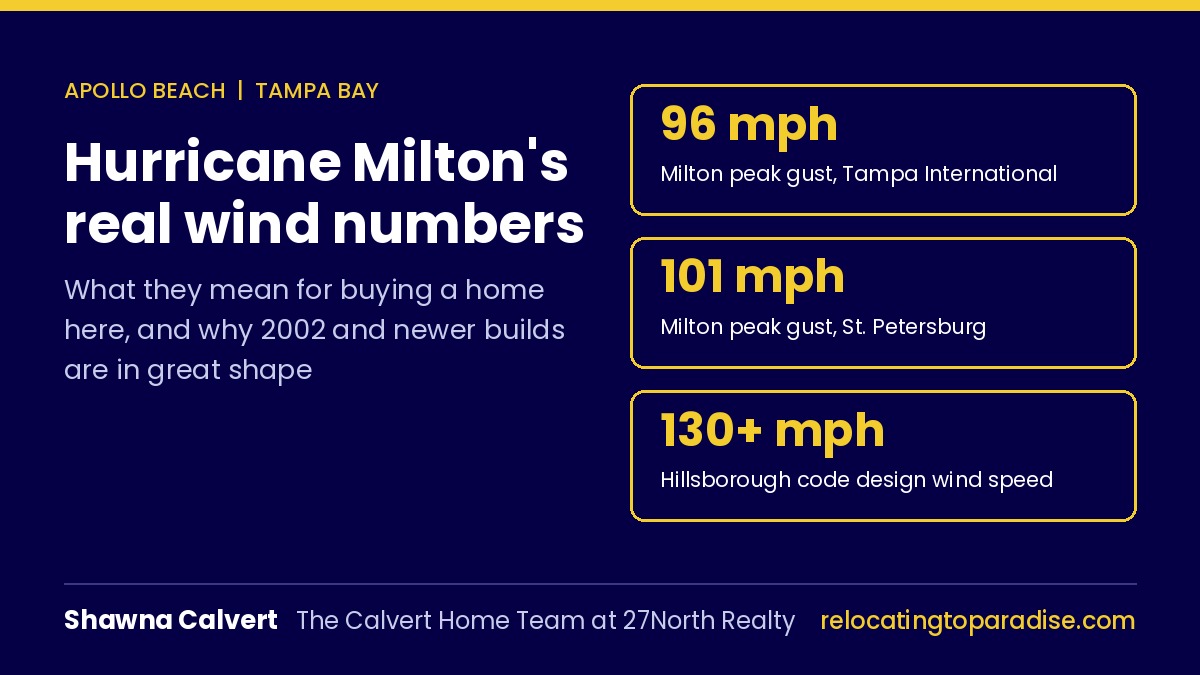
Milton made landfall at Siesta Key on October 9, 2024 as a Category 3 storm, south of us, which put Tampa Bay on the stronger side of the storm. Even so, the highest sustained wind at Tampa International Airport was 61 mph, with a peak gust of about 96 mph. At Albert Whitted Airport in St. Pete, the sustained wind reached 67 mph with a peak gust of about 101 mph. Down at Sarasota-Bradenton International, closer to landfall, the peak gust was about 102 mph.
Here is the part that surprises people. Hurricane force starts at 74 mph of sustained wind, and none of those land stations reached it. What most homes in our area actually felt were strong gusts in the 80 to 100 mph range for a few hours.
What about Helene and Idalia?
Both of those storms passed offshore to our west. During Helene in September 2024, Tampa International saw a peak gust of about 67 mph and Albert Whitted about 82 mph. During Idalia in August 2023, the Egmont Channel station at the mouth of Tampa Bay peaked at about 62 mph. Helene’s real story here was storm surge, not wind, which is why I always talk about elevation and flood zones alongside windows and roofs.
What wind are homes in Apollo Beach built to handle?
Homes in Hillsborough County are designed for wind speeds of 130 mph and up under the Florida Building Code, and that design speed is measured as a 3-second gust. That is the apples to apples comparison with the peak gusts above. Milton’s strongest gusts at our airports, about 96 to 101 mph, landed well below what a home built to today’s code is designed for. That is a lot of cushion.
Why do homes built after 2002 matter so much?
Florida’s first statewide building code took effect on March 1, 2002. From that day on, every coastal home built here had to come with protected openings, meaning impact rated windows and doors or approved hurricane shutters. The large-missile impact test those products had to pass, a 9-pound 2×4 fired at the glass, has not changed since. So a home built in 2005 or 2010 is not “behind” just because its windows look slimmer than the newest ones. Its openings were impact rated for their date, and that is real protection.
How often does a major hurricane hit Tampa Bay directly?
Rarely. The last direct hurricane landfall in Tampa Bay was in October 1921, more than a hundred years ago. Our geography helps us, because a storm has to come in from a very particular direction to strike the bay head on. That does not mean we skip preparation. It means that when you choose a well built home and have a good plan, living here is very manageable.
What should a buyer actually check?
Start with the year the home was permitted. Then ask for the current wind mitigation report, which shows the roof attachments, roof shape and opening protection, and can lower your insurance premium. Look for the etched marks on impact glass or the shutters and panels that came with the house, and keep any product approval paperwork in one place. Finally, check the elevation and flood zone, because in our area water usually matters more than wind. My Apollo Beach flood zone guide walks through that part.
If you are looking at a home and want help reading its wind mitigation report or figuring out what protection it already has, send me the address. I would also love to hear how you picture life here. Are you dreaming of mornings on the dock, or a lock and leave home you can close up easily when you travel? That answer shapes which home and which protection fits you best.
If you’re Canadian and shopping the Tampa Bay area, you’re in better company than you probably realize. In the first quarter of 2026, Tampa ranked fifth in the country for international home-shopping activity. Only Miami, Orlando and two markets outside Florida drew more. Canadians made up 58.8% of Tampa’s international demand, up 4.6 points from the year before.
Most of what gets written for Canadian buyers is written about Miami, Naples or Fort Myers. Apollo Beach and the Southshore communities south of Tampa rarely get a mention, which is a shame, because for a lot of Canadian buyers this is the better fit: deep-water canals, boat lifts, a real neighbourhood feel, and prices that haven’t gone the way Sarasota’s have.
Here’s what actually matters when you’re buying in Apollo Beach as a Canadian. Not the brochure version.
How long can a Canadian stay in Florida each year?
Two separate rules govern how long you can be here, and they have nothing to do with each other. People conflate them constantly, and it causes real problems.
What does the six-month visitor rule actually mean?
This is the immigration clock. As a Canadian visitor you’re generally admitted for up to six months at a time. That’s a border officer’s decision rather than an entitlement, and it says nothing at all about taxes. Plenty of Canadians assume that staying inside the immigration limit keeps them clear of the IRS. It doesn’t.
What is the Substantial Presence Test?
This is the tax clock, and it’s the one that catches people. The IRS Substantial Presence Test counts:
all your U.S. days this year, plus
one-third of last year’s days, plus
one-sixth of the year before that
If that weighted total hits 183 and you were here at least 31 days this year, the IRS can treat you as a U.S. tax resident, and that means on your worldwide income.
Do the arithmetic. Four months a winter, every winter, gets you there: 120 + 40 + 20 = 180. One extra week and you’re over.
What is Form 8840, and do I have to file it every year?
Form 8840 is the Closer Connection Exception, and it’s the fix. You can use it if you were physically here fewer than 183 actual days this year, kept your tax home in Canada, and have stronger ties there: home, family, bank, doctor, driver’s licence. It’s due June 15 of the following year if you had no U.S. wages, April 15 if you did.
It is not automatic. You have to file it. Every year.
What is FIRPTA, and how much does the IRS hold back when I sell?
Everyone researches the purchase. Almost nobody researches the sale.
When a foreign person sells U.S. real estate, the buyer is required to withhold a percentage of the gross sale price and send it to the IRS. Not your profit. The gross price.
Sale price
Buyer signs residence affidavit
Withholding
Under $300,000
Yes
0%
$300,001 to $1,000,000
Yes
10%
Over $1,000,000, or no affidavit
Either way
15%
FIRPTA withholding on a sale by a foreign person. The affidavit is the buyer confirming they’ll live in the property at least half the days over the next two years.
Sell an $800,000 canal home with no affidavit and $120,000 goes to the IRS at closing, regardless of whether you made a dollar. You get it back when you file, eventually.
Can I reduce FIRPTA withholding before closing?
Yes, by filing Form 8288-B for a withholding certificate in advance. The IRS takes roughly 90 days to process one, which means the time to start that paperwork is when you list, not when you’re already under contract. Miss that window and your money sits with the IRS until you file a return for the year.
This is the single most expensive thing Canadian sellers learn too late.
Can a Canadian get a mortgage on a Florida home?
Yes. Financing works, but not the way it does at home. You don’t need U.S. credit history, though you do need a lender who does this routinely.
There are two paths: the U.S. arms of Canadian banks, which can often use your Canadian credit file, or U.S. foreign-national mortgage programs. Either way, expect a larger down payment than a U.S. buyer would put down, and rates that reflect the added underwriting. Ask for the specific number early, because it varies more by lender than people expect, and it changes what you can shop for.
Cash is common here, and it’s a real negotiating advantage in Southshore.
Which costs do Canadian buyers underestimate?
Four of them, consistently.
Why don’t Canadians get Florida’s homestead exemption?
Because Florida’s homestead exemption and its 3% Save Our Homes assessment cap both require Florida permanent residency. As a non-resident you don’t get either. Your assessed value can rise up to 10% a year instead of 3%, and that 10% cap doesn’t cover school district taxes at all. Over a decade, the gap between 3% and 10% is not small.
Worth watching: Amendment 3 goes to Florida voters on November 3, 2026. Should 60% approve it, the non-homestead assessment cap drops from 10% to 5% starting January 1, 2027. The much larger homestead exemptions in that same amendment still wouldn’t apply to you, but the tighter cap would.
What does insurance actually cost on an Apollo Beach home?
More than the number in your head, and there’s no honest average anyone can give you. Windstorm and flood are separate from your standard policy, and they’re the line item that surprises people most, especially on the water. Get real quotes on a specific address before you fall in love with it. Never a regional average, because two homes on the same street can price very differently.
What is a CDD fee, and why is it on top of my HOA dues?
A CDD is a Community Development District, and many Southshore communities carry one. The assessment pays off the infrastructure the developer built, meaning roads, drainage and amenities, and it lands on your tax bill rather than your HOA statement. It isn’t optional, and buyers miss it constantly when they compare two homes that look identically priced.
How much does the exchange rate matter?
Enough to plan around. You’re buying a USD asset with CAD, so the purchase, the carrying costs and the eventual sale all move with the rate. That’s an exposure, and it cuts both ways.
Can I rent the house out while I’m back in Canada?
Plenty of Canadians offset costs by renting in the off-season. Two things matter before you count on it.
How is a Canadian owner’s rental income taxed?
Gross rental income paid to a foreign owner is subject to 30% withholding unless you make an election to be taxed on a net basis, after expenses and depreciation. That election almost always produces a better result, but it requires filing. Nobody applies it for you.
Will my community even allow it?
Southshore HOAs vary widely on minimum lease terms. Some allow monthly, many require three, six or twelve months, and short-term rental is off the table in a lot of neighbourhoods. Read the specific community’s documents before you buy on a rental assumption, because the rules differ from one gate to the next.
What happens to a Florida property when a Canadian owner dies?
This is the one almost nobody raises, and it deserves a conversation.
A non-resident who isn’t a U.S. citizen has a dramatically smaller U.S. estate tax exemption than a citizen does. We’re talking tens of thousands of dollars of U.S.-situs assets, not millions. A canal home in Apollo Beach clears that threshold comfortably.
The Canada and U.S. tax treaty provides meaningful relief, and how you take title matters. Put this question to a cross-border accountant before you close, because it’s far easier to structure at purchase than to fix later.
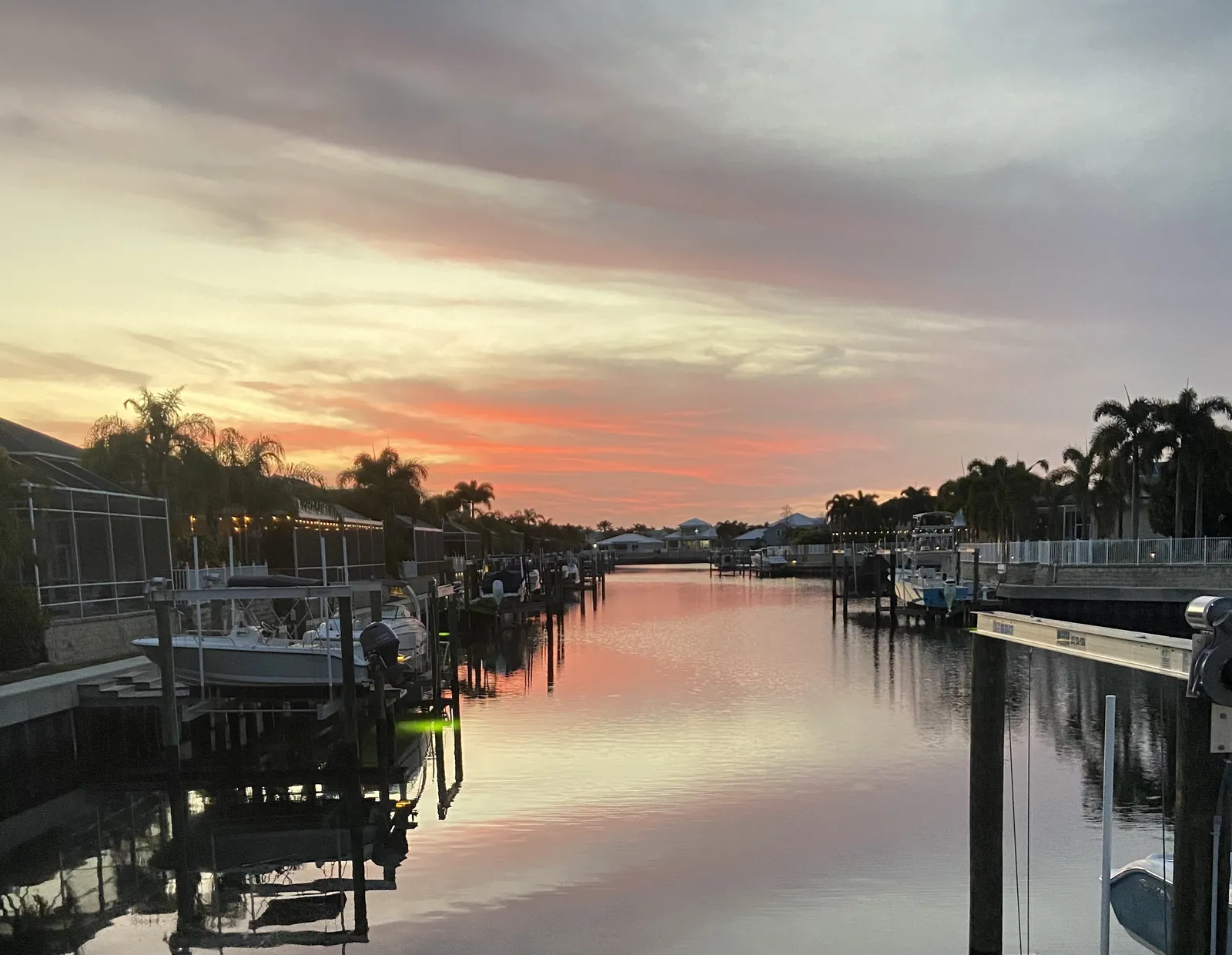
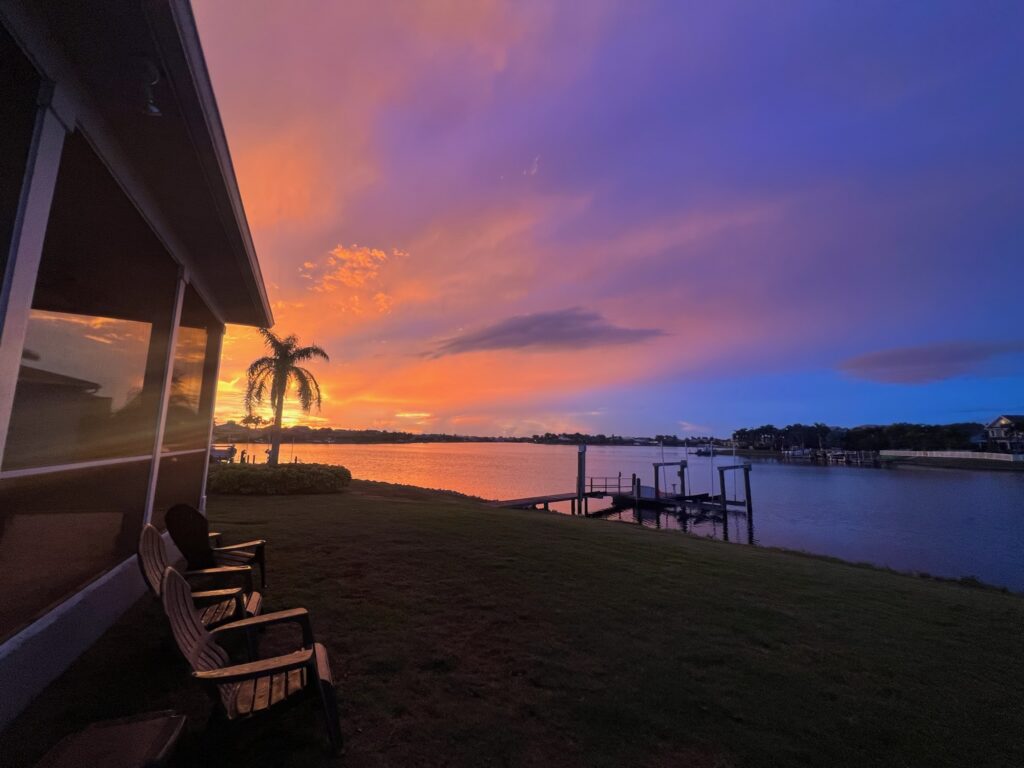
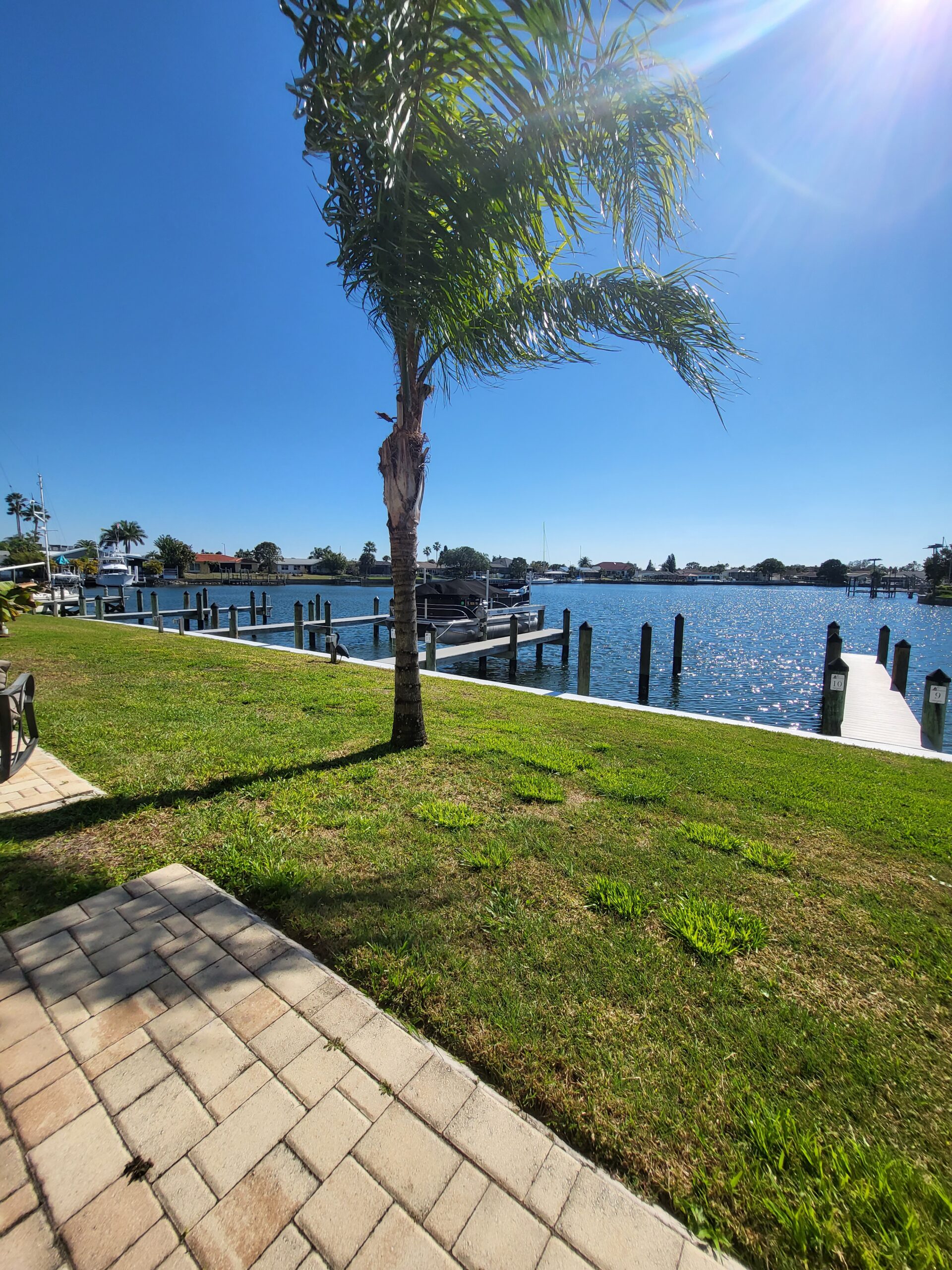
A canal home in Apollo Beach at sunset, dock and boat lift in view.
What should I check on an Apollo Beach waterfront home?
This is Apollo Beach, so the waterfront questions are the real questions.
Elevation and flood insurance come first. Before anything else, know the property’s elevation and get a real flood quote on that address. Two homes on the same canal can carry very different numbers.
Then the water. How deep is the canal at low tide, not at high tide, which is what listings tend to imply? What’s the bridge clearance between the property and open water? And what’s the lift capacity, meaning the weight the boat lift is rated to carry, which is a different question from whether it was ever permitted?
If your boat doesn’t fit under the bridge, or the lift can’t carry it, the waterfront is decorative.
Where should a Canadian buyer start?
Decide roughly how many days a year you’ll actually be here. That answers the tax-residency question before it becomes a problem.
Talk to a cross-border accountant early, before you make an offer rather than after. Title structure and estate planning are cheap to get right at the start.
Get insurance quotes on real addresses, not averages.
Then go look at houses.
Canadian buyer FAQ
Can a Canadian buy a house in Florida?
Yes. There’s no citizenship requirement and no visa requirement to own U.S. real estate, and Canadians buy in Florida every day. Owning a home gives you no additional right to stay in the country, though. Ownership and immigration status are completely separate systems.
How many days can a Canadian spend in Florida without becoming a U.S. tax resident?
Fewer than you’d guess, because the IRS weights prior years. Add all your U.S. days this year, one-third of last year’s and one-sixth of the year before; at 183 or more, with at least 31 days this year, you meet the Substantial Presence Test. Four consecutive winters of four months each puts you at 180.
Do I have to file Form 8840 every year?
Yes, if you’re relying on the Closer Connection Exception. The form isn’t a one-time registration and it isn’t automatic. File it by June 15 of the following year when you’ve had no U.S. wages, or April 15 when you have.
How much tax is withheld when a Canadian sells a Florida home?
Under FIRPTA the buyer withholds from the gross sale price: 0% under $300,000 with a buyer residence affidavit, 10% from $300,001 to $1,000,000 with that affidavit, and 15% above $1,000,000 or whenever no affidavit is signed. Filing Form 8288-B in advance can reduce it, but allow about 90 days.
Can a Canadian get a mortgage in Florida without U.S. credit?
Yes. The U.S. arms of Canadian banks can often read your Canadian credit file directly, and U.S. foreign-national mortgage programs exist for exactly this. Both usually want a larger down payment than a domestic buyer would make, so ask for the specific figure before you set a budget.
Do Canadians pay higher property taxes in Florida?
The tax rate is the same, but the protections aren’t. Florida residents get the homestead exemption and a 3% annual assessment cap; non-residents get neither, so an assessment can climb up to 10% a year, and that cap excludes school district taxes. Over ten years the difference compounds meaningfully.
Can I rent out my Apollo Beach home when I’m not there?
Usually, within limits. Your rental income faces 30% withholding on the gross unless you elect net-basis taxation, and your HOA sets the minimum lease term. Southshore communities range from monthly minimums to twelve-month minimums, and several prohibit short-term rental entirely, so check the documents before you buy on a rental assumption.
Do I need a U.S. bank account to own a home in Florida?
It isn’t legally required, but it makes ownership far simpler. Utilities, HOA dues, CDD assessments, insurance premiums and property tax bills all want a U.S. payment method, and paying each one from Canada means conversion costs every time. Most Canadian banks can open a U.S. account for you before you close.
Is Apollo Beach in a flood zone?
Much of waterfront Apollo Beach sits in a FEMA special flood hazard area, but the zone and the base flood elevation change parcel by parcel. Never take a neighbour’s premium as a guide to yours. Pull the elevation certificate and get a quote on the exact address you’re considering.
Which Apollo Beach community suits a Canadian buyer best?
It depends on the boat and on how much you want handled while you’re away. MiraBay is the amenity-heavy, golf-cart-friendly option; Bimini Bay is smaller and quieter on deep water; Andalucía is guarded and gated. All three are true navigable waterfront with Tampa Bay access.
This is general information, not tax or legal advice. Cross-border ownership touches U.S. and Canadian tax law, immigration rules and Florida property law at the same time, so work with a cross-border accountant and a Florida real estate attorney on your specific situation.
Shawna Calvert is a REALTOR® and Team Leader of The Calvert Home Team at 27North Realty in Apollo Beach. RateMyAgent ranked her #10 in its 2026 national Top 100 and named her Florida Agent of the Year, Hillsborough County Agent of the Year, and Apollo Beach Agent of the Year for the second year running. She has more than 290 verified five-star reviews there, and Stellar MLS ranks her the #1 agent in Apollo Beach by total sales volume for January 2025 through August 2026. She and her team work MiraBay, Bimini Bay, Andalucía, Waterset, Covington Park, Harbour Isles and Symphony Isles, and they answer the elevation and flood questions before you ask them.
There are some things you probably shouldn’t tell your Realtor until you know exactly who you’re talking to.
Kam learned that one sitting in the car with me.
Apollo Beach.
But I’m getting ahead of myself.
Kamala had been thinking about selling her house for quite a while before she was actually ready to do it.
We had lots of conversations before the sign ever went in the yard. We talked about the market, what she needed to do to get the house ready, pricing, timing and what selling was starting to look like as our market shifted.
And when she finally decided it was time, she did everything right.
Seriously.
If I could hand every seller a little instruction manual titled How to Be Kamala, my job would be considerably easier.
She got the house ready. She kept it ready. She accommodated showings and made sure everything looked beautiful when buyers came through.
And she had cats.
Which meant every showing involved gathering up the cats and getting everybody out of the house, only to have buyers occasionally show up late. Or really late. Or, everyone’s favorite, not show up at all.
This was also right around the time our market was becoming noticeably more difficult for sellers. Showings were slowing down. Buyers had more choices. They weren’t rushing anymore.
They were taking their sweet time.
Patience was becoming part of the job for both of us.
There were frustrating days. Kamala is a woman of faith, and more than once, she and I prayed together about getting her house sold and finding the right place for her to go next.
Her house was in the same neighborhood where I live, so I was close by, and during all those months of talking, preparing, showing, praying and waiting, Kamala and I got to know each other pretty well.
By the time we finally got her house under contract, we weren’t just Realtor and client anymore.
We were friends.
And now we needed to find her somewhere to go.
The reason for the move was pretty practical. Her property taxes had climbed higher than she wanted after building her home, and as a single woman, she liked the idea of something a little smaller, with lower carrying costs and maybe even some maintenance included.
So we started driving around the area looking at houses.
And somewhere along the way, Kamala started telling me about the house.
You know the one. The house she had loved.
Before building the home I was now selling for her, Kamala had actually been under contract on another house in Apollo Beach.
And she had REALLY wanted that house.
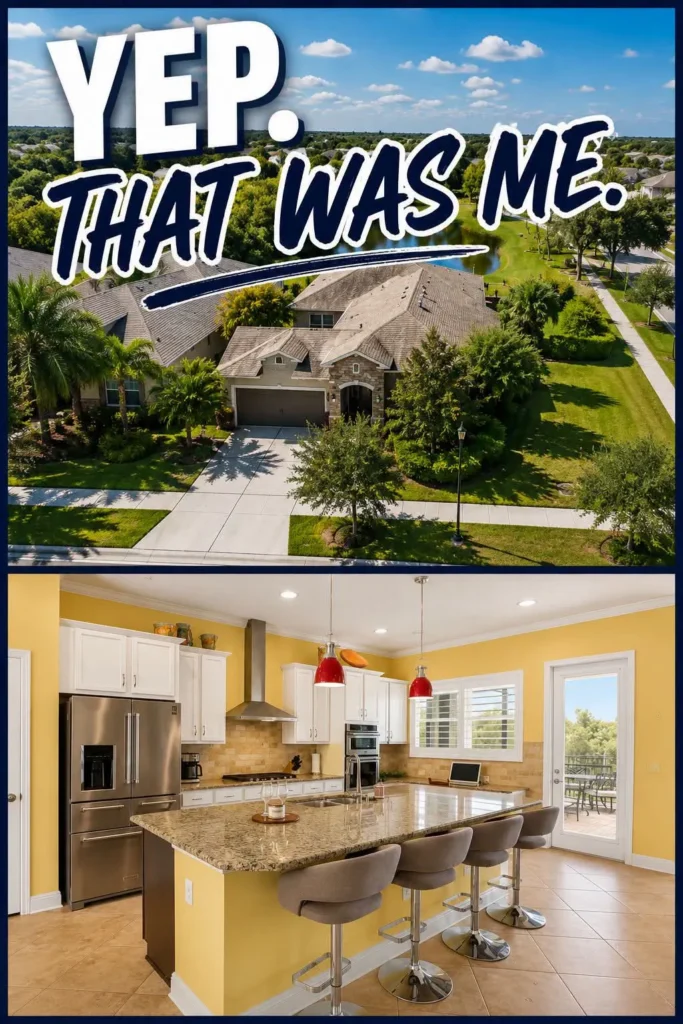
She especially loved the kitchen. It was big and bright, with white cabinets and these cheerful yellow walls that carried right into the dining area.
Years later, she could still describe that kitchen to me.
This wasn’t just some house she’d once lost.
This was the house she never quite got over.
It had happened during a completely different real estate market. Sellers had the upper hand. Multiple offers were common. Buyers had to move quickly, and sometimes you had to get creative to win.
Kamala had managed to get this particular house under contract, but her contract had something called a kick-out clause.
And this is where her story gets unusual.
Kick-out clauses are incredibly rare.
Plenty of Realtors can go their entire careers without ever dealing with one. Some may never even come across one in an actual transaction.
The simplest explanation is that a seller accepts an offer with a contingency but keeps the ability to consider another offer. If a stronger buyer comes along, the first buyer gets a very short window to remove that contingency or lose the house.
That’s what happened to Kamala.
Another family came along with cash. Kamala got her notice, couldn’t remove her contingency, and lost the house.
Now I’m sitting in the car listening to Kamala tell me this story.
And Kamala wasn’t just disappointed about what had happened.
Oh no.
Kamala was STILL MAD.
Years later mad.
She couldn’t believe another Realtor would even do something like that.
Who sees a house already under contract and thinks, You know what? Let’s go take that one.
She couldn’t believe there was even a strategy in real estate that allowed another buyer to come along and knock her out of the house she already thought was hers.
And that Realtor?
Oh, she had some thoughts about that Realtor.
She did NOT like her.
At all.
Kamala is going on about this woman. What kind of Realtor does something like that? How could she do that to somebody? Who operates that way?
And at first, I’m right there with her. Listening, nodding, being appropriately sympathetic.
Then she mentions the kick-out clause again.
And something starts sounding familiar.
Really familiar.
Because here’s the problem.
When somebody tells you about a normal real estate transaction, it could be one of hundreds.
When somebody tells you about a kick-out clause?
That’s a much shorter list.
I’m getting quieter. Kamala is getting more animated. She’s giving me more details, and I’m giving her fewer responses.
She’s talking about those buyers, that cash offer, that Realtor, that house she loved.
And somewhere in the middle of all of this, a horrible little thought enters my head.
Wait.
I’m trying to remember exactly how many transactions I’ve ever been involved with that had a kick-out clause.
Honestly, 2.
Kamala keeps going.
At this point, I’m squirming in my seat. I’m sitting on my hands. I’ve stopped nodding, and I’ve definitely stopped agreeing with her.
And now I’m silently begging her:
Please stop talking.
But Kamala does not stop talking.
She has waited YEARS to tell someone about this Realtor.
And apparently today is the day.
She’s telling me how awful the whole thing was, and I’m sitting there getting more uncomfortable with every identifying detail.
Finally, I couldn’t take it anymore.
“Kamala…”
She stopped.
“Was this house in Waterset?”
“Yes.”
Oh no.
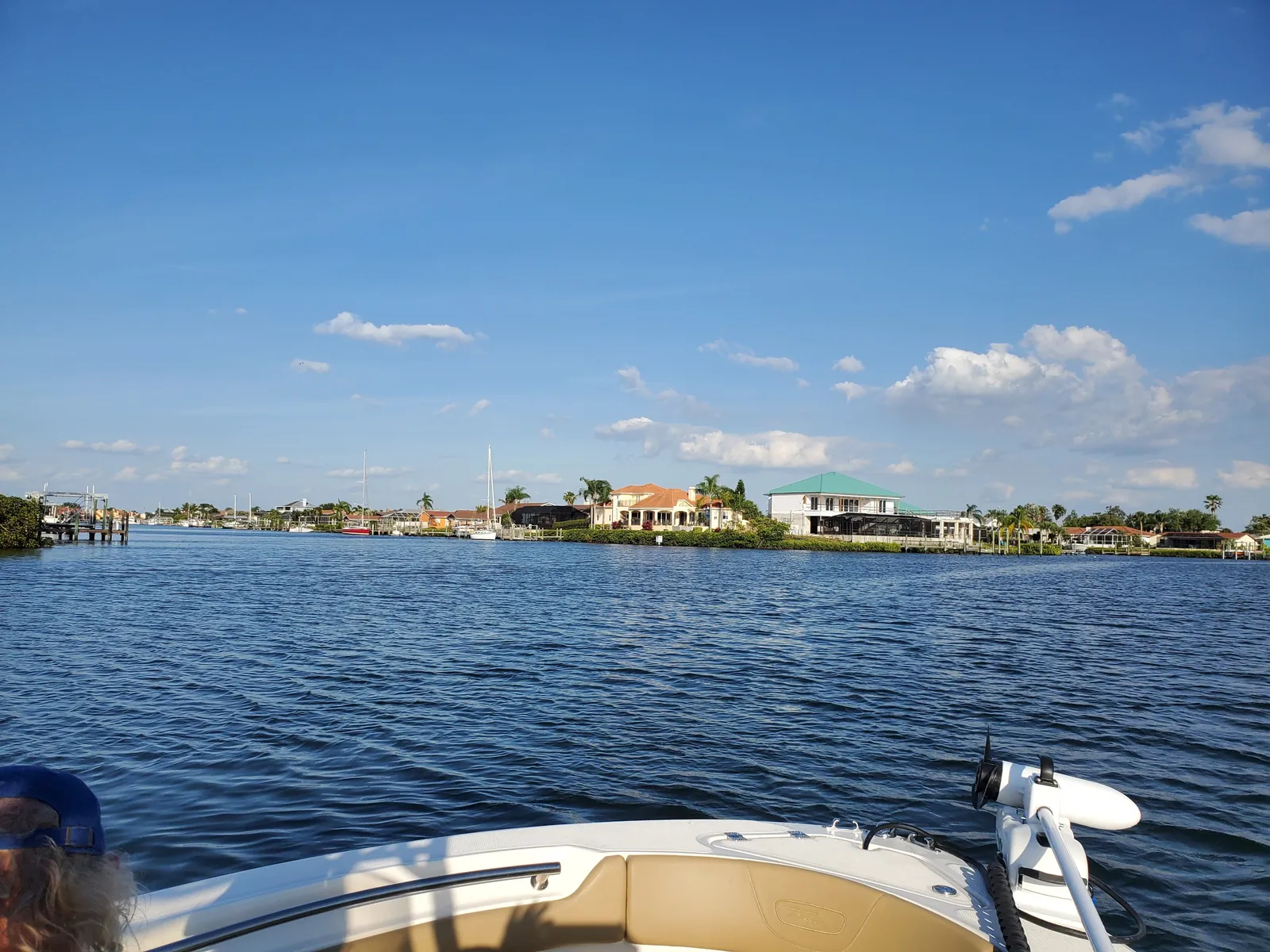
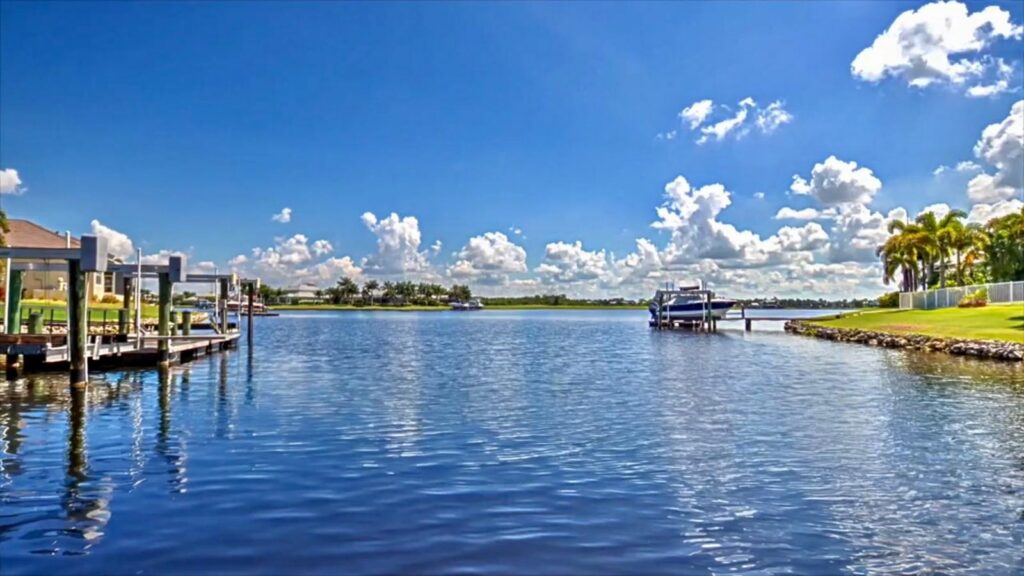
Open water and the bridge beyond — the view that made the decision easy.
Please say no to the next question.
“Was it on Crestpoint?”
She looked at me.
“Yes.”
Well.
There it was.
I knew the house. I knew the cash buyers.
And unfortunately, I knew that terrible Realtor quite well.
It was me.
There was really no graceful way out of this.
“Kamala…”
By now she could tell something was wrong.
“Yep. That was me.”
She stared at me.
You could almost watch the pieces connecting.
And then:
“OH NO.”
A beat.
“YOU were that terrible Realtor who did that to me?!”
Yep.
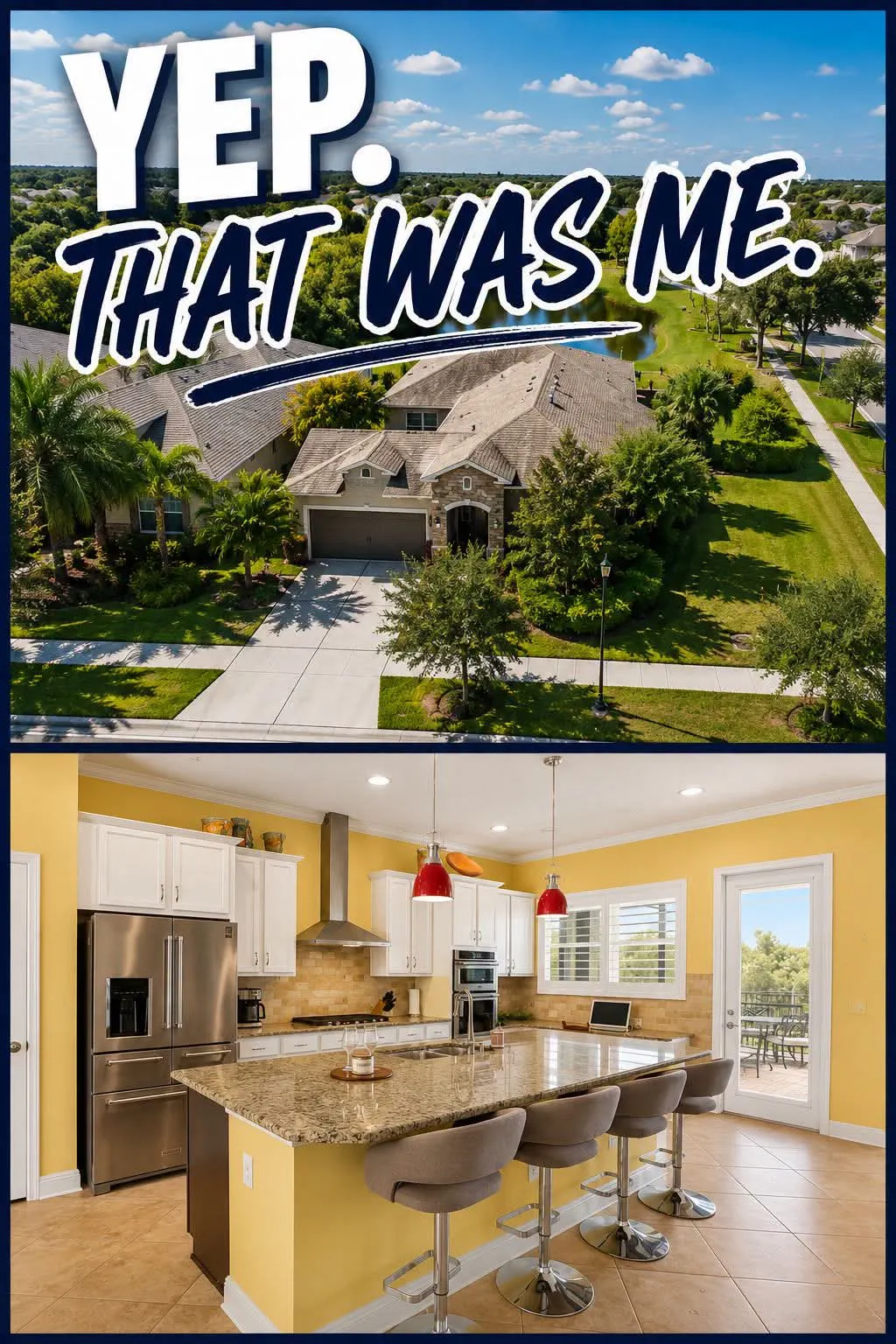
That was me.
The Realtor she had apparently spent years disliking. The Realtor whose strategy she couldn’t believe. The Realtor she couldn’t understand how anyone could possibly do business that way.
She had been sitting beside her all along.
And thankfully, by this point, we knew each other well enough that it was funny.
Really funny.
Because here’s the other side of the story.
I hadn’t actually done anything to Kamala. I didn’t even know Kamala.
I was representing another family, and my job was to do everything I ethically and legally could to help them get the house they wanted.
There was already a kick-out clause in the existing contract. My buyers were in a position to make a stronger offer. The seller chose to accept it, and the contract worked exactly the way it was written.
I had simply been doing my job for my clients.
Of course, that explanation probably sounds considerably more reasonable when you’re not the person who just lost your dream house.
To Kamala, some Realtor had swooped in with cash buyers and taken away the house she loved.
And she had never forgotten her.
What gets me is everything that had to happen for us to eventually have that conversation.
First, Kamala had to end up in one of the relatively rare transactions involving a kick-out clause.
Then I had to be the Realtor on the other side of it.
Years later, out of all the Realtors she could have called when she decided to sell, she somehow called me.
Neither one of us made the connection.
She hired me. Trusted me with the sale of her home. Spent countless hours talking to me. Got through the frustrations of a changing market with me. Prayed with me. Drove all over looking at houses with me.
And somewhere along the way, we became friends.
All before she discovered I was that Realtor.
Maybe there was more than a little grace in the timing of all of it.
Kamala and I had prayed together about getting her house sold and finding the right next home for her. Neither one of us had any idea that years before we met, our paths had already crossed.
She just knew me then as the Realtor she couldn’t stand.
Maybe God knew it was better to let her meet me first before filling her in on that little detail.
Because Kamala got the chance to know me before she knew who I was in that old story. She got to form a completely different opinion of me without either one of us knowing she already had one.
And I got the rare privilege of sitting quietly beside her while one of my best clients explained, in considerable detail, exactly how awful she thought I was.
We still laugh about it.
And by the grace of God, Kamala and I are still good friends.
So if you’re ever sitting in the car telling your Realtor about that absolutely terrible Realtor who did something to you years ago, maybe don’t get too far into the story.
Because eventually she may have to look over at you and say…
If you have started searching “sell my home” in Florida in 2026, preparation is what separates a smooth closing from a stressful one. Florida’s resale market continues to reward sellers who show up ready. Inventory has shifted in several Southshore and Tampa Bay submarkets, and buyers, especially relocation buyers moving from out of state, are more informed than ever. They pull FEMA maps before scheduling showings, ask about seawall certifications on the first call, and comparison-shop neighborhoods from a laptop two time zones away. If your home isn’t positioned precisely, it sits. If it is, you close with confidence.
At 27North Realty, Shawna Calvert and her team close more than 50 waterfront transactions annually across Hillsborough, Pasco, Manatee, and Pinellas counties. That volume reveals a consistent pattern: sellers who treat the pre-listing phase as seriously as the negotiation phase net more money and face far fewer surprises at the closing table. This guide walks through how to price strategically, stage for Florida buyers, meet the state’s disclosure requirements, handle waterfront-specific due diligence, compare your selling options, and execute a concrete 30/60/90-day plan from decision to close.
How do you set the right list price?
Pricing a Florida home is not a task you hand off to a national algorithm. Those tools index off broad county data and miss the nuances that actually drive buyer behavior in a market like Apollo Beach or Riverview. Your asking price determines how many buyers see your home in the first place. In an era where relocation buyers search within tight price brackets from out of state, landing on the wrong side of a key threshold costs you showing volume before you ever get feedback.
How Florida’s Seasonal Buyer Patterns Should Shape Your Asking Price
Florida’s relocation traffic surges from November through March, when out-of-state buyers are most motivated to escape cold climates and most serious about making a move. Listings that hit the market in Q1 consistently attract more competing offers than those launched in the summer. If your timeline allows any flexibility, aligning your launch with that buyer surge gives you a structural advantage before the first showing.
Pricing discipline matters especially for buyers searching remotely. A home listed at $510,000 disappears from every search set with a $499,000 ceiling. That cutoff may represent thousands of potential buyers who never see your property. Pricing just under key search thresholds is not a gimmick; it is a deliberate strategy to maximize your qualified buyer pool. Getting a reliable home value estimate from a local specialist, not a national automated tool, is the right starting point for that decision.
Why Waterfront Comps Require a Different Lens Than Standard Neighborhood Sales
A non-waterfront home two streets over from your canal property is not a comparable sale. Canal depth, navigability, bridge clearance, dock presence, lift type, and seawall condition all affect waterfront value in ways that a price-per-square-foot calculation simply cannot capture. An agent without specific waterfront experience can misprice a canal home by 5% to 10% in either direction, either leaving serious money behind or pricing the home out of its legitimate buyer pool entirely.
A listing sign is the last step, not the first — the prep work happens weeks before this goes in the yard.
What staging and curb appeal actually work in Florida?
Florida buyers expect a specific feeling when they walk through a home, and that expectation is amplified for relocation buyers viewing your property via photos and video tours before ever setting foot inside. The bar for listing photography is high, and the staging decisions you make directly determine how that photography performs.
Interior Priorities That Move the Needle in a Florida Market
Light and openness are the two qualities Florida buyers respond to before they even check the price. Heavy furniture, dark window treatments, and personal collections all compress perceived square footage in photos and suppress buyer interest before a showing is ever scheduled. Clear out clutter, maximize natural light, and let the space read as large as it actually is.
On the repair side, focus on cosmetic items that register on camera: cracked tile grout, scuffed baseboards, dated light fixtures, and worn front-door hardware. These are inexpensive to address and show up clearly in listing photos. Skip major renovations, kitchens and bathroom overhauls rarely return their full cost in a resale context, and the time they consume delays your market launch.
For a waterfront home, the emotional close happens outside. The lanai, dock, and backyard seating area carry as much persuasive weight as the kitchen, and they need to be staged with the same intentionality. Clean the dock, pressure-wash the seawall cap, replace faded outdoor furniture cushions, and add a few potted plants to the lanai. Buyers are imagining their life on the water the moment they open those photos.
Water-side photography is now a baseline expectation, not a premium upgrade. Aerial drone shots and photos taken from the water, showing the dock, seawall, and rear elevation of the home, are the first images relocation buyers share when they text their family “look at this one.” If those shots are missing or unflattering, your listing loses its most compelling selling point before a buyer reads a single word of the description.
What must Florida sellers disclose?
Florida’s disclosure laws tightened in 2025, and the changes took effect October 1, 2025 under Section 689.302, Florida Statutes. Florida law now requires residential sellers to disclose any flood damage that occurred during their ownership, not just damage tied to an insurance claim. Sellers must also disclose assistance received from any source for flood-related repairs, expanding the prior requirement that covered only federal assistance. These disclosures must be delivered at or before contract execution.
Flood Zone Status, FEMA Maps, and Elevation Certificates
Florida sellers must disclose known flood risk and history, and buyers, especially out-of-state relocation buyers who do extensive remote due diligence, will pull the FEMA map independently as part of their research. The disclosure framework applies to known flood damage regardless of whether the property sits in a formally designated Special Flood Hazard Area. Having an updated elevation certificate ready before your listing goes live removes a common last-minute friction point. Buyers who request one mid-contract often use the delay as leverage to renegotiate.
What “As-Is” Means in a Florida Contract and What It Doesn’t Excuse
Selling “as-is” is a contract position, not a disclosure shield. Florida law requires sellers to disclose known material defects regardless of contract language. For waterfront sellers specifically, this means disclosing known issues with the seawall, dock condition, drainage, and any prior flood claims or damage. Disclose it in writing, disclose it early, and keep a copy. A seller who hides a known defect can be sued for it long after closing, and a buyer who learns about it mid-inspection will renegotiate harder than one who knew going in.
How do you prepare a waterfront home to sell?
Waterfront deals derail for predictable reasons. Sellers who understand those reasons before listing can address them proactively, rather than watching a buyer walk away in the final weeks of a transaction. Three issues surface most consistently: dock permit status, seawall condition, and water access documentation.
Dock Condition and Permit Status: What Buyers’ Agents Will Verify
A buyer purchasing a waterfront home for boating access will verify that the dock and boat lift are permitted, structurally sound, and compliant with current codes. In unincorporated Hillsborough County, dock and boat lift work goes through the Environmental Protection Commission of Hillsborough County, and work in Tampa Bay waters can also require a Tampa Port Authority Minor Work Permit. Depending on the project, Florida DEP or Southwest Florida Water Management District authorization and Army Corps of Engineers sign-off can apply on top of that. Pull your permits before you list, know what was built and when, and be ready to provide documentation.
Seawall Inspections and How Structural Issues Affect Buyer Financing
A professional seawall inspection in the Tampa Bay area typically runs $300 to $800 for a standard residential evaluation, with more detailed assessments reaching $600 to $1,200 depending on seawall length and whether underwater inspection is included. Inspectors evaluate cap condition, panel integrity, tie-back and anchor status, weep hole drainage, soil conditions behind the wall, and overall deflection or movement. Lenders financing buyers with conventional loans may require repairs before funding if structural issues are identified mid-contract.
Sellers who commission that inspection before listing can repair proactively, adjust their asking price to reflect condition, or disclose with documentation already prepared, all on their own schedule rather than a buyer’s timeline. Shawna works with relocation buyers navigating waterfront due diligence for the first time on a daily basis, which means she knows exactly what questions those buyers bring to a waterfront showing and which pre-listing steps eliminate the issues that kill deals. That anticipatory knowledge is what separates a waterfront listing specialist from a generalist agent who occasionally sells canal homes.
Buyers picture their own evenings here, which is why the lanai and the view get photographed first.
Should you use an agent, FSBO, an iBuyer or a cash buyer?
Every seller’s situation is different, and the right selling method depends on your timeline, property condition, and net-proceeds priority. For waterfront and flood-zone properties in Florida, that choice carries an added layer of complexity, not every buyer channel handles these homes the same way. Here is how the four main options compare in 2026 with realistic numbers attached.
Timelines and Net Proceeds: What the 2026 Data Actually Shows
Traditional agent: 60 to 90 days list-to-close; total seller costs typically 8% to 10% including commissions, closing costs, and prep spending. Usually produces the highest net for homes in good condition and remains the strongest path for sellers who want to sell your home fast without sacrificing price.
FSBO: 55 to 105+ days; lower explicit fees (flat-fee MLS runs $300 to $500 plus any buyer-agent concession) but higher execution risk on pricing, disclosure management, and negotiation.
iBuyer (Opendoor, Offerpad):7 to 21 days; service fees around 5%, with total transaction costs often landing at 10% to 15% once repair deductions and closing costs are included. Note that major iBuyers often decline properties in FEMA Special Flood Hazard Areas, making this channel less predictable for waterfront and flood-zone homes in Florida.
Cash buyer: 7 to 14 days; no listing fees but offers typically come in 5% to 20% below retail depending on condition. Investors often apply a 70% rule: roughly 70% of after-repair value minus estimated renovation costs. Selling a house for cash can make sense when condition issues or timeline pressure outweigh the price difference.
For a standard Florida home in good condition, the traditional agent route typically produces the strongest net. For a property needing significant work, or for a seller prioritizing speed over price, a cash buyer can make real sense. The math shifts based on your specific situation, and running those numbers with a local advisor before committing to a method is worth the conversation.
Why Waterfront Listings Specifically Benefit From a Specialist’s Buyer Network
Waterfront homes have a narrower qualified buyer pool by nature. Reaching buyers who are actively searching for canal-front or bay-front homes in the Tampa Bay area, financially ready, and already motivated by the Florida waterfront lifestyle requires more than placing a home in the MLS. Agents who work with relocation buyers daily already have a pipeline of pre-qualified, lifestyle-driven buyers looking for exactly what a waterfront home offers. Fewer days on market and stronger offers follow from that direct connection in ways a generic listing strategy simply cannot replicate.
What does a 30/60/90-day selling plan look like?
This plan converts everything in this guide into an executable sequence. Work through each phase and you arrive at the closing table prepared rather than reactive. Understanding how to sell a house in Florida means following a structured timeline, not scrambling to respond to buyer demands after you’re already under contract.
Days 1 to 30: Prepare, Price, and Document
Order a pre-listing home inspection and a seawall and dock evaluation. Pull all dock and structural permits, gather your HOA and CDD documents, and request a current elevation certificate. Work with your agent to build a pricing strategy using waterfront comps, not just neighborhood averages. Begin staging, address cosmetic repairs, and clean and restore the dock and exterior living areas.
Days 31 to 60: List, Market, and Qualify Buyers
Launch the listing with professional photography that includes aerial shots and water-side images. Have all disclosure documents fully prepared and ready to deliver before contract execution. As offers come in, prioritize buyers with strong pre-approval letters and, for waterfront properties, lenders who have experience financing Florida flood-zone and canal-front homes. An out-of-state buyer using a national lender with no Florida waterfront experience introduces closing risk that a local lender largely eliminates.
Days 61 to 90: Contract to Close
Respond to inspection reports and repair requests with your pre-listing documentation already in hand. Your inspection reports and seawall assessment reduce the space for buyer leverage because there are no surprises to negotiate around. Coordinate title, satisfy any lender requirements, and request HOA and CDD estoppel letters early. Florida law gives an association 10 business days to deliver one, and if it misses that window it cannot charge you for it. Close with the confidence that the preparation work has eliminated the last-minute renegotiations that derail under-prepared transactions.
Ready to Sell My Home in Florida? Start With the Right Preparation
Florida real estate in 2026 rewards sellers who approach the process the way a well-informed local advisor would. That means understanding disclosure obligations before they become liabilities, handling waterfront due diligence before buyers uncover it, and pricing with precision rather than optimism. It also means choosing a selling method that matches your actual goals rather than defaulting to whatever feels familiar.
Shawna Calvert works with relocation buyers searching for waterfront homes in the Tampa Bay and Southshore area every week. She knows the questions those buyers ask, the concerns their lenders raise, and the inspection items that stall closings on canal-front properties. When she lists a waterfront home, she arrives already having answered the questions that tend to surface mid-contract, because she’s seen them hundreds of times. If you’re preparing to sell my home in Florida and want a straight conversation about pricing, positioning, and what buyers in this market are actually looking for, reach out to Shawna and the 27North Realty team directly. The preparation you do in the next 30 days determines how that closing goes.
Shawna Calvert | The Calvert Home Team at 27North Realty
Apollo BEACH | TAMPA Bay
Relocation Reality Check
Florida time is real, and it is one of the better reasons to move here.
Welcome to Florida Time.
The one thing nobody warns you about before you move here, and why it might just be the best business opportunity you have ever seen.
Shawna Calvert |May 2026 | The Calvert Home Team at 27North Realty
You did your research. You visited twice, maybe three times. You fell in love with the sunsets, the water, the pace of life. You made the move. And then you tried to get someone to call you back about your pool.
Let me introduce you to something no relocation guide will ever put in writing: Florida Time. It is a real thing. It is alive and well in every zip code from Hillsborough to Sarasota, and the sooner you make your peace with it, the happier you are going to be in your new paradise.
Florida Time is not laziness. It is not rudeness. It is the natural consequence of what happens when one of the fastest-growing states in the country adds thousands of new residents every single week, and the contractor, plumber, pool guy, and pressure washer who were perfectly busy two years ago are now so overwhelmed they genuinely do not need to market themselves, return calls promptly, or even finish a job before a backordered part sends them to three other houses for three weeks while yours sits waiting. They are not ignoring you. They are just fine. And so is their schedule, and their bank account, and their fishing boat on Saturday.
They do not need your business. That is not personal. That is Florida in 2026.
So How Do You Actually Get Someone Out Here?
Ask a neighbor. And not just any neighbor. Ask someone who has been here long enough to have a guy. Better yet, ask them to make the introduction. There is a magic phrase that unlocks doors in South Shore that no amount of five-star Google reviews or Angi listings can replicate. It sounds like this:
“Hi, Shawna Calvert told me to call you.” That one sentence tells a vendor everything they need to know. Someone they already trust vouched for you. You are not a stranger calling from a Zillow listing. You are a real person in the community with a real referral, and now you have just moved to the top of the mental queue.
Name-dropping is not rude in Florida. It is currency. The right name attached to your call is the difference between a callback that afternoon and a voicemail that gets forgotten before dinner. Use it freely and without apology.
The Hidden Opportunity Nobody Is Talking About
Here is where this gets interesting. Florida Time is not just a quirk to survive. For the right person, it is a wide-open invitation.
Think about what the market is actually telling you. Population growth is outpacing the local service industry at a rate that would make any MBA student sit up straight. Demand is enormous. Supply of reliable, responsive service providers is genuinely limited. And the bar, if we are being completely honest, is sitting on the ground.
If you are someone relocating to Florida and you are wondering what kind of work you could build here, the answer is simple: almost anything. Pick a trade, a skill, a service. And then do one thing your competition largely refuses to do.
Answer your phone.
That is it. Answer your phone, return texts the same day, show up when you say you will, and finish what you start. You will have more business than you can handle within sixty days. I am not being dramatic. I have watched it happen over and over again in this community.
The need is real across every category you can imagine:
· Pool Service
· Lawn Care
· Pressure Washing
· House Cleaning
· Home Organizing
· Handyman Work
· Plumbing
· Babysitting
· Errand Running
· Pet Care
· Move-In Help
· Painting
The families moving into Waterset, MiraBay, Cypress Mill, Crosswind Ranch, and every other growing community across South Shore are arriving from all over the country. They do not have a guy yet. They need a whole list of guys. And girls. And anyone who picks up the phone and cares about doing good work.
A Servant Heart Is a Business Strategy Down Here
I have lived in this community long enough to watch what actually works. The service providers who build thriving businesses here are not necessarily the most skilled or the most experienced. They are the ones who treat every customer like that customer matters. They follow up when the job is done. They check in when there was a problem. They remember your name. They show up for you even when they are busy, because you are not just a job ticket to them.
That is a Go Giver spirit, and it is absolutely electric in a market where the alternative is not calling you back for two weeks because the part is on order and they honestly forgot which house you were.
If you come to Florida with a skill in your hands and a servant heart in your chest, you are holding a lottery ticket. The population is here. The money is here. The need is undeniable. All you have to do is show up, do what you said, and give people a reason to call you again and hand your number to every neighbor they know.
Answer your phone. Show up. Finish what you start. In Florida right now, that alone will build you something extraordinary.
And if you are still in the middle of your move and wondering who to call for literally anything, ask me. I have been building that list for years, and I share it freely. That is what neighbors are for.
It’s July in Florida—aka full-blown summer mode. The fireworks have barely faded, the grills are still hot, and everywhere you look, it feels like paradise.
But here’s the little secret: while the rest of the country might be slowing down, Florida real estate is still moving, especially here in the SouthShore area.
If you’ve been sitting on the fence about buying or selling this summer, let’s talk about why July might be your perfect window.
July in Florida: the water is warm, the days are long, and the market keeps moving.
1. Buyers Are in Vacation Mode—But Still Shopping
You might think summer equals slowdown, but many buyers are using this time to explore new neighborhoods—especially if they’re in town on vacation or visiting family. And let’s be honest… one visit to Apollo Beach, and the dream of “living here full-time” kicks in real fast.
For sellers, that means more out-of-town eyes on your listing. For buyers, it’s a great time to scout before competition heats back up in late summer.
2. More Listings = More Options (But That Won’t Last)
Right now, inventory is a little higher than usual, which gives buyers more to choose from. But this won’t last. Come late July and August, we often see sellers who waited too long take their homes off the market if they don’t get results.
So if you’re shopping? This is a sweet spot. If you’re selling? Be the one who stands out now—before the market thins out or shifts again.
3. Summer Vibes = Better Showings
It’s true—homes just show better in the summer. The sun’s shining, landscaping is lush, and people can picture the lifestyle: backyard BBQs, pool parties, sunset boat rides. If your home’s got curb appeal and those Florida-style extras, now’s your time to shine.
Pro tip: Crank that A/C before a showing. Buyers love stepping into a cool, comfy space—it makes them want to stay.
4. July Is a Smart Planning Month
If you’re not quite ready to list or buy yet, that’s okay too. Use July to plan smart. Get your pre-approval in order, explore neighborhoods, or talk strategy with a local expert (hey, I happen to know one 😉).
This way, when you’re ready to make a move—whether it’s next month or next season—you’re not starting from scratch.
Thinking About a Move? Let’s Chat.
Whether you’re dreaming, downsizing, upsizing, or just done with snow up north, I’m here to help you #MakeTheMove with confidence.
Let’s take advantage of this summer momentum—because paradise is calling.
Shawna Calvert 🏡 27North Realty 📱 (509) 294-6818 🌐 relocatingtoparadise.com 📺 YouTube @27NorthRealty 📍Top Agent in Apollo Beach | Top 10 in Florida | Top 100 in the U.S. #MakeTheMove
The Tampa Bay area housing market, like much of the country, is experiencing a unique moment in real estate history. With newly built homes flooding the market at levels not seen since 2009, builders are working overtime to attract buyers. Yet, despite offering discounts, mortgage rate buydowns, and incentives like help with closing costs, sales aren’t surging as some might expect.
Why is it that even with more homes to choose from, buyers remain hesitant?
The Affordability Crunch
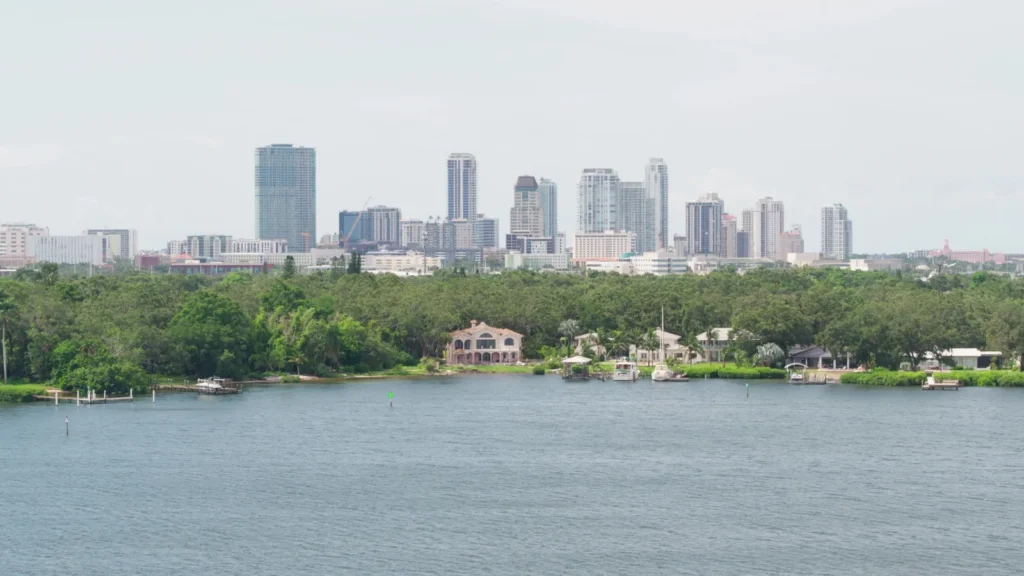
Tampa Bay from across the water. High inventory changes what a seller has to do, not whether they can sell.
The biggest roadblock in today’s housing market is affordability. Across the U.S., homebuyers are facing an unprecedented combination of high home prices and elevated mortgage rates. In Tampa Bay, where the median home price of a new single-family home hovers around $427,000, the typical buyer is stretched thin trying to afford a home at today’s 7.11% mortgage rate.
This challenge isn’t unique to our region but is felt acutely here due to Tampa Bay’s recent boom in home values and population growth. Over the last few years, many families and retirees relocated to the area, drawn by its sunny weather and waterfront lifestyle. This influx, paired with limited resale inventory, drove prices up dramatically. Now, with mortgage rates up and wages struggling to keep pace with inflation, many buyers are being priced out.
Builders Facing Inventory Pressures
Builders have responded to the slowdown by increasing their offerings of discounts and incentives. According to the National Association of Home Builders, 30% of builders cut prices in January, with the average reduction being 5%. Builders like Lennar and D.R. Horton are even revisiting their pricing strategies, designing smaller, more affordable homes, and providing mortgage-rate buydowns to spur demand.
In Tampa Bay, we’re seeing a clear divide between the new construction market and resale homes. While resale inventory has risen 16.2% year-over-year, creating more competition, builders are still grappling with bloated inventories of unsold homes from the spring market. These completed homes, while offering a new and modern appeal, come with price tags that don’t align with many buyers’ budgets.
A Tale of Two Markets
The resale home market tells a different story. Nationwide, 2024 marked the worst year for resale home sales in 30 years. In Tampa Bay, resale activity has been slow, but some buyers are finding more options as inventory grows. Sellers who price competitively and make their homes move-in ready are seeing success, while overpriced listings linger.
New construction, on the other hand, benefits from builders’ ability to offer financial incentives. First-time buyers, in particular, are taking advantage of these perks. Federal data shows that sales of newly built homes grew in 2024 compared to 2023, indicating that some buyers are finding value in these offerings despite the broader affordability challenges.
What’s Next for Tampa Bay?
As we move into 2025, the outlook for Tampa Bay real estate remains cautious but hopeful. Here’s what to watch:
Mortgage Rates: Any decline in rates could be a game-changer for affordability and buyer confidence.
Builder Strategies: Expect builders to continue cutting prices and offering incentives to move inventory. Smaller floor plans and modern designs may attract buyers looking for value.
Resale Market Trends: Sellers in Tampa Bay must stay competitive, pricing their homes to match current market conditions. Staged and well-maintained properties are likely to stand out.
While today’s housing market poses challenges, it also presents opportunities. For buyers, builder incentives and increased resale options mean there’s more room to negotiate and find a home that fits their needs. For sellers, working with an experienced team like the Calvert Home Team is crucial to navigating this complex market.
Partnering with the Calvert Home Team
At the Calvert Home Team, we specialize in helping buyers and sellers in the Tampa Bay area make informed decisions. With deep local expertise and a data-driven approach, we guide our clients through every step of the process. Whether you’re a first-time buyer taking advantage of builder incentives or a seller looking to stand out in a crowded market, we’re here to help.
Reach out today to learn how we can turn today’s challenges into opportunities for your real estate journey. Together, we’ll find the right path forward in the ever-evolving Tampa Bay market.
Nestled along Florida’s stunning Gulf Coast, Apollo Beach is a hidden gem that offers the perfect blend of coastal beauty, community spirit, and modern convenience. Whether you’re a longtime Floridian or considering a move to the Sunshine State, Apollo Beach has something special to offer everyone.
Coastal Living at Its Best
Apollo Beach is renowned for its waterfront lifestyle. With miles of canals and easy access to Tampa Bay, it’s a haven for boating enthusiasts, anglers, and anyone who loves being near the water. Many homes feature private docks, making it easy to set sail from your backyard. If you’re more of a landlubber, the beautiful views and quiet sunsets over the bay will still captivate your heart.
A Thriving Community
This vibrant town is more than just a picturesque setting. Apollo Beach is home to a warm, welcoming community. Residents enjoy a calendar full of local events, from farmer’s markets to outdoor concerts. The Apollo Beach Nature Preserve is a favorite spot for hiking, picnicking, and wildlife observation, offering a slice of natural Florida to explore.
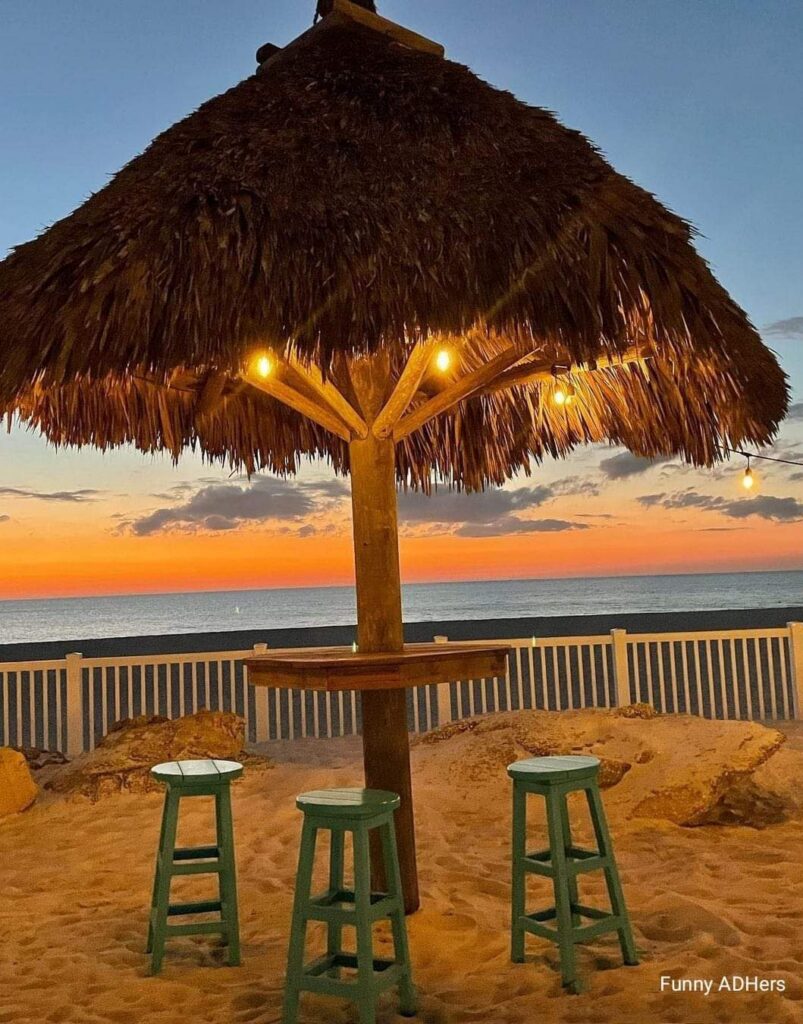
A tiki bar at dusk — one of the reasons people stop looking after they visit.
Amenities and Convenience
Apollo Beach offers all the modern conveniences you need. The area has excellent schools, shopping centers, and dining options ranging from casual waterfront eateries to fine dining experiences. Plus, with easy access to Tampa and St. Petersburg, big-city attractions like museums, professional sports, and international airports are just a short drive away.
The real estate market in Apollo Beach is as diverse as its residents. From large waterfront estates to charming family homes and maintenance-free condos, there’s a property to fit every lifestyle and budget. Master-planned communities like Mirabay and Waterset offer resort-style amenities, including pools, fitness centers, and walking trails, making them particularly attractive to families and retirees alike.
Apollo Beach is more than just a place to live—it’s a way of life. Whether you’re drawn by the call of the water, the sense of community, or the opportunity to enjoy Florida’s sunshine year-round, this charming coastal town has it all.
If you’re considering making Apollo Beach your home, I’d love to help you find the perfect property to match your needs. Let’s explore this beautiful area together and discover why so many people are proud to call Apollo Beach home.