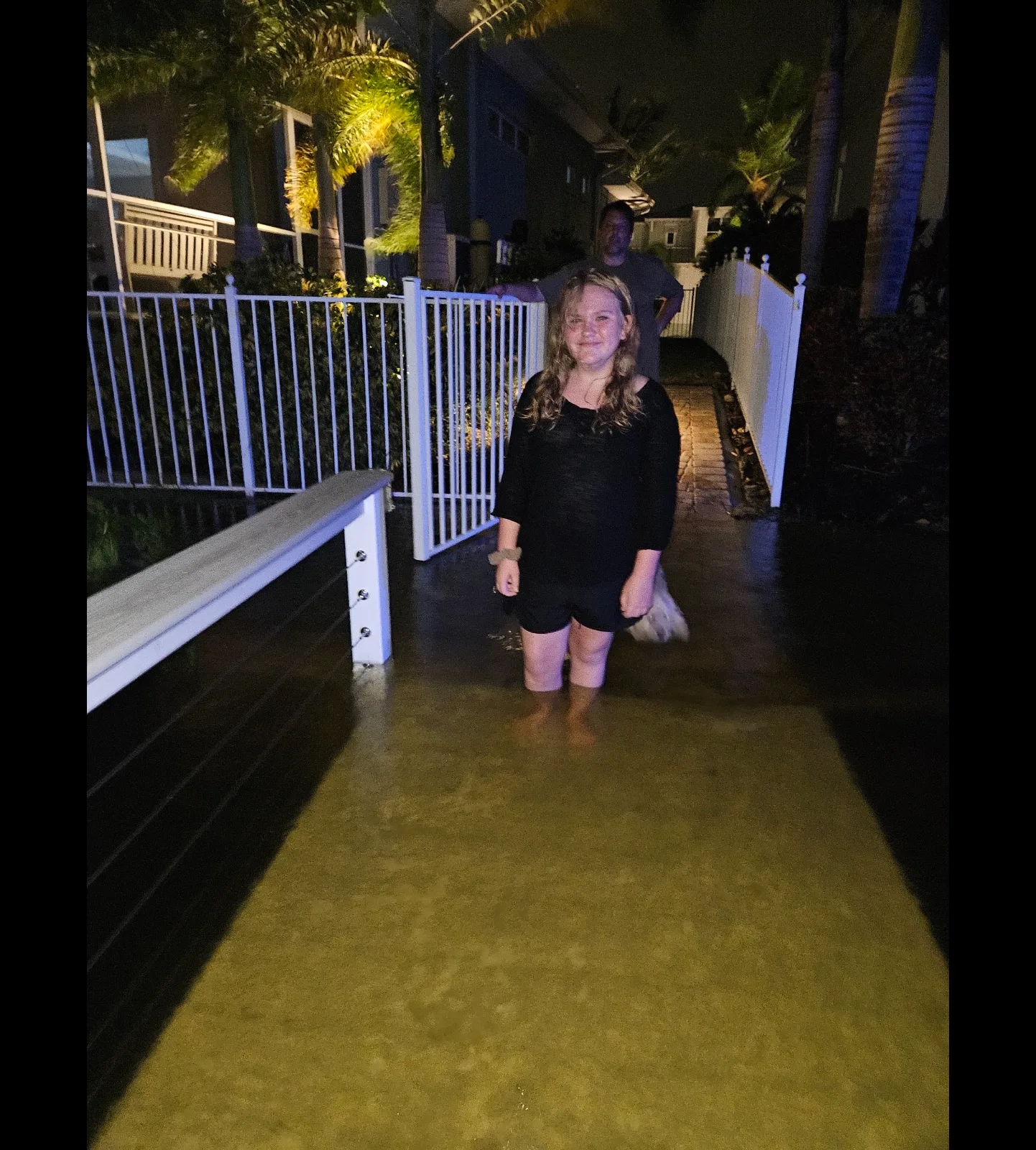
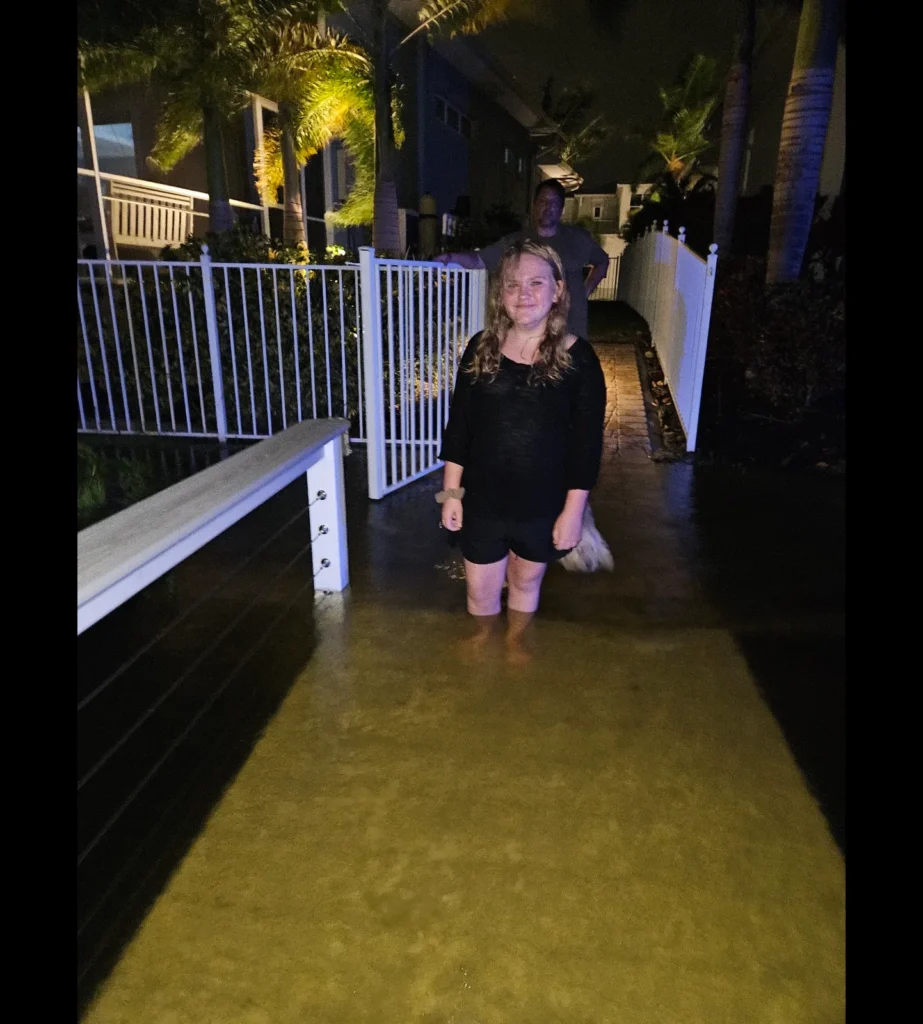
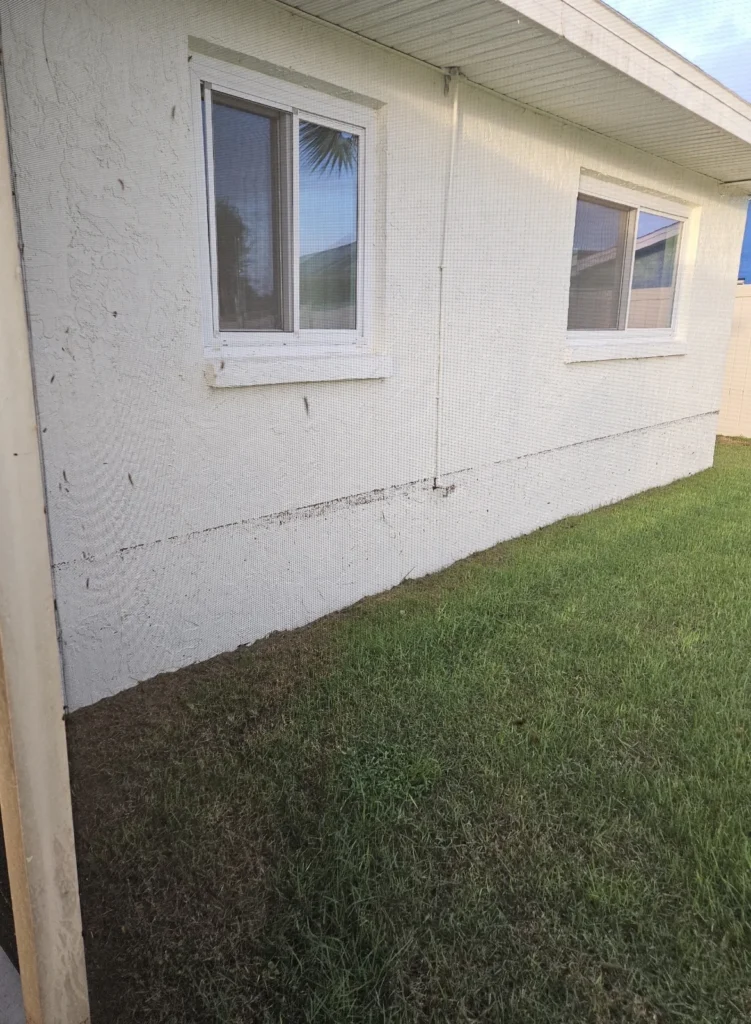
The night Helene came through, the surge came right up over our dock. That is Sophia standing in it. And the question I get more than any other from buyers moving here is the one that picture raises: “Is Apollo Beach in a flood zone?”
It is a fair question, and I love answering it, because the honest answer is more helpful than people expect.
Is Apollo Beach in a flood zone?
Parts of it are. Here is the rule I give everyone. Stand on US Highway 41 and look west, toward the water. That side is in a flood zone, so plan on flood insurance. Look east, and you are generally out of one. A couple of streets and a few communities east of 41 are still mapped Zone AE, and most of the rest is Zone X. That one rule tells you most of what you need to know.
What did Helene actually do here?
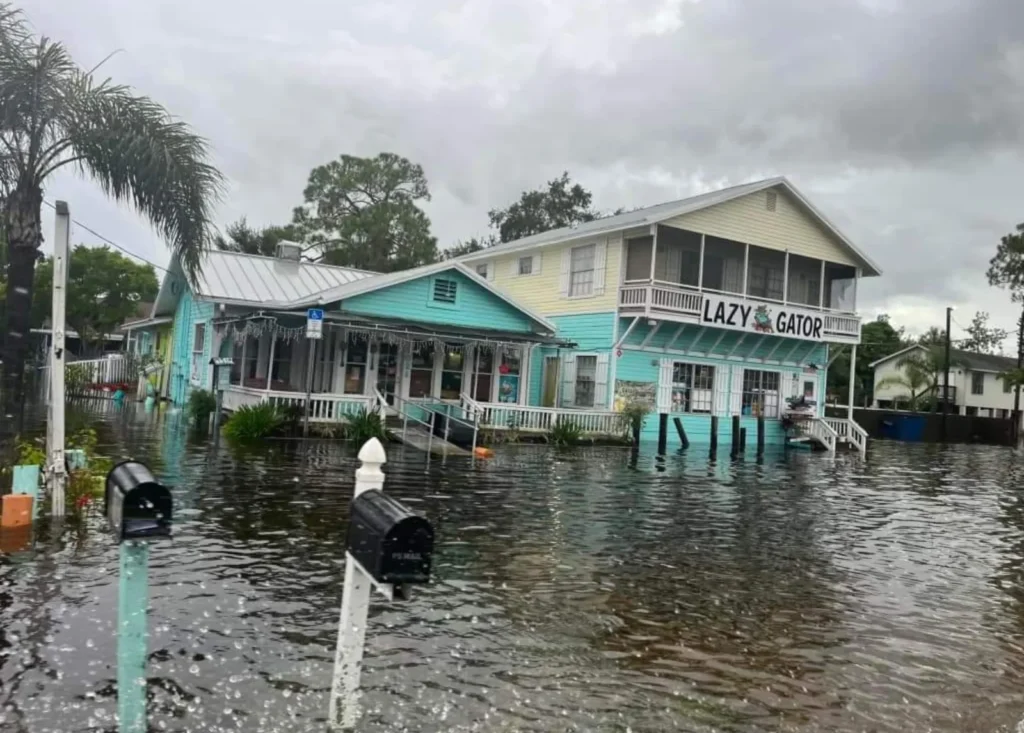
Older waterfront homes surrounded by storm surge.
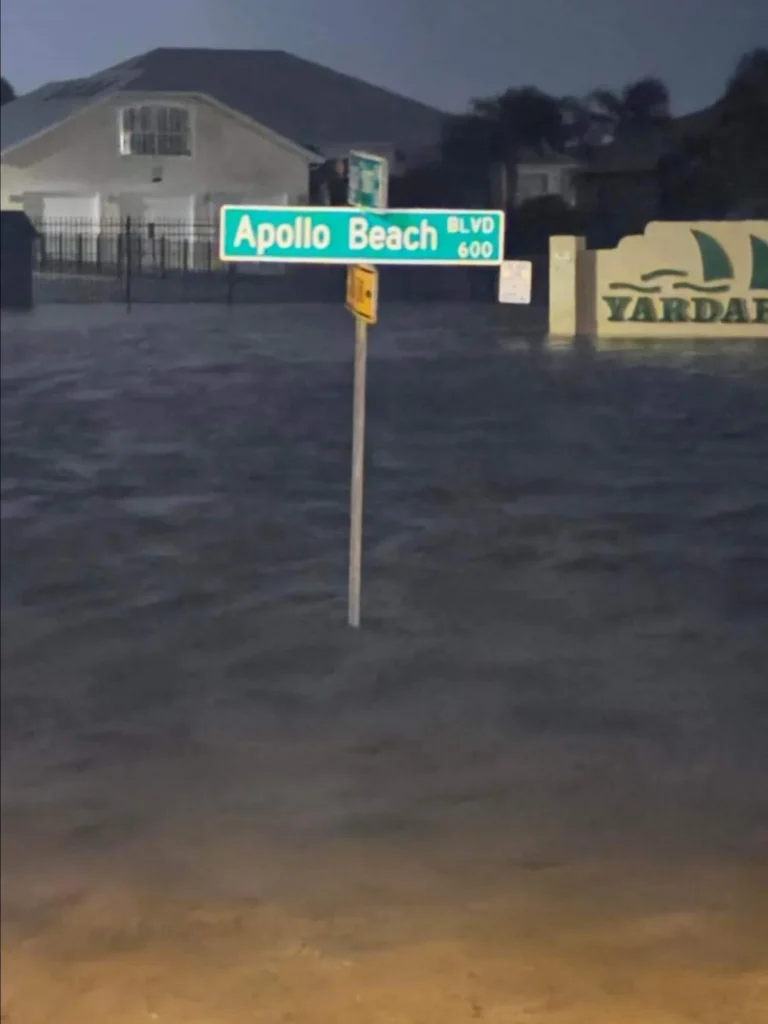
Helene’s surge came in at 4 to 6 feet at most, and really closer to 4. It was devastating for the older, lower parts of Apollo Beach. Streets like Apollo Beach Blvd sat under water, and afterward the curbs in those neighborhoods filled up with drywall and flooring.
Apollo Beach Blvd under water.
The communities built after 2000 were a different story. They sit at about 10 feet, and they were not impacted. You barely feel the hill when you drive between the two, but it is about six feet, and it made all the difference.
Why does elevation matter so much?
A flood water line on an older, lower home.
The original Apollo Beach was built where it landed, at roughly 1, 2 and 4 to 6 feet above sea level. The communities built from about 2000 on were raised to about 10 feet. That one difference is why two homes a few streets apart can both be in a flood zone and still be completely different to own and to insure. Since the 2002 Florida Building Code, new coastal homes need impact rated windows and doors or approved shutters, and either one helps your premium too.
So being in a flood zone is usually not the deal breaker people fear. What you want to know is how high the house sits, when it was built, and what the elevation certificate says.
What should you check before you make an offer?
Is flood insurance required by your lender, and what does the seller pay now?
Is there an elevation certificate? It is often the single most useful document for pricing flood insurance.
Has the home had any flood claims or storm damage?
Does it have impact windows and doors, or shutters?
Which evacuation zone is it in, and what is your route out to 41? Hillsborough County updated the zones for 2026, so check even if you looked last year.
Get the free Apollo Beach Flood Zone Guide
I put everything I tell buyers into one free guide: the US 41 rule, how elevation and the year a home was built affect your insurance, what Helene did here, my hurricane prep checklist and the new 2026 Hillsborough County evacuation zone map.
And if there is an address you are curious about, send it to me. I will pull the flood zone, the elevation and the insurance picture for you. I would love to hear what you are picturing, too. Is it a boat in the backyard, or a pool on a quieter street a little closer to 41?
If you have been searching online for an Apollo Beach waterfront home with a pool, dock, boat lift, beautiful updates and direct access to Tampa Bay for less than $1 million, you have probably seen a few results that make it look possible.
Here is the honest answer: you should not build your expectations around them.
An unusually low-priced listing may be a short sale, a major renovation project, a condo, a home without truly navigable water, or a property missing one or more of the features you assumed were included. Sometimes a legitimate outlier appears. That does not make it a realistic description of the broader Apollo Beach waterfront market.
I sell more than 50 waterfront homes a year, and the most helpful thing I can do for a buyer is explain what the different price ranges actually buy before we waste a weekend touring homes that cannot deliver the lifestyle they want.
What does an Apollo Beach waterfront home really cost?
The short answer is that Apollo Beach waterfront home prices start around $550,000 for genuinely navigable water, but the complete boating lifestyle most buyers picture generally costs considerably more.
Approximate budget
What buyers should realistically expect
Around $550,000
An older, smaller and dated home on navigable water, generally without a pool and with limited storage or living space
About $750,000–$980,000
More space, renovations or a pool may become possible, especially outside amenity communities, but buyers should expect tradeoffs
Around $1 million and above
Entry into more community waterfront choices, although a pool, private dock, boat lift, updates and ideal bay access rarely all arrive together at the bottom of this range
About $1.2 million–$1.9 million
The range where buyers are more likely to find a well-finished home in a well-maintained community with the pool, dock, lift, boating access and updates they actually want
These are practical expectations, not appraisal ranges or promises about a particular property. Waterfront value can change dramatically based on the canal, boat route, bridge clearance, elevation, seawall, dock, lift, home condition and neighborhood.
What can approximately $550,000 buy on navigable water?
It is sometimes possible to buy an Apollo Beach home with navigable access to Tampa Bay for around $550,000.
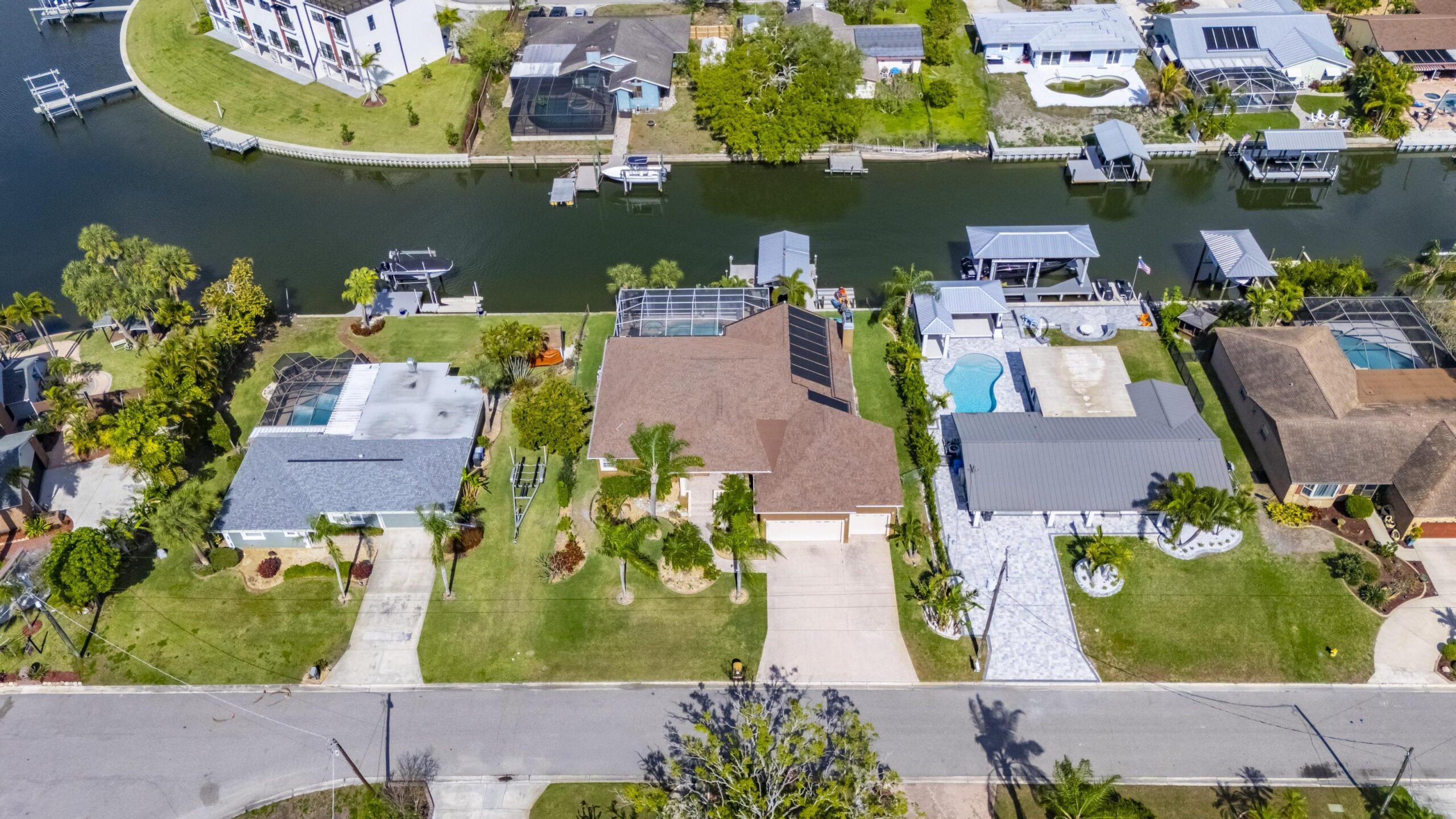
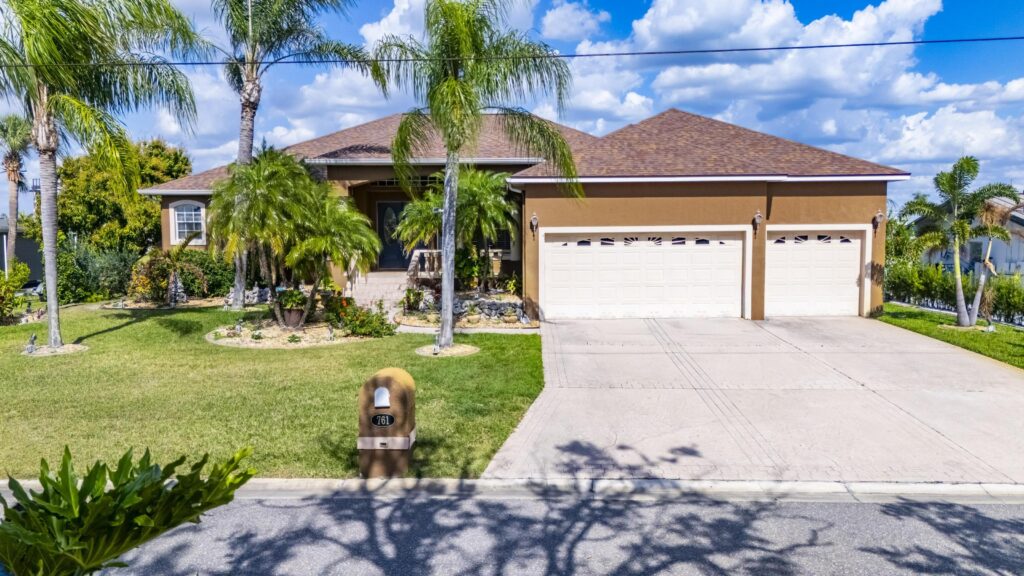
Entry-level waterfront: an older canal home on navigable water, no HOA, no pool.
At that price, expect substantial compromises. The home may be much older, smaller and outdated. It may have limited closet space, an older floor plan, deferred improvements and no pool. The seawall, dock, lift, roof, electrical system, plumbing, flood history and insurance options all need careful investigation.
For the right buyer, that can still be a wonderful opportunity. Some people care far more about keeping a boat behind the house than having a large kitchen or modern primary suite. The mistake is expecting an entry-level waterfront price to deliver both the premium land and a fully renovated home.
At this level, you are usually buying the water first and the house second.
What changes between approximately $750,000 and $980,000?
This range can open the door to a larger home, meaningful renovations, a pool or a better overall waterfront setup. It does not automatically buy every one of those things at once.
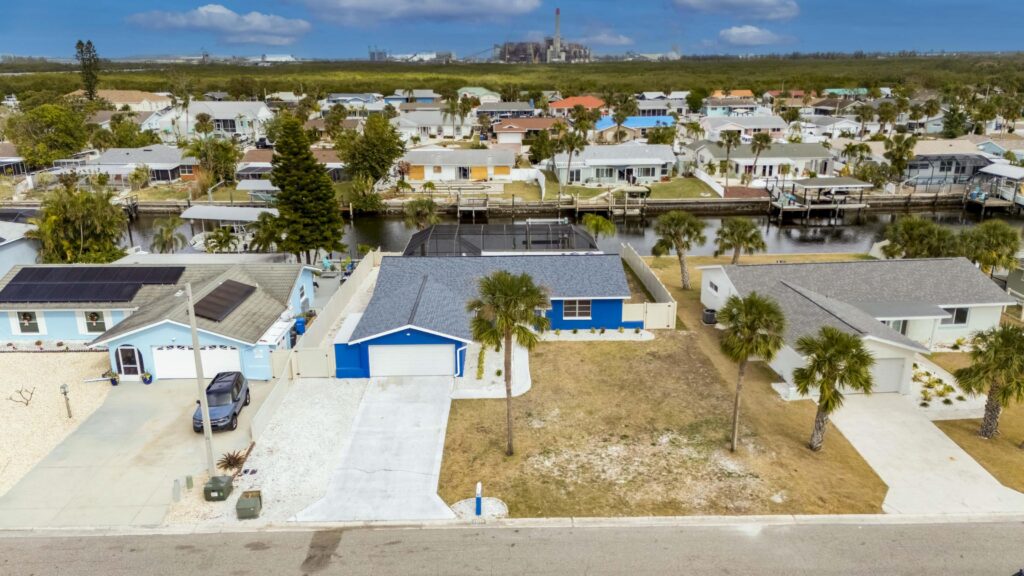
Mid-range: a no-HOA canal home with a pool, and no fixed bridges between the dock and the bay.
Many homes in this range are located in older canal neighborhoods with little or no homeowners-association oversight. Some buyers love that freedom. They may want fewer restrictions on boats, vehicles, rentals or how they use their property.
That freedom comes with a tradeoff. Neighboring homes can vary widely in condition and use, and short-term rentals may be possible where permitted by local law. The same lack of uniform standards that gives an owner flexibility can also make resale values less predictable and limit how high prices rise compared with a consistently maintained gated or amenity community.
This does not make these neighborhoods undesirable. It makes them a different product. Buyers should decide whether they value fewer restrictions more than community amenities, appearance standards and a more consistent resale environment.
Can I get a pool, dock, boat lift, updates and Tampa Bay access for under $1 million?
You should assume that you cannot, particularly if you also want a desirable community with amenities.
Could one unusual property appear? Yes. Real estate always produces exceptions. It may be a distressed sale, need significant work, have an inferior water route, carry an issue that is not obvious in the first photograph, or simply be priced aggressively enough to attract immediate competition.
That exception should not become your buying plan.
If your non-negotiable list includes all of the following, a sub-$1 million budget will usually require you to change either the location, condition, size or feature list:
Navigable access to Tampa Bay
A private pool
A private dock
A boat lift with the right weight capacity for your boat
Attractive, current renovations
Comfortable square footage and storage
A well-maintained community
Community amenities
Online search tools often suggest that this entire package exists for less because the word waterfront covers many very different properties.
Why online real estate apps create unrealistic expectations
On a property-search website, “waterfront” may describe a saltwater canal, freshwater pond, lake, retention area, lagoon, community waterfront or simply a water view. It does not necessarily mean you can keep your boat behind the house and reach Tampa Bay.
The seawall, the dock and the lift’s weight capacity are the things a listing photo will not tell you.
A “dock” may be private, shared, community-owned, unusable for your boat or located somewhere other than directly behind the home. A lift may not carry the weight of your boat. A canal may become difficult at low tide. A bridge may prevent the boat you own from reaching open water.
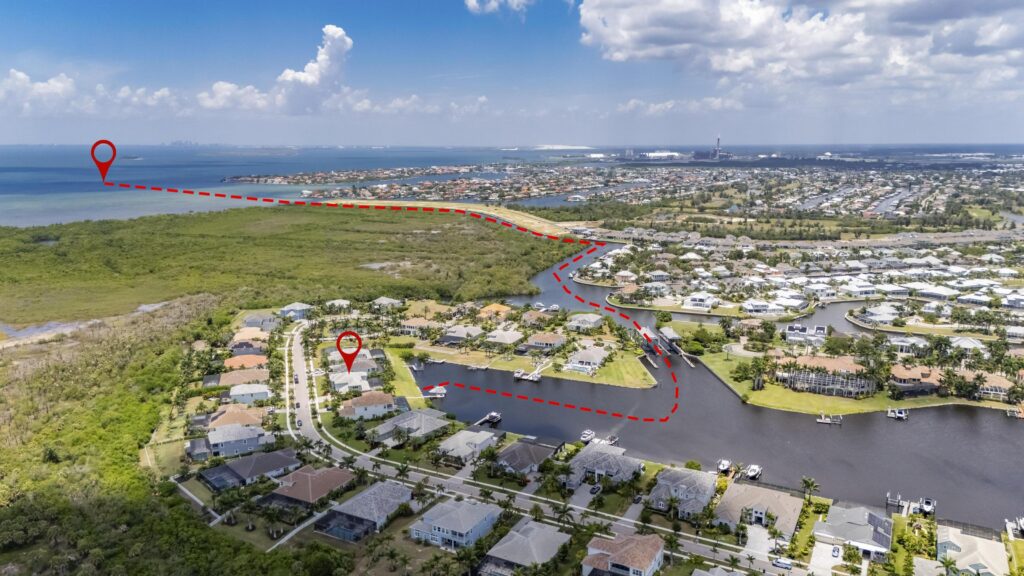
The route from the dock out to Tampa Bay. This is the part a listing never shows you.
Search results can also mix together:
Single-family homes, condos and manufactured homes
Navigable and non-navigable water
Private docks and community docks
Homes with lifts and homes where a lift might be allowed
Pools located at the property and community pools
Active, pending, distressed and stale listings
Updated homes and properties needing major renovation
That is why a low price in a search result is not proof that the complete lifestyle exists at that price. The individual property has to be investigated.
What does $1.2 million to $1.9 million buy?
This is where the search becomes more realistic for buyers who want an attractive home in a cared-for community along with a private pool, dock, boat lift, navigable access and meaningful updates. In Apollo Beach that usually means MiraBay, Symphony Isles or Andalucía.
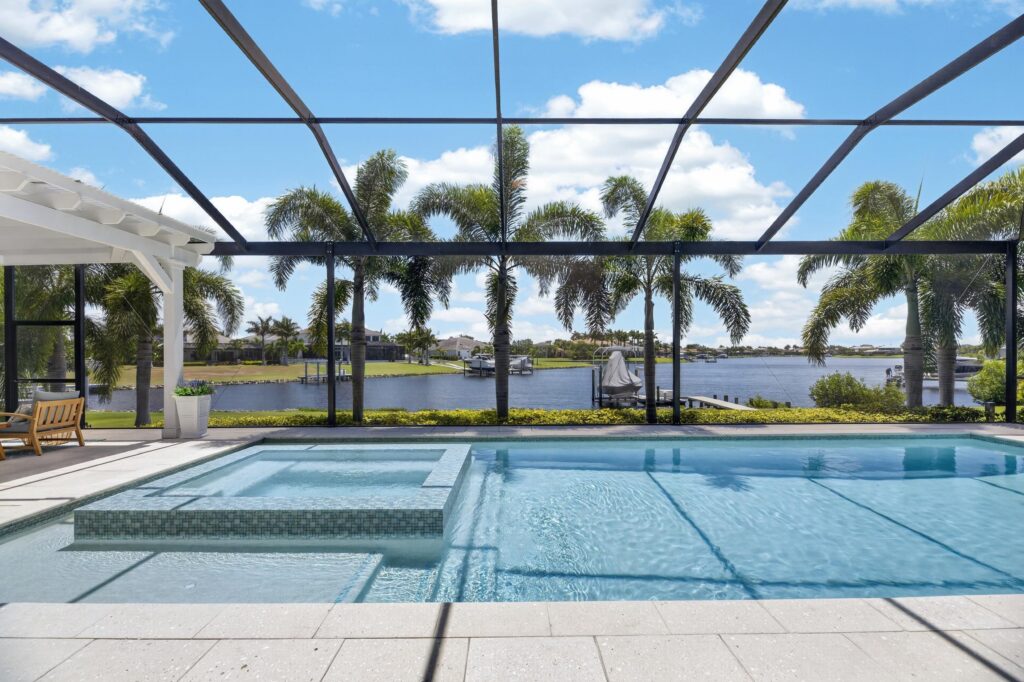
The complete package: pool, lagoon frontage, a dock with a lift and a clear route out to Tampa Bay.
The final price still depends on taste and the details. A larger custom home, wider water view, shorter route to the bay, newer seawall, higher-capacity lift, better elevation, extensive renovation or premium lot can push the price toward the upper end or beyond it. In an amenity community, budget for the CDD as well as the HOA.
Buyers in this range generally have more control over their choices. Instead of asking, “Which major feature do I have to give up?” they can spend more time deciding which home, community and boating setup fit them best.
What if my budget is lower?
You can still buy a great Apollo Beach home. The key is adjusting the correct expectation.
A newer home in an amenity community is one of the trades buyers make when the private dock does not fit the budget.
You might choose:
Navigable water without a pool
A smaller or older waterfront home that you improve over time
A pool home off the water with access to a community boat ramp or marina
A waterfront condo or villa instead of a detached house
A home with a water view rather than private boating access
A newer home in an amenity community without a private dock
A nearby community where your money buys a different balance of features
There is nothing wrong with making a compromise. The expensive mistake is buying before you understand which compromise you are making.
Questions to answer before touring Apollo Beach waterfront homes
Before I build a waterfront search for a buyer, I want to know:
What kind of boat do you own or plan to own?
What are its length, beam, draft, height and loaded weight?
Must the boat remain behind the house?
Is a private pool required, or would a community pool work?
Are renovations required, or would you update the home gradually?
Do you want a gated or amenity community?
How much do neighborhood rules and appearance standards matter to you?
Are you comfortable with a neighborhood where short-term rentals may be allowed?
Have you budgeted for flood insurance, homeowners insurance, seawall and dock maintenance, HOA fees and possible CDD assessments?
Which matters more: the best house, the best community or the best boating access?
Those answers tell us far more than checking the “waterfront” box on an app.
The honest Apollo Beach waterfront search
Apollo Beach offers an extraordinary boating lifestyle, but waterfront homes are not interchangeable. Two houses with similar square footage and asking prices can have completely different boat access, insurance considerations, neighborhood environments and long-term resale potential.
My job is not to convince you that every waterfront listing is a good opportunity. It is to identify which properties genuinely match your boat, budget, lifestyle and expectations, and to tell you when something that looks attractive online does not hold up in person.
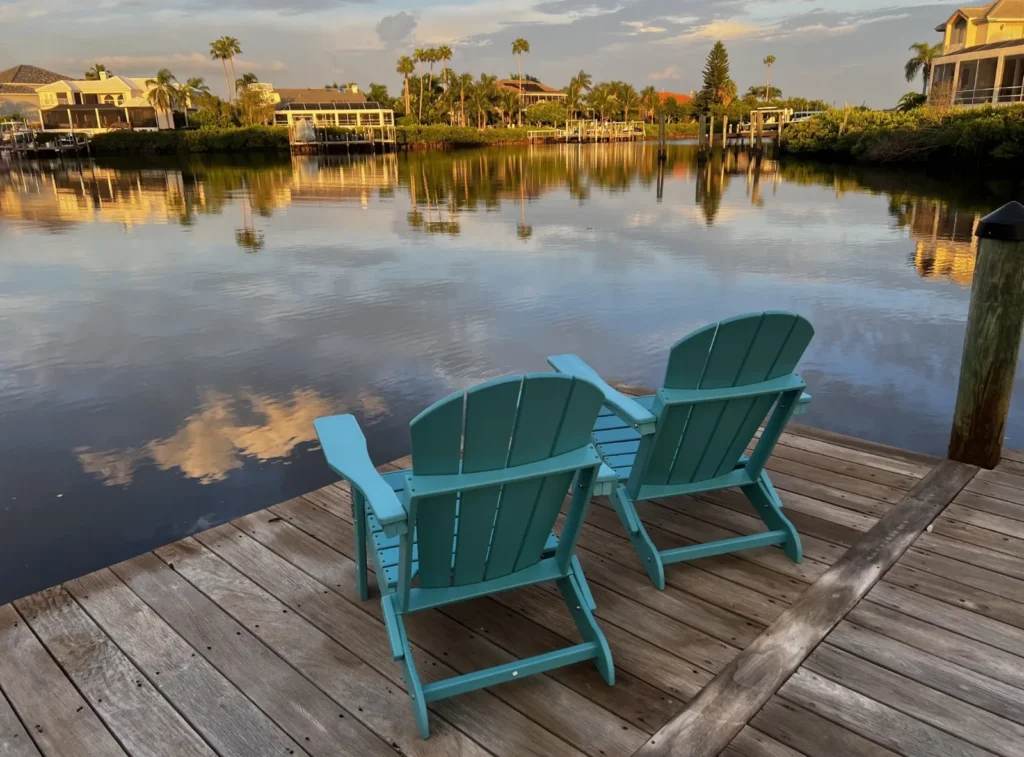
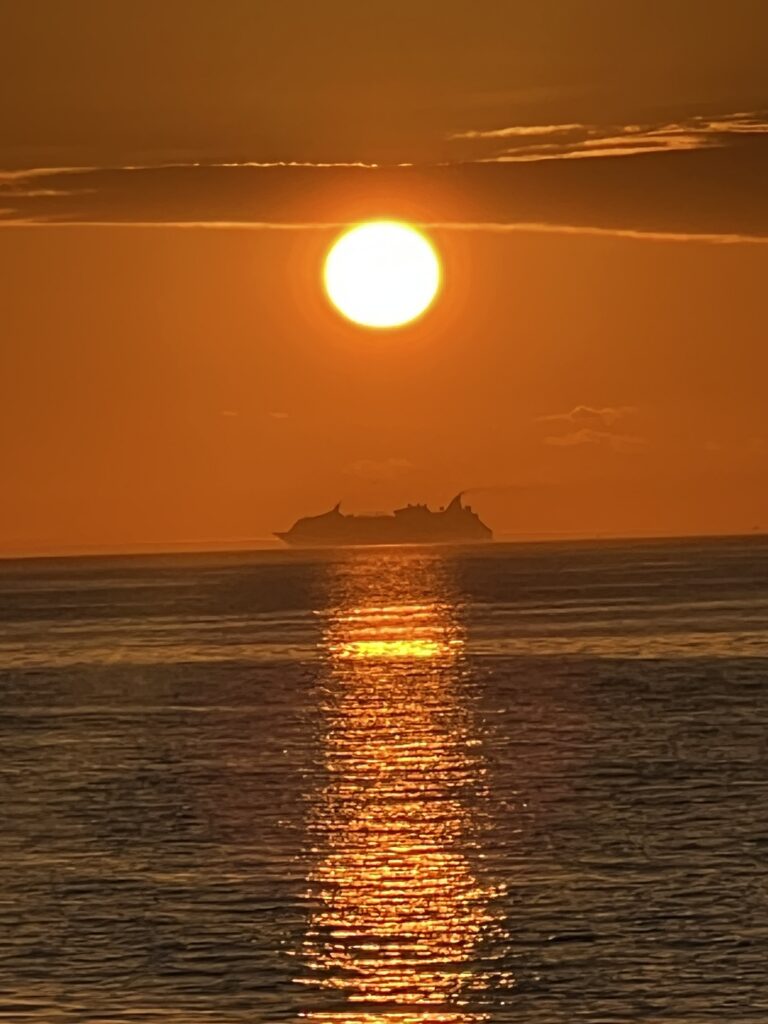
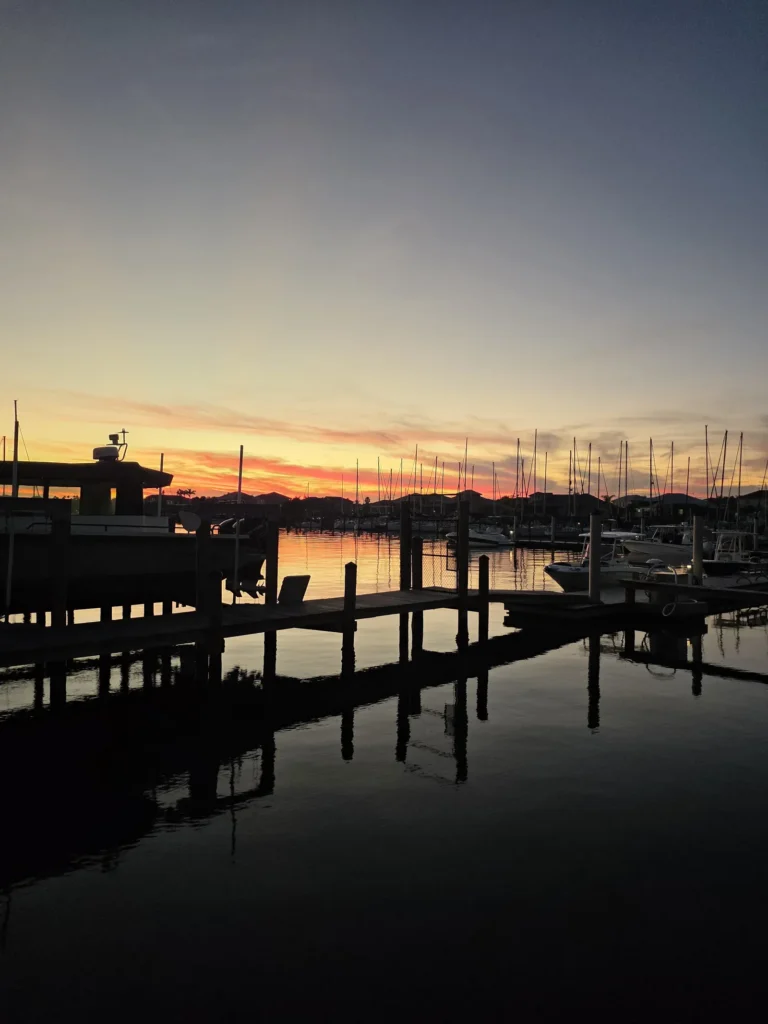
Sunset off Apollo Beach. This is the part nobody argues about.
If you are considering an Apollo Beach waterfront home, tell me your budget, boat requirements, preferred features and tolerance for renovations. I will give you an honest picture of what is realistic and help you build a search around homes that can actually work.
Market conditions and available inventory change. Price ranges in this article describe general buyer expectations and are not appraisals, guarantees or substitutes for property-specific due diligence. Rental rules, boating access, flood information, insurance availability, HOA restrictions and CDD assessments must be verified for each property.
Buying a waterfront home in Apollo Beach is not the same as buying any other house. You are buying the seawall, the dock, the lift, the canal behind the house and every rule that comes attached to the water. None of that shows up in listing photos, and it is where waterfront buyers get hurt.
This post is the due-diligence checklist — the things to inspect, ask and price out before you write an offer on a waterfront house. If you are still deciding which community to look in, start with the waterfront communities guide and come back here once you have a house in mind.
I sell more than 100 homes a year and more than 50 of those are waterfront. The problems I run into on waterfront deals are almost never the house.
Here is the version that keeps happening. A buyer flies in, falls for a canal home with a dock and a lift, writes the offer that afternoon and starts shopping for a boat before the inspection is even scheduled. Then they find out the lift is not rated for the boat they just fell in love with. Or the community master dock plan limits what that particular lot can keep on the water. Or they run out toward the bay for the first time and realize the hardtop was never going to clear the bridge. None of that is bad luck. All of it was findable before the offer.
Here is what I check on every waterfront property, and what you should be asking before you write one: canal depth against your boat, the community master dock plan, the lift, the seawall, the flood zone and a real insurance quote, and what the HOA and CDD actually cost on that specific lot.
What are you really buying when you buy a canal home?
You are buying the house, and you are also buying the seawall, your right to use the water behind it, and the dock and lift if there are any. Every one of those pieces has an age, a cost and a lifespan. A seawall can look fine from the deck and be undermined below the waterline. A lift can be far too small for the boat you plan to buy. All of it becomes yours at closing.
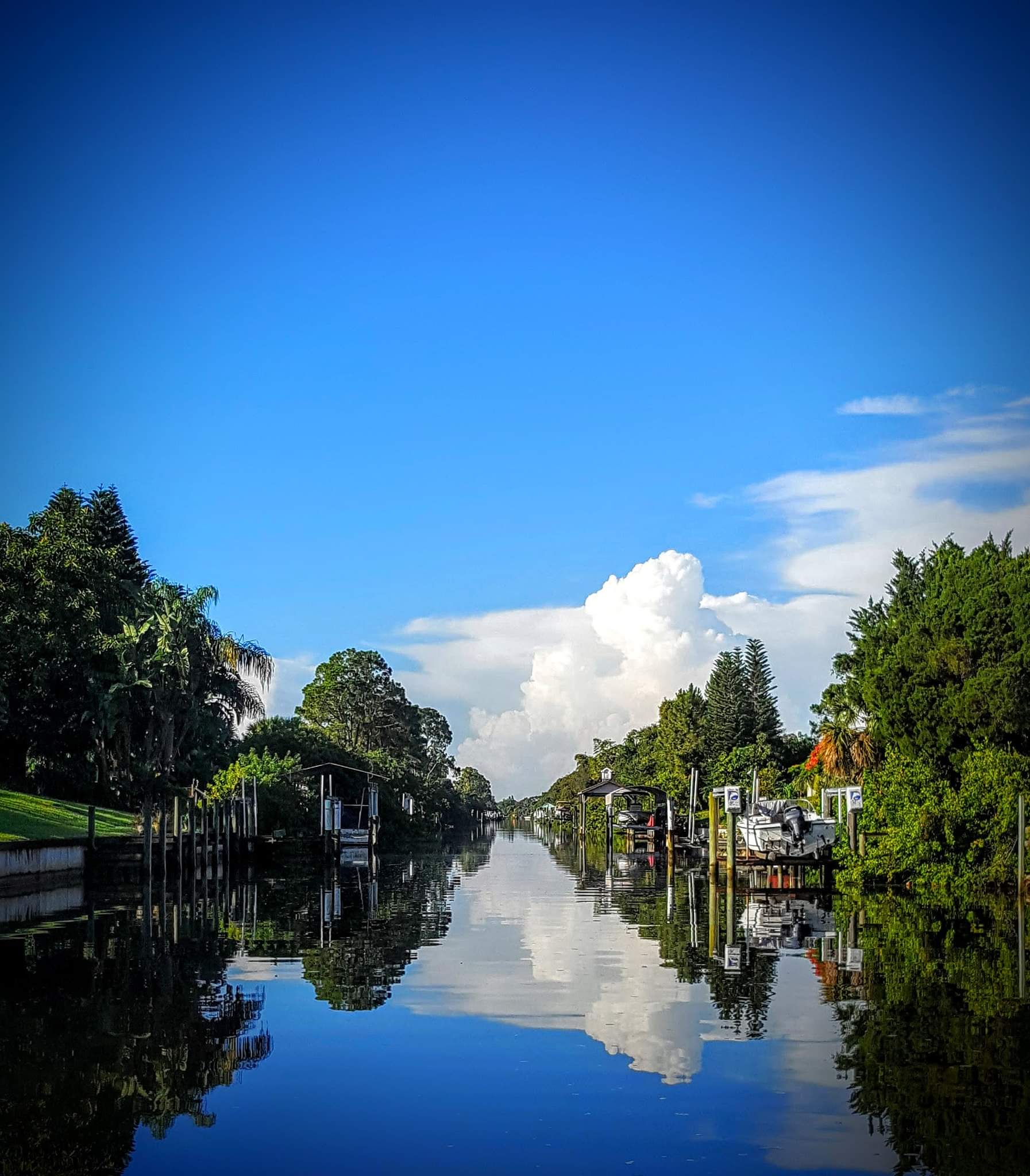
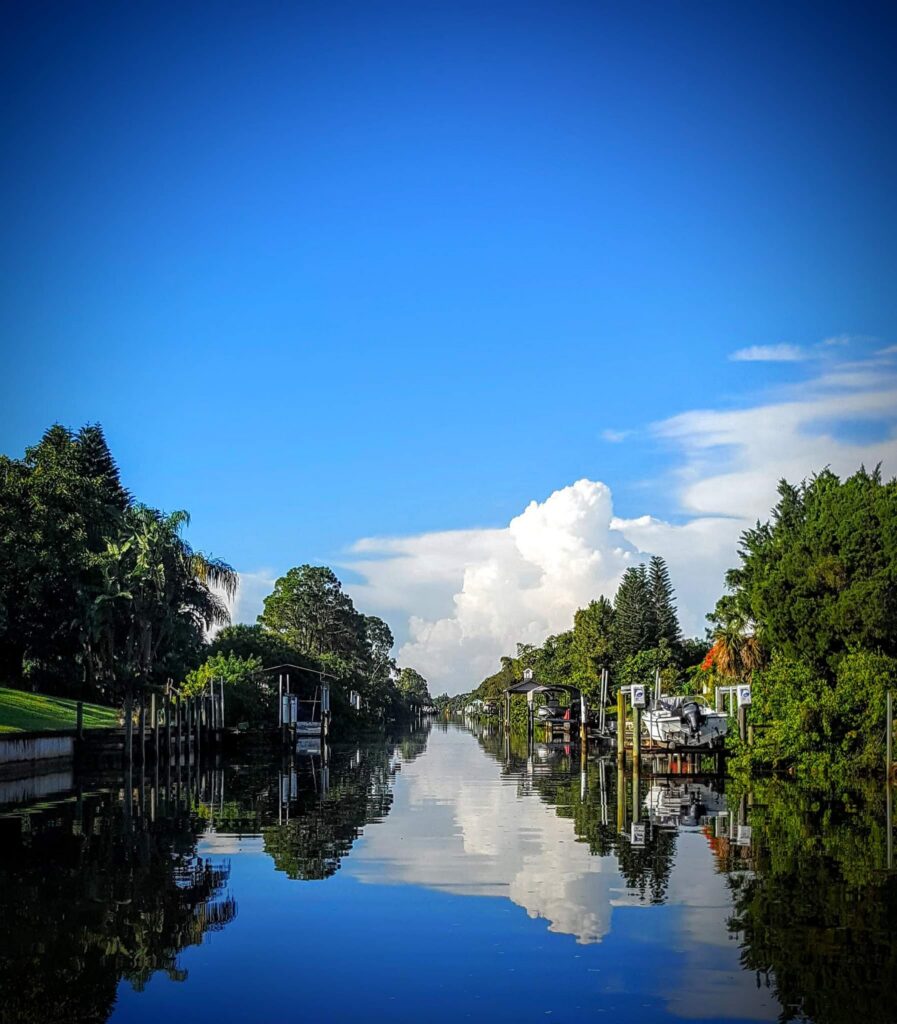
A canal like this one in Bradenton is what buyers picture. What matters is depth at low tide, bridge clearance and the condition of the seawall.
Is the property actually on navigable water?
This is the first question, and the answer is not always what the listing implies. Around Southshore we have on-water neighborhoods and off-water neighborhoods, and both are full of good homes. On water does not automatically mean you can get a boat to Tampa Bay, either. Some homes sit on lakes and ponds. Some sit on canals with a clear run to open water. Ask directly whether the water is navigable, ask what sits between the dock and the bay, and do not let a pretty water photo answer the question for you.
How do you know the canal is deep enough for your boat?
Why does canal depth matter when you lower the lift?
Canal depth is not about whether your boat floats in the middle of the canal. It is about whether there is water under your boat when you lower the lift at low tide. Your draft and the depth at the seawall at low water are the two numbers that matter. Get the depth measured at the dock rather than out in the channel, and find out how much the tide moves in that canal.
Will your boat clear every bridge between the dock and the bay?
Fixed bridge clearance is measured at high water, and it does not care what the listing calls the property. Direct access language does not tell you whether your specific boat, with your hardtop or tower on it, will fit under every bridge on the route out. Run the route if you can. If you cannot, get the clearance numbers before you commit.
What is a community master dock plan, and why should you ask for a copy?
This is the document most buyers never hear about. Many waterfront communities have a master dock plan that governs what can be built and what size boat a specific lot can keep on a lift. The restrictions usually come down to the size of the lot and whether a boat has the room it needs to navigate, turn around and let people board and get off the lift. Some smaller lots are limited because of it. Ask for a copy of the master dock plan and find out whether the lot you are looking at carries a restriction, before you are under contract with a boat you cannot keep there.
What should you check on an existing boat lift?
Start with the pound capacity, because that is what decides whether your boat can go on it. A lift can be replaced or upsized later and buyers do it all the time. It is simply easier and cheaper when the lift already there fits the boat you want to own. Ask for the capacity, the age and any service history, and look at the pilings, cables and motors while you are standing on the dock.
Who inspects the seawall, and what do the big repairs cost?
Your general home inspector does not inspect the seawall. A marine contractor does, and that inspection covers the cap, the panels, the tie back anchors, the weep holes and the soil behind and beneath the wall where voids and erosion start. These are the two numbers worth knowing before you write an offer: a new seawall runs roughly $800 to $1,000 per square foot, and a dock replacement runs $37,000 to $75,000. Neither one is a surprise you want after closing. Ask for the age of the wall and any repair history, and look at the walls on either side of it while you are there.
How do you check the flood zone before you make an offer?
Go to the FEMA Flood Map Service Center and enter the address. That gives you the flood map panel and the flood zone for that parcel. Zones AE and VE are high risk, which means your lender will require flood insurance as a condition of the loan. Zone X is moderate to low risk. Flood zone is assigned parcel by parcel, so never assume the house you are looking at carries the same designation as the one down the street.
Then get an actual quote on that specific address instead of a number someone quoted for a different house. An elevation certificate, which shows where the lowest finished floor sits relative to the base flood elevation, can change what you pay. Insurance is part of your monthly payment, so it affects what you qualify for now and what your buyer will qualify for when you sell. Florida sellers are also required to disclose flood history and past claims, so read that disclosure closely.
Does the age of the neighborhood affect flood insurance?
It does, and this is one of the easiest things to check. A neighborhood built after 2000 was usually built up to a higher elevation, and higher elevation brings the flood insurance premium down. That difference is worth weighing when you are comparing an older canal home to a newer one. Either way, plan on carrying it. If you have a mortgage on a waterfront home, you are going to need flood insurance.
Wide canals mean easier turning and bigger boats. Narrow ones limit both.
What boating restrictions will the listing not tell you?
Deed restrictions and HOA documents can limit boat size, prohibit living aboard, restrict the type of lift you install and require board approval before you make a change at the dock. Many canal communities also sit inside manatee protection zones with posted speed limits on how you run your boat. None of this is hidden. It is all in writing, and it just takes someone willing to read it and confirm it in writing before you close.
What is the difference between an HOA fee and a CDD fee in Florida?
HOA dues go to a private association that maintains shared amenities and enforces the community rules. A CDD is different. It is the portion of your tax bill that goes back to the community, funding the operation and maintenance of the community and paying off the original development bonds. You do not write a separate check for it, it shows up on the tax bill, and it belongs in your monthly number from the start.
A CDD is also not the penalty buyers assume it is. Communities with a CDD usually have a very low HOA, and they tend to be amenity rich or come with enhancements other neighborhoods do not have, like natural gas or gated entries. The bond portion does eventually get paid down.
Here is what surprises buyers: very few waterfront communities carry a CDD at all. Around here it is really just Antigua Cove in Ruskin, which most people know as Little Harbor, and MiraBay. Off water is the opposite, where plenty of neighborhoods do carry one. Where a CDD exists it is usually based on lot size, so two houses in the same community can pay very different amounts. In MiraBay a 50 foot lot runs around $2,300 yearly while lots over 100 feet run between $6,000 and $7,000. Get the exact figure for the specific parcel before you decide what you can afford.
What should you verify before you write the offer?
Buying a waterfront home in Apollo Beach comes down to a short list: whether the water is navigable and what your boat needs to get out, the depth at the dock at low tide, the master dock plan and any restriction on that lot, the lift capacity, the seawall condition and age, the flood zone and a real insurance quote for that address, and the HOA and CDD numbers for that exact parcel. Most of it can be confirmed inside your inspection period if someone starts on it the day you go under contract.
Is buying a waterfront home in Apollo Beach worth it?
Every time. Dolphins and manatees in your back yard, sunsets from your own dock, and your boat in the water five minutes after you decide to go. I sell these homes because I believe in them and because I know this water. Nothing in this guide is an argument against buying waterfront. It is an argument for understanding what you are buying before you are emotionally committed to it. A generalist agent can open the door. Someone who works this water every week can tell you whether your boat fits, what the seawall is likely to cost you in five years, and whether the CDD makes the deal work.
If you are buying a waterfront home in Apollo Beach, Ruskin, anywhere across Southshore or anywhere else in Florida, reach out before you make an offer. I will walk the dock and the seawall with you, get you the community master dock plan, and make sure the water and the lift actually fit the boat you want.
Awards are worth something when they come from clients and closings. They’re worth nothing as a reason to hire somebody, and I’d honestly rather you call three people I’ve sold for than read a plaque.
For what it’s worth: RateMyAgent named me its 2026 Florida State Agent of the Year, and in 2025 I was included in Newsweek and Statista’s Florida’s Top Real Estate Professionals. Both programs come down to the same question — did clients feel taken care of, and did the deals close. That’s the part that means something to me.
Verified recognition
RateMyAgent lists me as its 2026 Florida state winner. The award program evaluates agents through customer satisfaction and transaction performance. In 2025, I was also honored to be included in the Newsweek and Statista Florida real estate recognition program, which Statista describes as a program recognizing licensed professionals who help buyers and sellers navigate real estate transactions.
Awards are review-based. What they measure is whether past clients would do it again.
I appreciate both honors. Still, a badge doesn’t explain how an agent handles a complicated inspection, evaluates waterfront access, communicates during underwriting or responds when a closing changes at the last minute. Those are the moments that define the client experience.
What does this recognition mean for buyers?
For a buyer, strong representation begins with questions. Which canal works for the boat you own? Is the advertised water access practical at different tides? What should you investigate about a seawall, dock, lift, flood zone, insurance or permitting history? Which neighborhood fits your daily life after the excitement of moving wears off?
My work is especially grounded in Apollo Beach, Southshore and Tampa Bay waterfront living. That local experience helps buyers compare properties that may look similar online but function very differently in real life. If you’re beginning that search, start with my Apollo Beach waterfront home buying guide and my guide to Apollo Beach neighborhoods and waterfront communities.
What does this recognition mean for sellers?
Sellers need more than a sign and a set of photographs. They need honest pricing guidance, a clear positioning strategy, careful preparation, responsive communication and a plan for handling inspection, appraisal and closing issues. Waterfront properties add another layer because buyers evaluate boating access, dock and seawall condition, insurance, elevation and maintenance along with the home itself.
Check current licensing and experience. Ask where the agent actively works and which property types they handle regularly.
Read reviews for patterns. Look for repeated comments about communication, problem-solving, honesty and follow-through.
Ask for a clear process. A good agent should be able to explain what happens before, during and after an offer or listing.
Discuss representation in writing. Understand the brokerage relationship, services and compensation before you commit.
Choose the right fit. Credentials matter, but so do responsiveness, judgment and the ability to listen.
Awards are a starting point, not the finish line
I’m grateful for every recognition, but I never want an award to become the whole story. The work is still personal. It’s answering the call, explaining the fine print, spotting the issue that deserves more investigation and helping a client make a confident decision.
Frequently asked questions
What RateMyAgent award did Shawna Calvert receive?
RateMyAgent lists Shawna Calvert as its 2026 Florida state Agent of the Year winner.
Does an award guarantee a successful transaction?
No. Awards are one useful signal, but buyers and sellers should also review experience, licensing, client feedback, local knowledge, services and the written representation agreement.
What areas does Shawna Calvert serve?
Shawna provides Florida relocation guidance with especially strong local experience in Apollo Beach, Southshore, Tampa Bay and nearby waterfront communities.
Boating in Apollo Beach usually starts the same way. You walk out the back door, step onto your boat and you are headed for Tampa Bay. No trailer, no ramp, no waiting. That part is every bit as good as it sounds. What nobody explains is what comes with it once the boat is actually yours.
This one is the day-to-day: what owning a canal home actually feels like once the novelty wears off. For why Apollo Beach is the place to do it, read why Apollo Beach is a boating town. For which communities have the water to support it, see the waterfront communities guide.
I sell more than 100 homes a year and more than 50 of those are waterfront, so I spend a lot of time standing on docks with people who are about to own their first boat lift. Here is what matters once you are the one using it.
What does it really mean to keep a boat behind your house?
It means you go out for an hour because you feel like it. No ramp line, no trailer to store, no deciding the night before whether the trip is worth the hassle. It also means the boat becomes part of the house. The lift, the dock and the seawall all need attention, salt gets into everything, and the day you stop using the boat is the day it starts costing you money for nothing. People who use their boat love canal living. People who buy a boat only because the house came with a dock tend to sell it.
How does the tide decide when you can leave the dock?
This is the part that catches new boat owners. Boating in Apollo Beach runs on the tide. What matters is not how deep the canal looks in the middle. It is how much water sits under your hull at the seawall at low tide, with the lift down. Your boat’s draft and that low water depth are the two numbers to put side by side. Some canals give you all day. Some give you a window. Find out how much the tide swings behind that particular house before you commit to a boat, because the boat is easier to change than the canal.
Do you really have to worry about bridge clearance?
Yes, and it is measured at high water, which is exactly when you are most likely to be heading out. Count your hardtop, your tower, your antennas and anything else standing up on that boat. A listing that says direct access is telling you the water connects. It is not telling you your boat fits. Run the route before you buy if you can, and if you cannot, get the clearance numbers for every fixed bridge between the dock and open water.
How big a boat can you actually keep there?
Not always as big as the dock suggests. Many communities have a master dock plan that governs what can be built and what size boat a given lot can keep on a lift. The limits usually track lot size and whether there is room for a boat to navigate, turn around and let people board and get off safely. Ask for a copy of that master dock plan and find out whether the lot carries a restriction. It is a short document and it answers a question that otherwise costs you a boat.
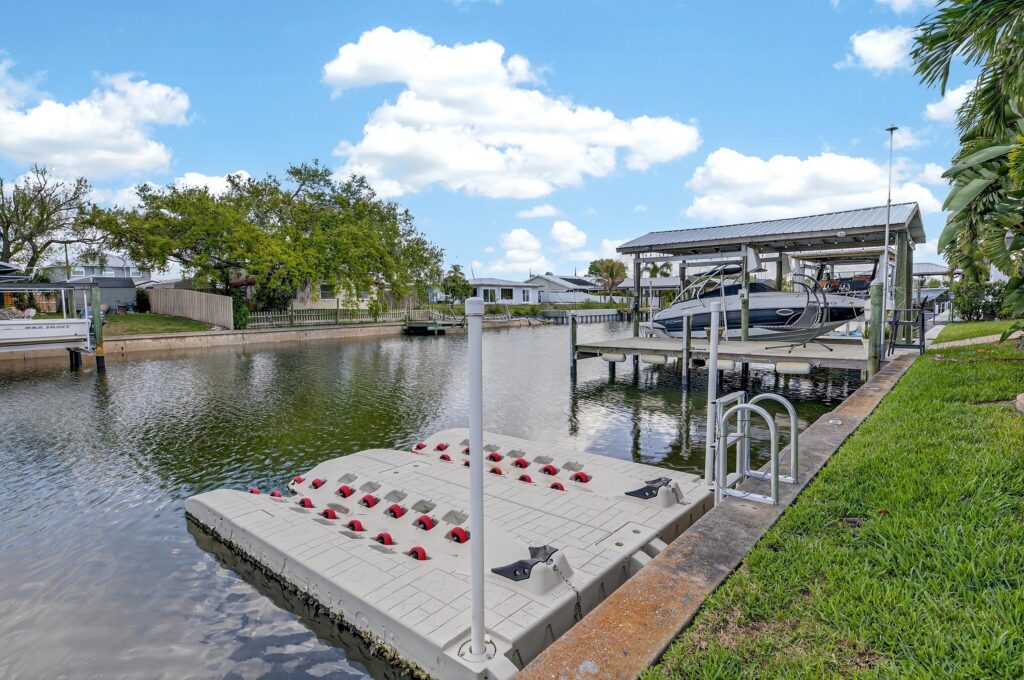
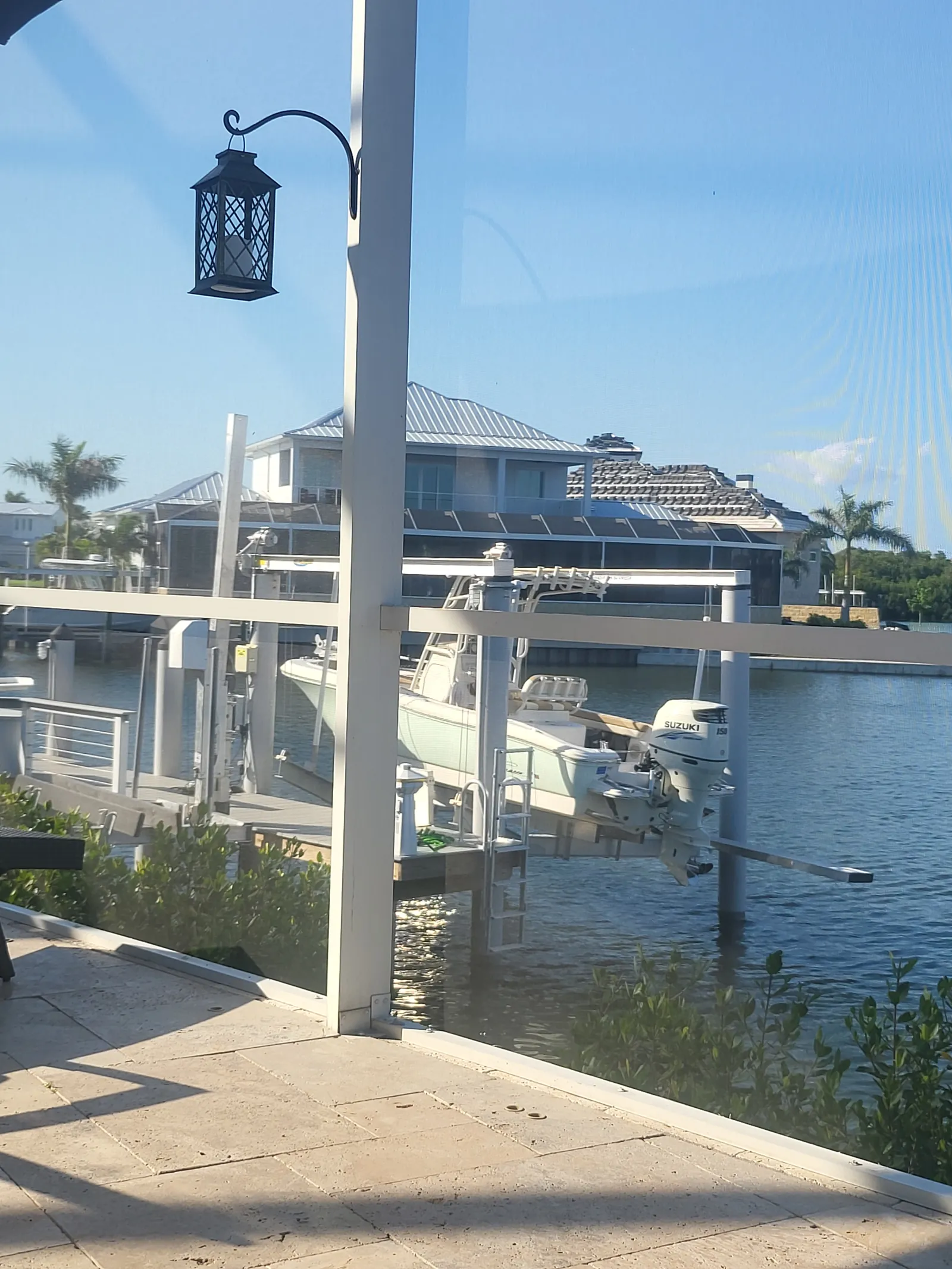
A boat lift viewed from the lanai of an Apollo Beach canal home.
What should you know about the boat lift itself?
Start with the pound capacity, because that is the number that decides everything. Weigh the boat the way you actually use it, with fuel, water, gear and everything you leave on board, not the dry weight on the brochure. Then look at the hardware while you are standing there: cables, motors, switches, bunks and how the cradle is set for that hull. Lifts can be replaced or upsized and people do it all the time. It is just easier and cheaper when the one already hanging there fits the boat you want to own.
Should the boat live in the water or on the lift?
On the lift, almost always. Warm salt water grows things on a hull fast, and a boat left floating needs bottom paint and regular cleaning to keep up. That is why nearly every canal home here has a lift rather than a slip. Getting the boat up out of the water after every trip is the single easiest thing you can do to keep the maintenance bill down.
What are the speed rules between your dock and open water?
Expect no-wake and manatee protection zones. The posted limits get stricter in the cooler months, when the manatees move into the warm water. The Florida Fish and Wildlife Conservation Commission publishes the rules and the zone maps. Your wake is your responsibility. A fast exit through a residential canal is how you damage a neighbor’s boat and meet that neighbor on the same day. Learn the zones on your route before the first trip, not after somebody flags you down.
What happens to your boat when a storm is coming?
Decide this before hurricane season, not while you are watching a cone move. A lift is not a storm plan by itself. Some owners haul the boat and trailer it inland, some move it to a more protected spot, and some strip and secure it in place. All of that takes time you will not have when everyone else in the neighborhood is doing the same thing. Have your plan written down and know who you would call.
What surprises people new to boating in Apollo Beach?
Salt. It gets into hardware, batteries, electronics and every fastener on the lift, and the fix is boring: rinse things, look at them, and service the lift on a schedule instead of when it stops working. The other surprise is a good one. People who thought they would go out a few times a summer end up on the water constantly, because the barrier to going is gone.
Is a canal home worth it if you only boat once in a while?
Honestly, if you would use a boat three times a year, a ramp or a dry stack does that job cheaper. But that is not usually why people buy here. They buy for the water itself, the sunsets, the dolphins and manatees showing up behind the house, and the option to go out whenever they want. The boat is part of it, not the whole reason.
Where should you start?
Tell me what boat you own, or the one you are planning to buy, before we look at houses. Draft, length, beam and the height of the tallest thing on it. I will check depth at the dock at low water, the bridges on the route out, the master dock plan for that lot and the capacity of whatever lift is hanging there, You will know before you make an offer whether the house and the boat go together. Boating in Apollo Beach is a lot better when the boat fits the water behind the house.
Waterfront isn’t about bedrooms, square footage and a pretty view. The questions that actually matter are different, and most of them are about water.
Will your boat fit the route out? What’s the bridge clearance at high tide? How much life is left in that seawall — and who pays when it goes? Were the dock and lift ever permitted? What will elevation, flood risk and insurance really add to the monthly number? I bring those up early, before anybody falls in love, because I live in MiraBay and I’ve watched what happens when nobody asks.
Quick Answer: Why Work With Shawna Calvert?
Waterfront buyers and sellers choose Shawna for a combination of high-volume transaction experience, local canal and boating knowledge, direct communication, relocation guidance, and a practical approach to property-specific risk.
Her business reports more than 110 transactions in a typical year, including more than 50 waterfront home sales annually. Volume alone isn’t the reason to hire an agent, but repeated exposure to inspections, appraisals, insurance questions, title issues, seawalls, docks, lifts, flood zones, and negotiations creates useful pattern recognition.
Waterfront transactions turn on elevation, flood insurance and water access. That is the work.
Why does local knowledge go beyond the community name?
Two homes in the same waterfront community can offer very different boating experiences. Shawna helps buyers look beyond the listing description and investigate the route from the property to open water.
That review may include:
canal depth and how tides may affect a specific boat;
fixed bridges, bridge clearance, and route restrictions;
canal width, turning room, and travel time to Tampa Bay;
dock design, pilings, lift capacity, electrical service, and permits;
seawall age, visible condition, maintenance history, and responsibility;
flood zone, elevation, prior claims, drainage, and insurance questions;
HOA, condominium, CDD, marina, architectural, and leasing rules;
whether a slip is deeded, assigned, leased, transferable, or available at all.
A listing may say “waterfront” without explaining whether the water is navigable, whether the dock can support the buyer’s boat, or whether the route includes a limitation that changes the experience. Those distinctions should be understood before the buyer becomes emotionally committed.
Waterfront sellers need more than attractive sunset photographs. The marketing should help the right buyer understand what makes the property usable and distinctive while avoiding claims that haven’t been verified.
Shawna works with sellers to organize information such as:
dock, lift, seawall, roof, pool, and major-system records;
available surveys, elevation information, permits, and warranties;
boat-route details and known access considerations;
insurance and flood information that may help buyers ask informed questions;
community amenities, fees, rules, and boating features;
improvements that add meaningful value for the likely buyer.
That preparation can reduce confusion during due diligence and help the marketing focus on usable lifestyle value instead of vague waterfront language.
Apollo Beach and Southshore Community Perspective
Shawna’s home base in MiraBay gives her a resident’s view of Apollo Beach, but her work isn’t limited to one neighborhood. She helps clients compare gated waterfront communities such as MiraBay, Symphony Isles, Andalucia, Bimini Bay, Caribbean Isles, Treviso, and developing Hammock Bay options.
She also works with established canal neighborhoods and waterfront pockets including Cobia Cay, Beach Club Estates, Dolphin Cove, Shagos Bay, Bal Harbour, Hemingway Estates, and older no-HOA canal-front homes. Hemingway Estates is waterfront but isn’t gated.
For buyers who don’t need direct saltwater access, the comparison may include master-planned, gated, active-adult, condominium, townhome, and suburban options. The right choice depends on the buyer’s boat, lifestyle, commute, maintenance preferences, insurance comfort, fees, and future plans.
Relocation Guidance Built Around Real Decisions
Many of Shawna’s clients are moving to Florida from another state. Relocation buyers often need more context than a local move provides. They may be comparing several counties, unfamiliar insurance requirements, homestead rules, CDD fees, flood zones, construction styles, commute patterns, and the practical realities of heat, storms, pests, salt air, and year-round outdoor living.
Shawna’s process helps buyers narrow the search by decision criteria before spending an entire visit touring homes that don’t fit. A useful first conversation covers:
preferred cities and acceptable drive times;
direct boating needs versus water view or community marina access;
boat dimensions, draft, lift requirements, and storage plans;
new construction versus established homes;
HOA, CDD, condominium, or no-HOA preferences;
insurance, tax, flood, maintenance, and renovation budget;
primary residence, seasonal use, multigenerational living, or investment goals.
The goal isn’t to sell every buyer the same version of Florida. It’s to identify which version actually fits.
Recognition and Transaction Experience
Shawna’s public professional profiles document a substantial sales history and waterfront focus. RateMyAgent named her its 2026 Florida Agent of the Year, and her profile includes client reviews and sales information. She also appears in RealTrends and Homes.com professional profiles.
Awards and rankings should be read with context. Results can vary by year, geography, transaction reporting, eligibility, review requirements, and the methodology used by each organization. No award replaces a conversation about your property, communication expectations, strategy, and the services included.
What a Waterfront Consultation Should Accomplish
If you’re buying
If you’re selling
Define boat and water-access requirements before touring.
Identify the property’s verified waterfront features and buyer audience.
Compare total ownership cost, not just purchase price.
Organize records that may reduce buyer uncertainty.
Flag due-diligence questions for inspectors and specialists.
Prepare for likely inspection, insurance, appraisal, and permit questions.
Compare communities based on lifestyle and restrictions.
Build marketing around specific, supportable advantages.
Create a realistic visit, offer, and closing plan.
Choose pricing and negotiation strategies grounded in current competition.
Frequently Asked Questions
Does Shawna only sell waterfront homes?
No. Waterfront and boating properties are a major specialty, but Shawna also helps clients with relocation, luxury homes, new construction, suburban communities, condominiums, townhomes, and non-waterfront properties.
Does Shawna work outside Apollo Beach?
Yes. Her strongest on-the-ground coverage includes Southshore, Tampa Bay, the Sun Coast, Sarasota, and surrounding Florida markets, with statewide relocation support through 27North Realty.
Can a Realtor determine whether my seawall or dock is structurally sound?
A Realtor can identify questions, review available records, and coordinate due diligence, but structural condition, permitting, engineering, marine construction, insurance, and legal conclusions should come from the appropriate qualified professionals and government offices.
Can Shawna guarantee flood insurance or boating access?
No responsible agent should guarantee either. Conditions, maps, underwriting, policy terms, tides, sediment, structures, permits, and boat specifications can change. The role is to help clients verify the right facts with reliable sources.
What should I bring to the first waterfront buyer call?
Bring your target locations, timeline, financing plan, monthly comfort range, preferred home style, and boat dimensions, including length, beam, draft, height, and approximate weight if a lift is needed.
Talk With Shawna About Your Florida Move
Whether you’re comparing Tampa Bay waterfront communities, selling a canal home, or relocating to Florida without knowing where to begin, a focused conversation can replace guesswork with a practical plan.
Transaction counts, awards, rankings, community information, and market conditions can change. Confirm current details and review the methodology and scope of any third-party recognition.
In the right Apollo Beach house, the boat is behind you, fishing happens before breakfast, and a sunset cruise doesn’t involve a trailer, a ramp, or an argument. That’s not a brochure line — that’s a Tuesday here.
This post makes the case for boating here — why Apollo Beach beats the alternatives if life on the water is what you are after. For what a normal day on the canal actually looks like, read life on a canal. For which communities have real boat access, see the waterfront communities guide.
But “waterfront home” is doing a lot of heavy lifting in that sentence. Apollo Beach has bayfront estates, saltwater canals, protected lagoons, community marinas, lakefront homes, water-view homes, and plenty of houses with no water access at all. Which one is right depends on your boat, the route you want, how much maintenance you’ll tolerate, and what you can genuinely afford to own.
Quick Answer: Why Do Boaters Choose Apollo Beach?
Apollo Beach sits along eastern Tampa Bay and offers an extensive network of residential waterways, private docks, boat lifts, waterfront communities, marina options, and convenient access to Tampa Bay from many properties. It also has a strong boating culture, waterfront dining, fishing opportunities, and neighborhoods built around life near the water.
The important qualifier is from many properties. Travel time, depth, bridge clearance, canal width, tides, dock condition, and boat size vary from one address to another. There’s no single Apollo Beach answer that fits every boat.
Most weekends here end up on the water one way or another.
What types of water access does Apollo Beach have?
Property type
What buyers should understand
Bayfront
Open-water views and direct exposure can be exceptional, but wind, waves, seawall design, dock engineering, and insurance deserve close review.
Saltwater canal
Backyard docking may be possible, but the route can include depth, width, bridge, tide, turn, and maintenance considerations.
Lagoon or protected basin
Water may feel calmer and more protected. Buyers still need to verify the exact connection to navigable water and any route restrictions.
Community marina or assigned slip
A home may be off water while offering access through a marina. Confirm whether a slip is deeded, assigned, leased, wait-listed, transferable, or separately purchased.
Water view or lakefront
The view can be beautiful without providing saltwater boat access. Never assume “waterfront” means navigable Tampa Bay access.
Which Apollo Beach communities do boaters compare?
Apollo Beach has several gated waterfront communities, including MiraBay, Symphony Isles, Andalucia, Bimini Bay, Treviso, Caribbean Isles, and the developing Hammock Bay community. The area also includes established canal neighborhoods and waterfront pockets such as Cobia Cay, Beach Club Estates, Dolphin Cove, Shagos Bay, Bal Harbour, Hemingway Estates, and many older no-HOA canal-front streets.
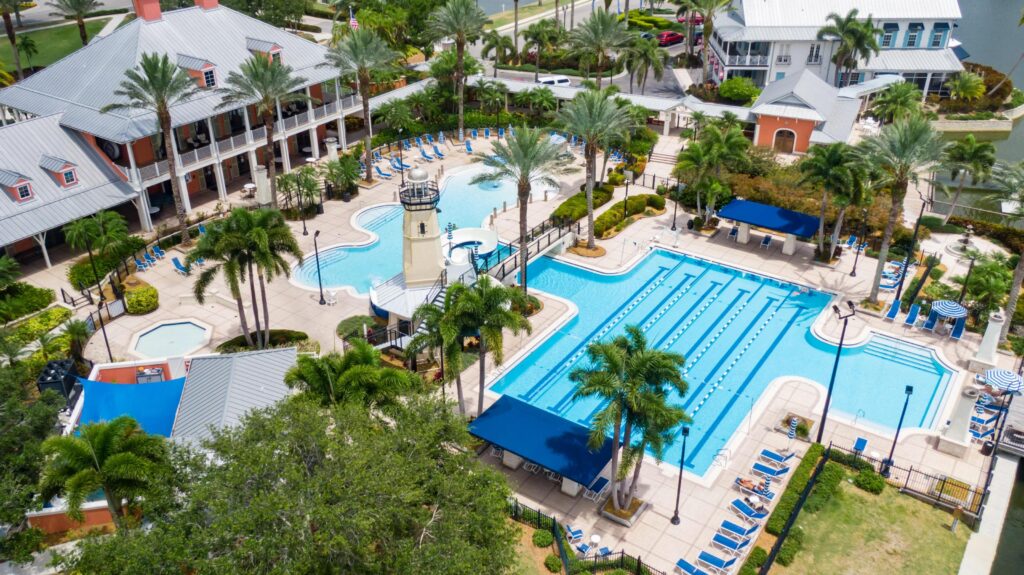
These communities aren’t interchangeable. Symphony Isles may appeal to a buyer seeking a guard-gated custom-home environment and deep-water options. MiraBay offers a larger coastal community with multiple home types, heated resort-style pools, a 24-hour fitness center, trails, courts, activities, and both waterfront and off-water properties. Caribbean Isles offers a gated 55-plus waterfront manufactured-home setting. Older canal areas may provide fewer association restrictions but more property-specific maintenance responsibility.
A buyer can fall in love with a house and discover too late that the boat doesn’t fit the lift, pass under a fixed bridge, turn comfortably in the canal, or maintain enough clearance at lower tides.
Bring these specifications before touring waterfront homes:
overall length;
beam;
draft;
height above the waterline, including antennas, towers, and hardtops;
approximate wet weight with fuel, water, equipment, and gear;
required lift capacity and bunk configuration;
shore-power and electrical needs;
preferred minimum depth and turning room.
Then compare the boat with the entire route, not only the water behind the property. Conditions can change with tides, sediment, weather, maintenance, and future improvements, so use qualified marine and permitting professionals when a conclusion matters to the purchase.
Should the dock and boat lift be inspected separately?
A dock and lift can add meaningful convenience and value, but age, condition, capacity, permits, electrical work, pilings, decking, hardware, and maintenance history matter.
Ask for available permits, invoices, warranties, engineering documents, and maintenance records. Confirm whether the configuration is legal for the parcel and whether a desired modification would be allowed. A lift label is helpful, but a marine contractor should evaluate whether the entire system is appropriate for the intended boat.
Pay special attention to waterfront electrical equipment. Shore power, lighting, and lift motors live in a wet, corrosive environment and should be evaluated by properly qualified professionals.
Why is the seawall part of the purchase?
The view may get the attention, but the seawall can carry one of the largest waterfront maintenance obligations. Buyers should ask about age, material, visible cracking, movement, cap condition, tie-backs, repairs, permits, neighboring walls, drainage, and who’s responsible for maintenance.
Some newer CDD communities may have district-owned or district-maintained seawalls or other waterfront infrastructure. That can be a meaningful ownership benefit, but responsibility must be verified through current district and property documents. Don’t assume the HOA, CDD, neighbor, or local government will cover a repair.
When replacement or major work may be needed, obtain a property-specific opinion and estimate. Waterfront construction cost depends heavily on access, engineering, permitting, wall type, length, soil, neighboring conditions, and the work required.
What should you ask about flood zone, elevation and insurance?
Water access and flood risk are related but not identical. A home west of US 41 is a practical visual cue that flood-zone due diligence is especially important, but it doesn’t establish the parcel’s official flood zone or insurance requirement.
Review the current FEMA map information, available elevation certificate, finished-floor elevation, claims history, drainage, roof and opening protection, and insurance options. Obtain property-specific insurance quotes during the inspection period. A neighbor’s premium may not predict yours because policy, coverage, elevation, construction, roof age, mitigation credits, claims, and underwriting can differ.
Direct Gulf access without a fixed bridge is what makes Apollo Beach a boater’s address rather than just a waterfront one.
What is daily boating life actually like?
The appeal of Apollo Beach isn’t only the route to open water. It’s the ability to build everyday life around the water. Residents fish from docks, paddle protected waterways, watch wildlife, visit waterfront restaurants, cruise Tampa Bay, and gather for community boating events.
Public natural areas add another side of coastal living. Hillsborough County describes the Apollo Beach Nature Preserve as a 63-acre habitat with fishing, bird watching, picnic areas, restrooms, and an observation tower. Tampa Electric’s seasonal Manatee Viewing Center gives residents and visitors another way to experience local wildlife.
Apollo Beach is a coastal community, but buyers expecting a traditional resort beach with long stretches of swimming sand should understand the local geography. The lifestyle is centered more on Tampa Bay, canals, boating, fishing, preserves, pools, and waterfront gathering places.
Boating Costs to Include in the Home Budget
dock, lift, seawall, and waterfront electrical maintenance;
boat insurance, registration, fuel, service, storage, and detailing;
bottom care and corrosion management when applicable;
HOA, condominium, CDD, marina, or slip fees;
flood and homeowners insurance;
storm preparation and post-storm inspection;
future permitting, engineering, or marine-contractor work.
A less expensive house can become the more expensive boating choice if the lift, route, dock, or seawall requires major work. Compare the complete setup.
Frequently Asked Questions
Does every Apollo Beach waterfront home have direct Tampa Bay access?
No. Some properties are on lakes, ponds, or non-navigable water. Saltwater routes can also have bridges, depth limitations, tides, locks, canal-width issues, or other restrictions.
Can I keep any size boat behind an Apollo Beach home?
No. The boat must fit the dock or lift and the full route. Verify length, beam, draft, height, weight, turning room, depth, and applicable rules.
Do I need to buy a waterfront home to enjoy boating?
No. Buyers can compare marinas, boat clubs, public launch options, dry storage, assigned slips, and off-water homes near the water. Availability and terms should be confirmed directly.
Is a newer seawall automatically problem-free?
No. Review permits, engineering, installation, drainage, visible condition, adjacent walls, warranties, and maintenance responsibility regardless of age.
What should I inspect before making a waterfront purchase?
Start with the Apollo Beach waterfront home buying guide, then use qualified home, marine, seawall, dock, electrical, insurance, survey, and permitting professionals as appropriate.
Find the Home That Fits Your Boat and Your Life
Shawna Calvert lives in MiraBay and specializes in Apollo Beach waterfront, boating, luxury, and relocation real estate. She helps buyers compare the house, boat route, elevation, seawall, dock, lift, insurance questions, community rules, and total ownership cost before making a decision.
Water access, depth, tides, routes, bridge clearances, community rules, marina availability, permits, insurance, flood information, and property conditions can change. Verify every material detail for the specific property and boat.