Every storm season I hear the same question once a storm starts heading our way: can I still get flood insurance? Usually the answer is yes, you can buy it, but it will not cover that storm. Here is why, and what to do while the skies are still clear. Have you looked at your own flood coverage this year?
How long does it take to get flood insurance in Florida?
A new policy through the National Flood Insurance Program typically has a 30 day waiting period before coverage takes effect, according to FloodSmart, the program’s official site. That means a policy bought when a storm is already in the forecast will not help with that storm. Private flood insurers set their own waiting periods, and many insurers stop writing new policies in an area once a storm is threatening.
What is the mandatory waiting period before flood coverage becomes active?
For the NFIP, it is generally 30 days. There are a few exceptions. Coverage can start right away when the policy is required as part of making, increasing, extending or renewing a mortgage loan. A one day wait can apply when a home is newly mapped into a high risk flood zone and the policy is bought within 13 months of that map change. Some renewals and policy transfers also avoid the wait. Your insurance agent can tell you which applies to you.
Can I buy flood insurance before a hurricane?
Yes, and the earlier the better. The best time is the start of the year or right after you close on a home, well before June 1. Keep in mind that standard homeowners policies do not cover flood from storm surge or rising water, so flood coverage is a separate policy.
Find your flood policy, check the effective date and coverage limits, and write the policy number on the storm card in my Apollo Beach Hurricane Prep Kit. If you do not have a policy, call your agent now so the 30 days are behind you before the next storm.
If you have questions about your home, your dock or your flood picture, call or text me at 509-294-6818 or email shawna@27northrealty.com. I am Shawna Calvert with 27North Realty, the #1 agent in Apollo Beach by total sales volume in Stellar MLS from January 2025 through August 2026.
This is general information, not insurance, legal or emergency management advice. Always follow official orders from Hillsborough County and the National Hurricane Center.
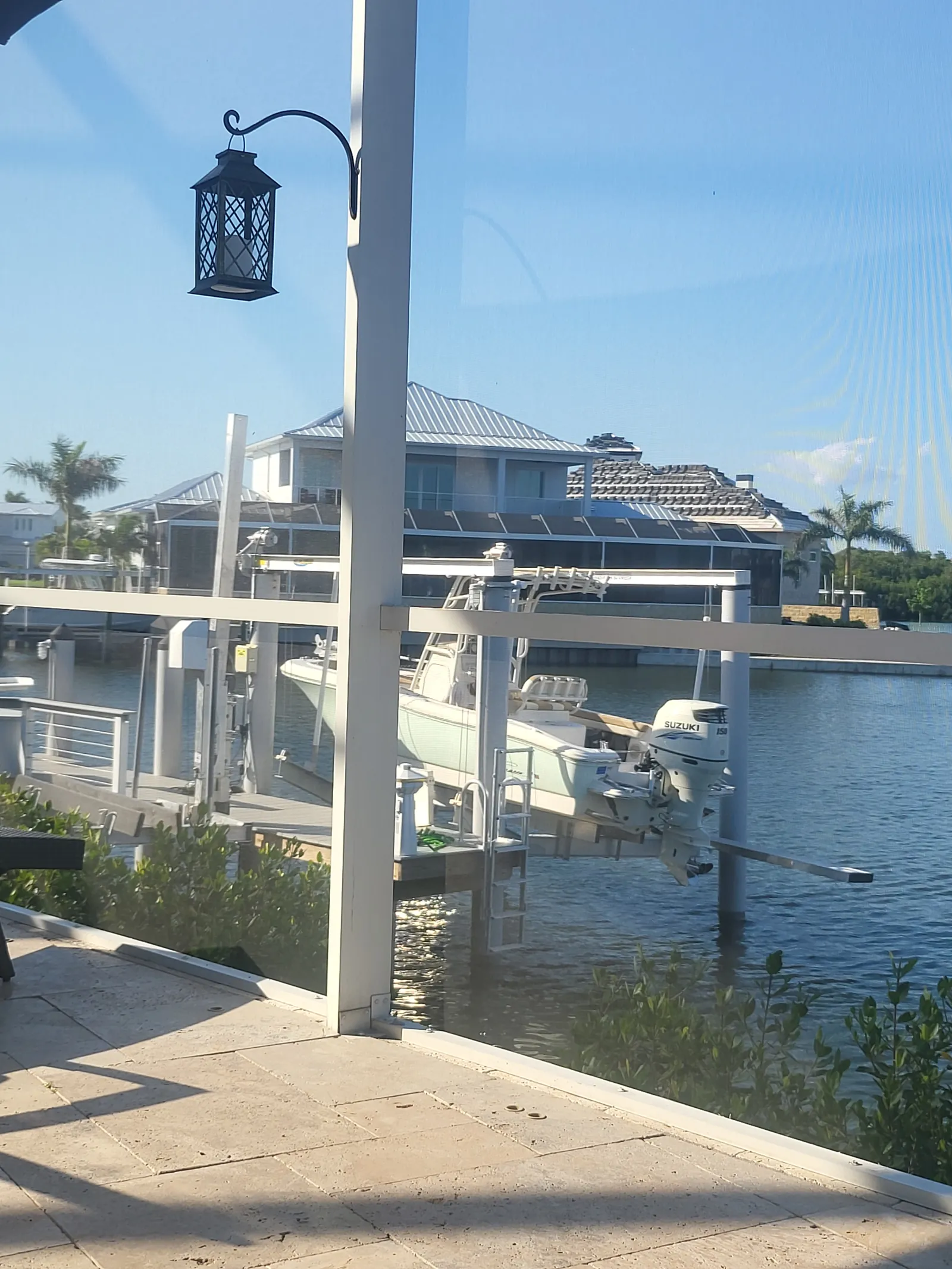
For a lot of us, the boat is the reason we chose Apollo Beach. So when a storm shows up in the forecast, the boat plan is usually the first thing on our minds. Is yours on a lift behind the house, or does it live at a local marina? Either way, the best time to make the plan is before the season gets busy.
How do you prepare your boat for a hurricane?
Start with the decision that has the longest lead time: will you haul out? Getting the boat out of the water and secured on land is usually the safest choice, but haul out and dry storage spots fill quickly once a storm is in the forecast cone. Call your marina or boatyard early in the season, ask about their hurricane plan, and get on their list. Ask your boat insurer whether your policy helps pay for a named storm haul out and what they expect you to do.
Should I leave my boat on the lift during a hurricane?
It is a common choice in our canal neighborhoods, but it carries real risk. Storm surge can raise the water high enough to float a boat off its cradle, and high wind can work a boat loose on the lift. If the boat has to stay, talk with your insurer and lift installer about how it should be secured on your specific lift, strip off canvas, biminis and anything that catches wind, and keep up with the lift’s maintenance before the season. If you can move it to land, that is usually the better option.
How do you secure a boat that stays in the water?
Double your dock lines and use longer lines that give the boat room to rise with surge, add chafe protection where lines cross cleats and pilings, and set extra fenders. Remove canvas, electronics, cushions and loose gear. Make sure batteries are charged and bilge pumps work. Take photos of the boat and the setup for insurance, and keep the hull ID and policy number on your storm card.
Bring in or tie down everything on the dock, including chairs, kayaks, grills and dock boxes. Turn off power to the lift and dock at the breaker. Note any loose boards, cracked pilings or seawall gaps before the season and get them repaired, because small problems get bigger in surge. After the storm, stay off the dock until you can see it is solid and the power is off.
What should you do after the storm?
Wait for the all clear, then photograph the boat, lift, dock and seawall before you touch anything. Call your insurer, make only the repairs needed to prevent more damage, and keep every receipt. My Apollo Beach Hurricane Prep Kit has a full before, during and after checklist, and the Waterfront Home Checklist covers docks, lifts and seawalls when you are buying or selling.
If you have questions about your home, your dock or your flood picture, call or text me at 509-294-6818 or email shawna@27northrealty.com. I am Shawna Calvert with 27North Realty, the #1 agent in Apollo Beach by total sales volume in Stellar MLS from January 2025 through August 2026.
This is general information, not insurance, legal or emergency management advice. Always follow official orders from Hillsborough County and the National Hurricane Center.
If you have lived in Apollo Beach for a while, you probably remember your evacuation zone the way you remember your zip code. This year it is worth looking again. In May 2026, Hillsborough County updated its hurricane evacuation zones, and some Apollo Beach neighborhoods landed in a different zone than they were in before. Do you know which zone your home is in today?
What changed in Hillsborough County evacuation zones?
The county redrew its zones using updated storm surge modeling from NOAA, announced in May 2026. Local coverage from FOX 13 named Apollo Beach among the areas where Zone A expanded, and inland parts of Apollo Beach south of Big Bend Road were added to Zone E. The update came from new surge data, not from damage in any single storm, and the county has not published a count of how many homes changed zones. The only way to know about your home is to look up your address.
How do you know what evacuation zone you are in?
Go to HCFL.gov/HEAT, the Hurricane Evacuation Assessment Tool, and type in your address. It shows your zone and the nearest shelters. While you are there, sign up for county alerts at HCFL.gov/Alert so evacuation orders come straight to your phone. Then write your zone on the storm card in my free Hurricane Prep Kit so everyone in your house knows it.
What is the difference between an evacuation zone and a flood zone?
They answer two different questions. Your evacuation zone tells you when the county may ask you to leave because of storm surge. Your FEMA flood zone is used for flood insurance and building rules. A home can be in Zone A for evacuation and still have a moderate risk flood zone, or the other way around. My page Is Apollo Beach in a Flood Zone? explains how to read your flood map.
Where are hurricane shelters near Apollo Beach?
Shelters open only when the county announces them, and the list changes with each storm. During Hurricane Milton in October 2024, Shields Middle School in Ruskin opened as a pet friendly shelter, along with others around the county. Check county alerts for which shelters are open before you head out, and plan for a friend or family member’s home outside the surge zone as your first choice.
Does a zone change affect buying or selling a home?
It is one more thing buyers ask about, especially folks relocating from out of state. A zone change does not change the house, but it may change your plan for storm season. When I work with buyers, we look up the evacuation zone and the flood zone together so there are no surprises. For the full checklist, see my Apollo Beach Hurricane Prep Kit and the 2026 Hurricane Preparedness Guide.
If you have questions about your home, your dock or your flood picture, call or text me at 509-294-6818 or email shawna@27northrealty.com. I am Shawna Calvert with 27North Realty, the #1 agent in Apollo Beach by total sales volume in Stellar MLS from January 2025 through August 2026.
This is general information, not insurance, legal or emergency management advice. Always follow official orders from Hillsborough County and the National Hurricane Center.
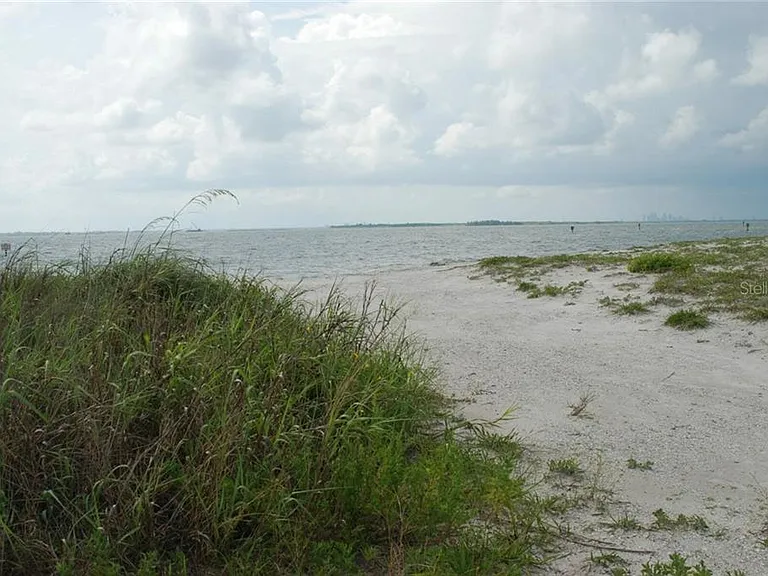
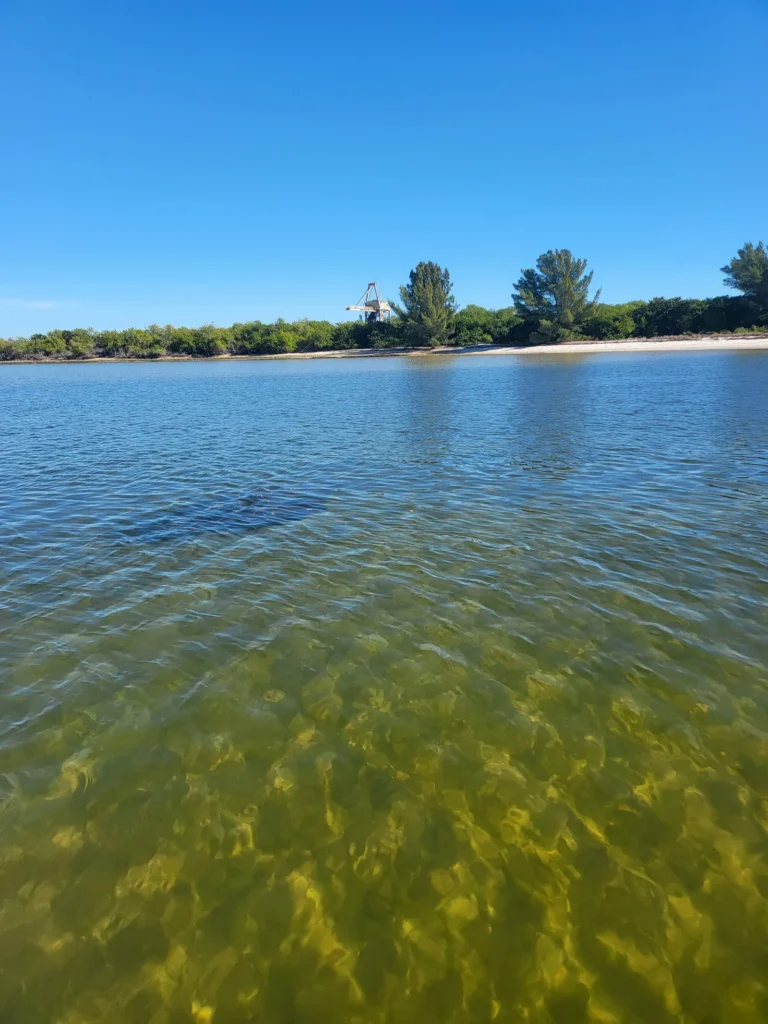
The shoreline at the Apollo Beach Nature Preserve.
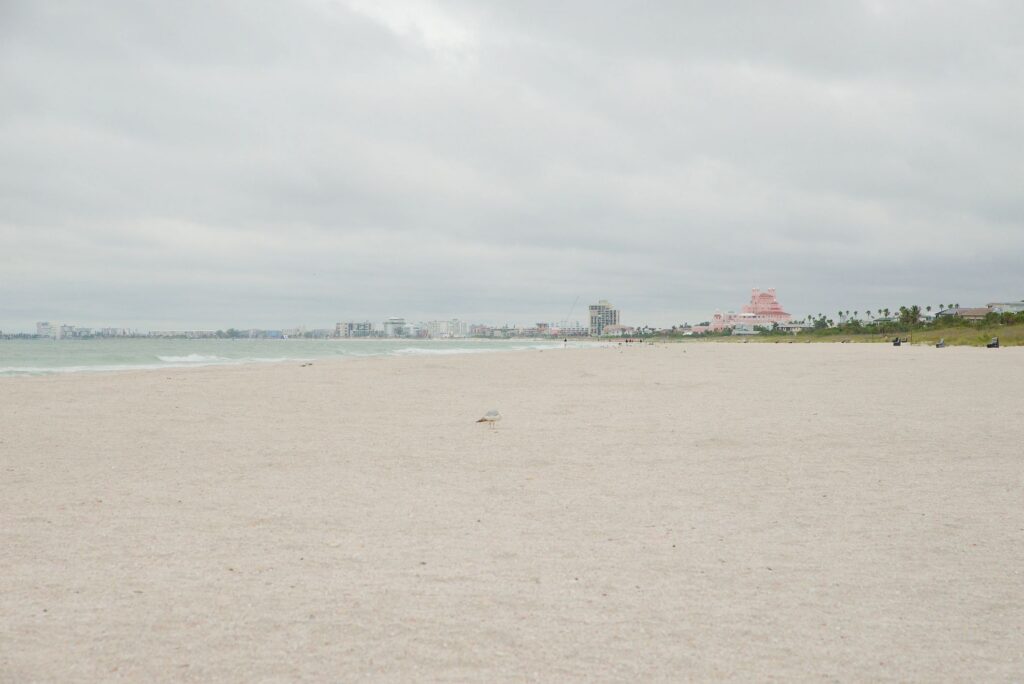
Yes, there is, and it’s beautiful. It’s one of the first things people ask me when they’re thinking about moving here, usually right after “Can you swim there?” The honest answer is that you can’t swim at our beach. You can walk it, bring your dog, hunt for shells and watch some of the best sunsets on Tampa Bay. Here’s what our beach is really like, where locals get in the water instead, and the world-famous beaches that are an easy day trip away.
What is the beach in Apollo Beach like?
Our beach is part of the Apollo Beach Nature Preserve at the end of Surfside Boulevard. It’s a 63-acre county preserve with a stretch of soft, white sand right on Tampa Bay. It’s the kind of place you go for a long walk at the end of the day, with your shoes in your hand.
You can walk the shoreline, go shelling, fish, picnic under the pavilion and bring your dog. Dogs are welcome on the beach, which surprises a lot of people. Behind the beach, walking trails wind through restored wetlands, and it’s a great spot for birding.
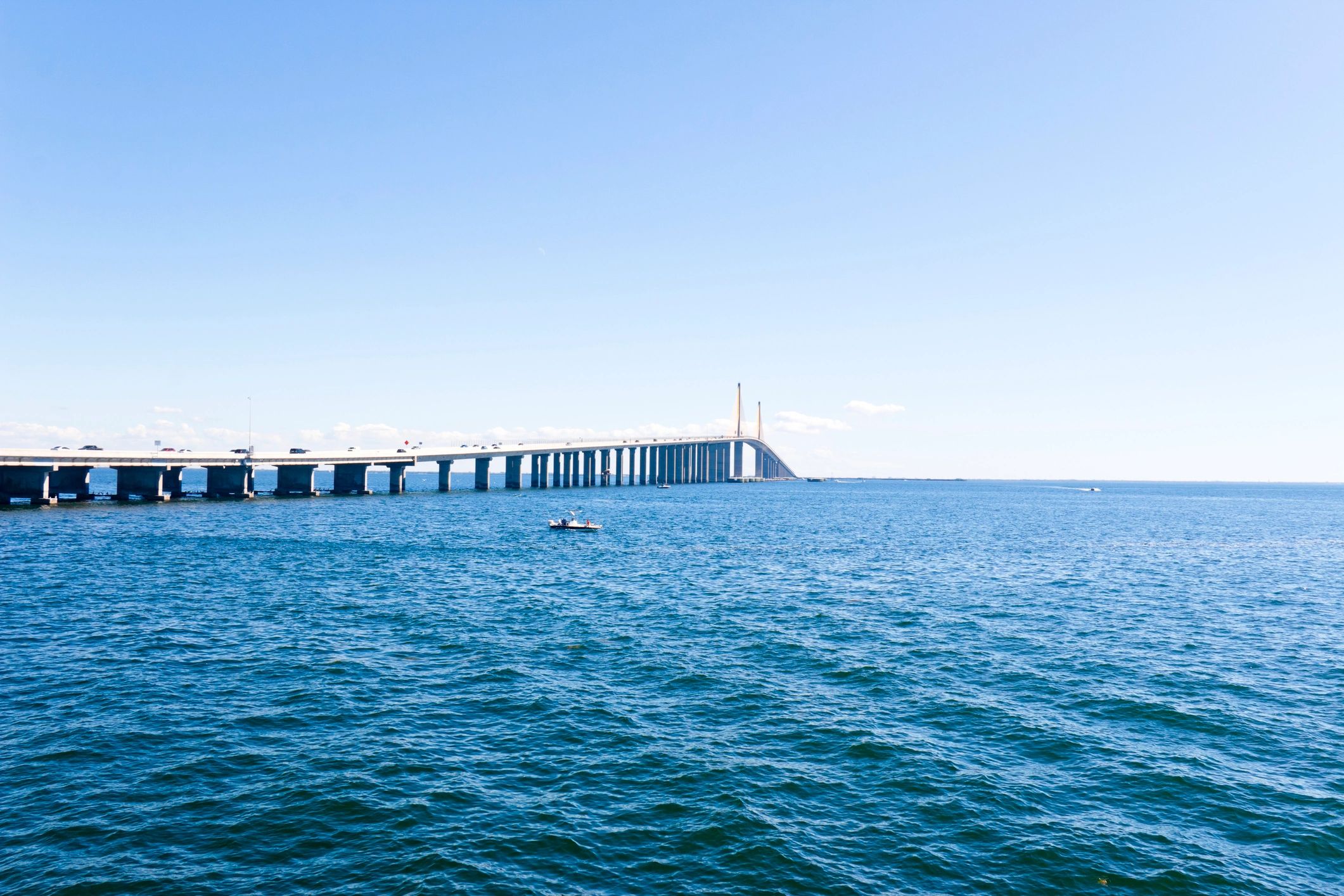
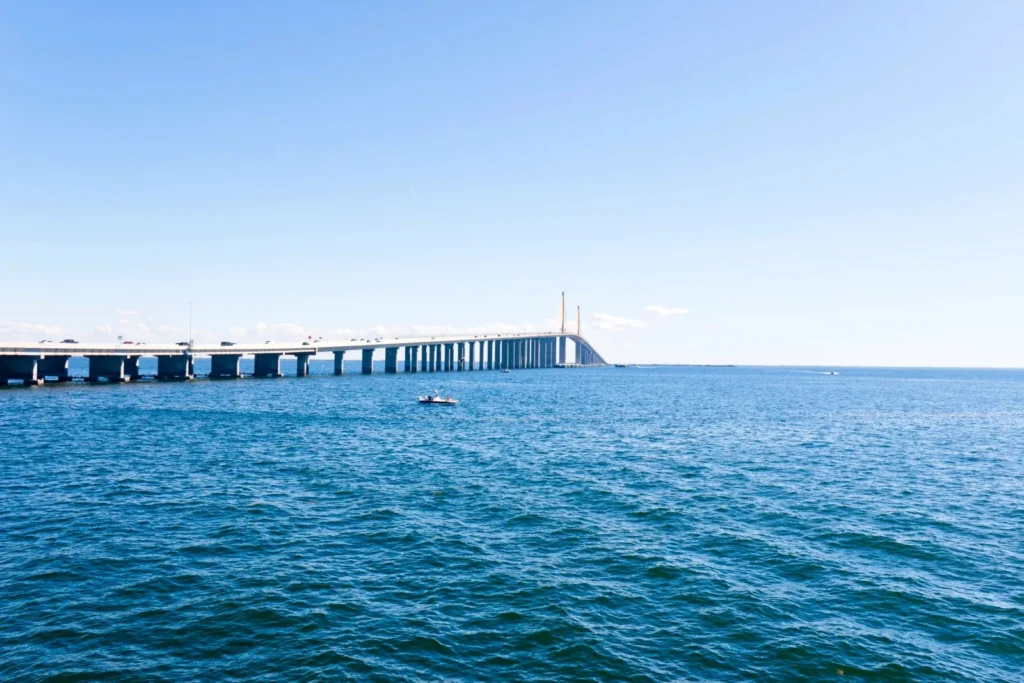
The best part is the view. From the preserve’s 37-foot observation tower you can see the Tampa skyline, St. Petersburg across the bay, and the Sunshine Skyway Bridge stretching out to the south. The tower has a ramp instead of stairs, so almost anyone can get to the top. The preserve is open every day from 8 a.m. until sunset.
Why can’t you swim at the Apollo Beach Nature Preserve?
The water looks calm, and that’s what makes it dangerous. Just offshore the bottom drops off suddenly, and there are strong currents under the surface that you can’t see from the sand. The county posts the beach as no swimming and no wading, and it means it.
Tragically, we learned this the hard way. In June 2021, three lives were lost here: a father, his young son, and a man who went into the water to try to save them. The county added more warning signs afterward. So please enjoy the sand, the sunset and the shelling, and stay out of the water.
What else is near the beach?
Manatees gathered at the Manatee Viewing Center in Apollo Beach.
Just down the road is the TECO Manatee Viewing Center, and if you’re new to the area it’s a must. In the cooler months, hundreds of manatees gather in the warm water coming off the power plant. You watch them from a long boardwalk, and on a cold morning the water can be packed with them.
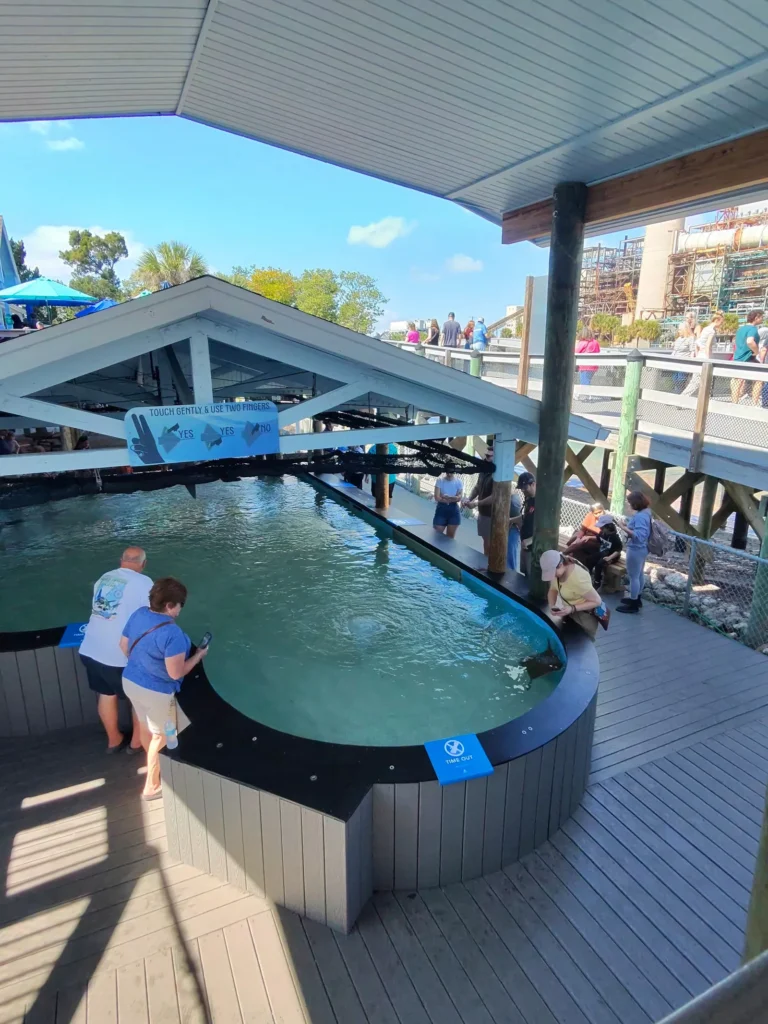
The Manatee Viewing Center is open daily from November 1 through April 15, from 10 a.m. to 5 p.m. Parking and admission are free. It has its own 50-foot observation tower along a coastal trail, so between the preserve and the Manatee Viewing Center we have two viewing towers looking out over the bay. There’s also a stingray touch tank the kids love, and a little café.
Where can you swim near Apollo Beach?
We have options close to home.
E.G. Simmons Conservation Park in Ruskin has about 700 feet of beach on Tampa Bay with a designated swimming area. It also has picnic shelters, a playground, a boat ramp, kayaking and camping, and entry is $2 per car. The county sometimes closes the beach to swimming when water testing shows high bacteria, so check the county’s beach advisories before you pack the car.
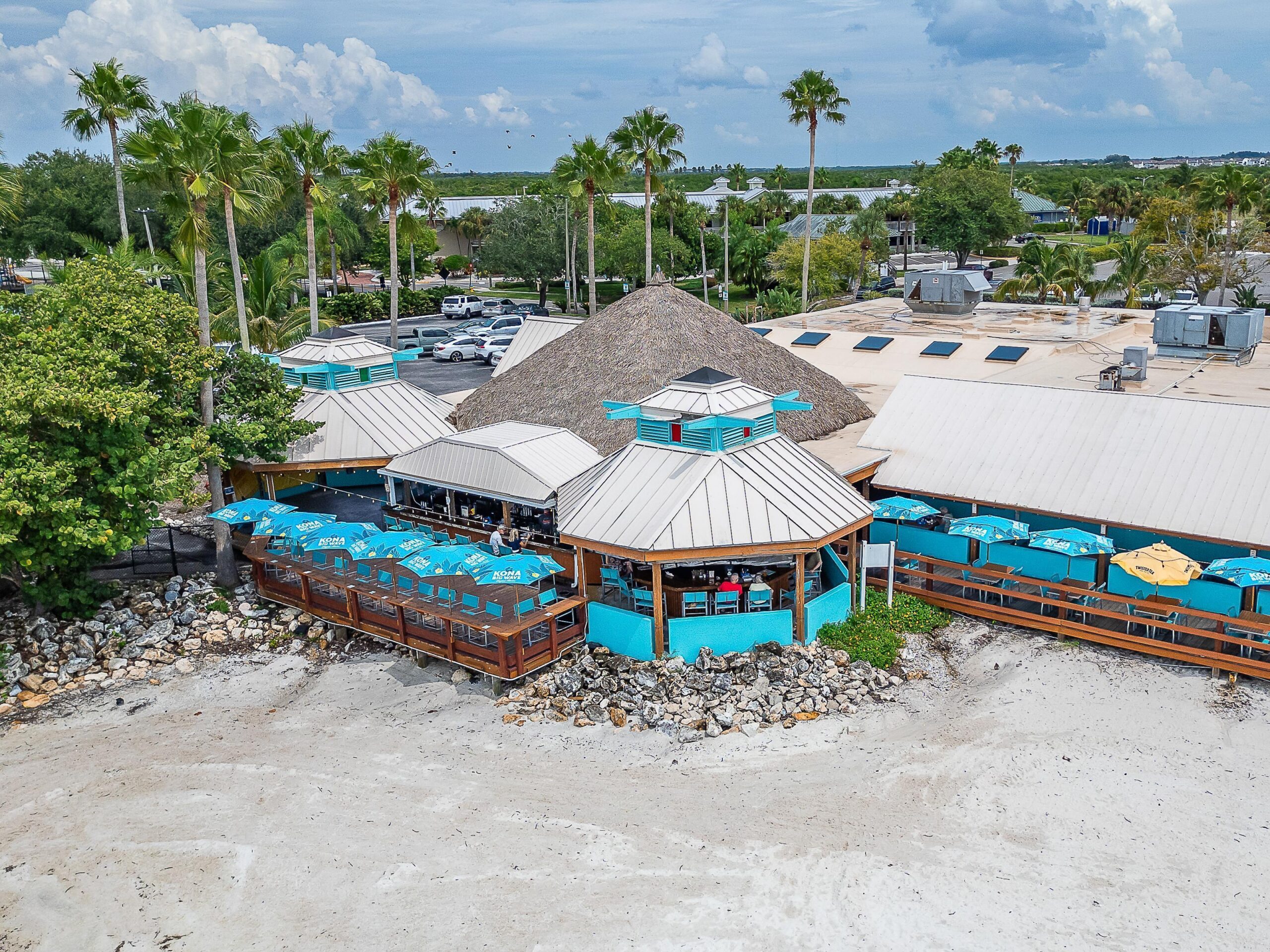
Little Harbor in Ruskin has a beach right on the bay by the Sunset Grill, with a long dock for watching the sun go down over St. Pete and live music at night. It’s one of my favorite spots. Just know the beach lots there are paid parking now, with free parking for restaurant guests.
The beach and Sunset Grill at Little Harbor in Ruskin.
And here’s something that makes one of our neighborhoods truly special. Symphony Isles is the only community in Apollo Beach with its own private beach you can swim in. It’s for residents, right on Tampa Bay, and it’s a really neat perk. If a swimmable beach right outside your front door is on your wish list, that’s the community I’d show you first.
How far is Apollo Beach from the Gulf beaches?
This is one of my favorite things to tell people. You live on the quiet side of the bay, and some of the most famous beaches in the country are a short drive away when you want to make a whole day of it.
Fort De Soto Park, about 45 minutes away across the Skyway, has wide, natural beaches, calm water on the bay side and a historic fort to explore. It’s often named one of the best beaches in America.
St. Pete Beach, about 45 minutes away, has the big, lively Gulf beach, with beach bars, restaurants and hotels.
Anna Maria Island, about 50 minutes south, feels like old Florida: small cottages, a trolley, a pier and a slower pace.
Siesta Key, about an hour south, is famous for its powdery white sand. It’s so fine it stays cool under your feet even in summer.
Caspersen Beach in Venice, a little over an hour south, is where you go to hunt for shark teeth. Venice calls itself the Shark Tooth Capital of the World. Fossilized teeth wash up along the shoreline, and every once in a while someone finds a piece of a megalodon tooth. Bring a sifter (locals call it a Florida snow shovel) and plan to lose track of time. It’s a wonderful day with the grandkids.
So is Apollo Beach a beach town?
It is, just not the way people picture it. We’re a boating town first, with canals, docks and the whole bay right out the back door. Our own beach is for walks, dogs, shells and sunsets, and the swimming beaches are close by. If you’re still getting to know the area, my Apollo Beach guide and neighborhood guide are good places to start.
I’d love to know how you picture your days here. Are you the early-morning beach walk with the dog type, or do you see yourself packing up the boat and heading out to a sandbar for the whole afternoon? Tell me, and I’ll show you the neighborhoods that fit.
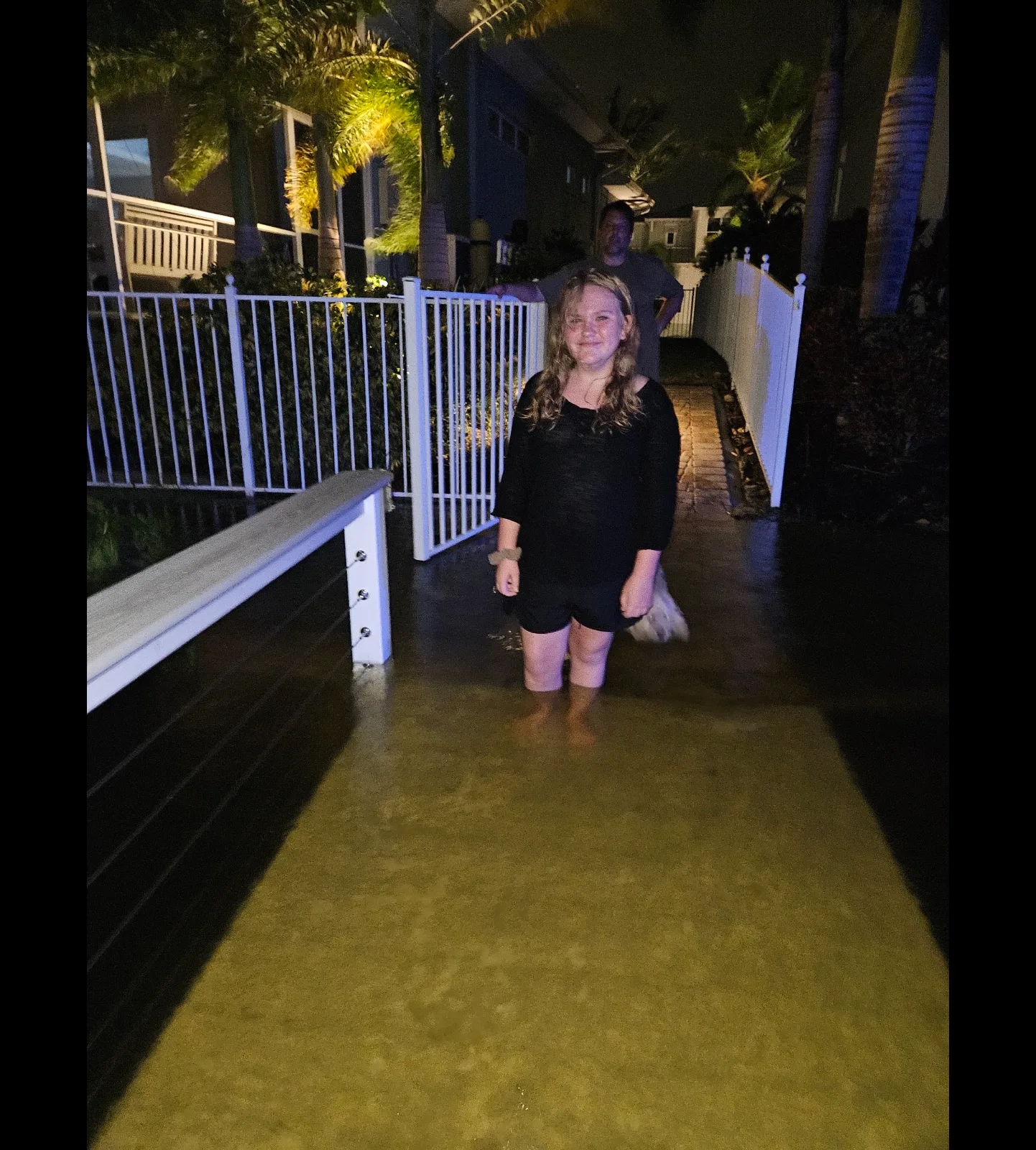
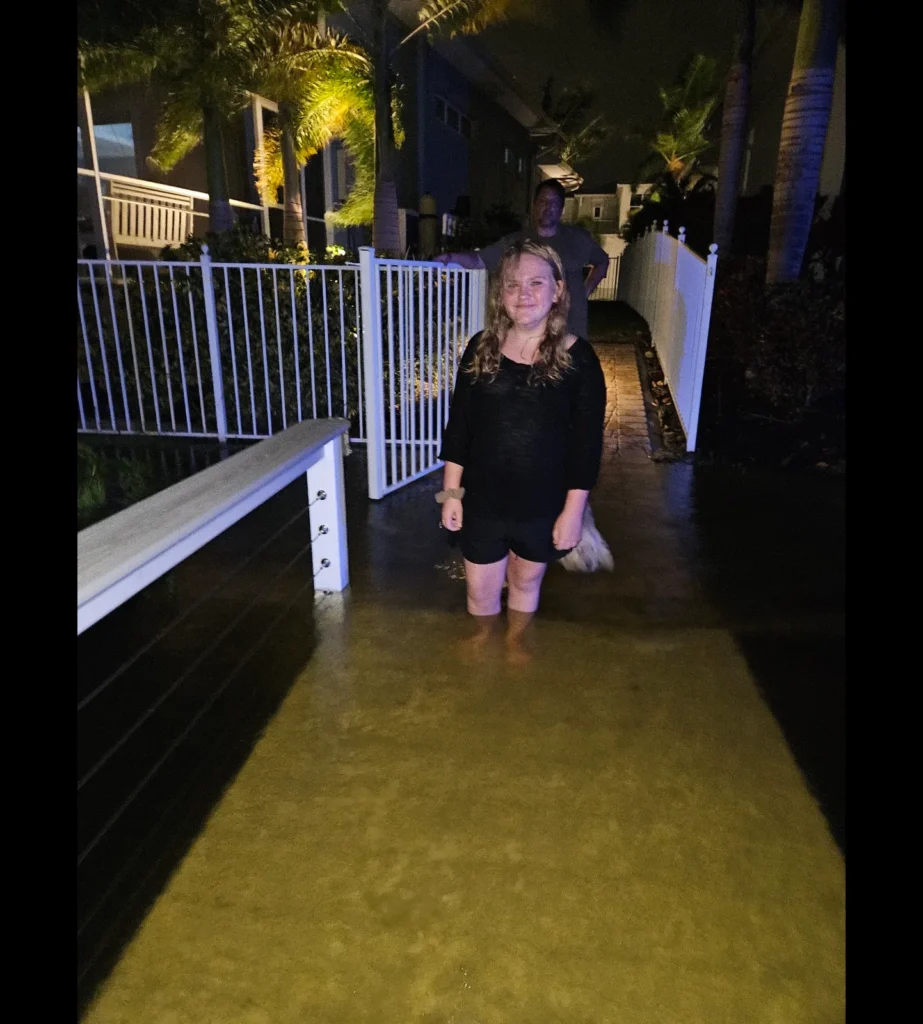
The night Helene came through, the surge came right up over our dock. That is Sophia standing in it. And the question I get more than any other from buyers moving here is the one that picture raises: “Is Apollo Beach in a flood zone?”
It is a fair question, and I love answering it, because the honest answer is more helpful than people expect.
Is Apollo Beach in a flood zone?
Parts of it are. Here is the rule I give everyone. Stand on US Highway 41 and look west, toward the water. That side is in a flood zone, so plan on flood insurance. Look east, and you are generally out of one. A couple of streets and a few communities east of 41 are still mapped Zone AE, and most of the rest is Zone X. That one rule tells you most of what you need to know.
What did Helene actually do here?
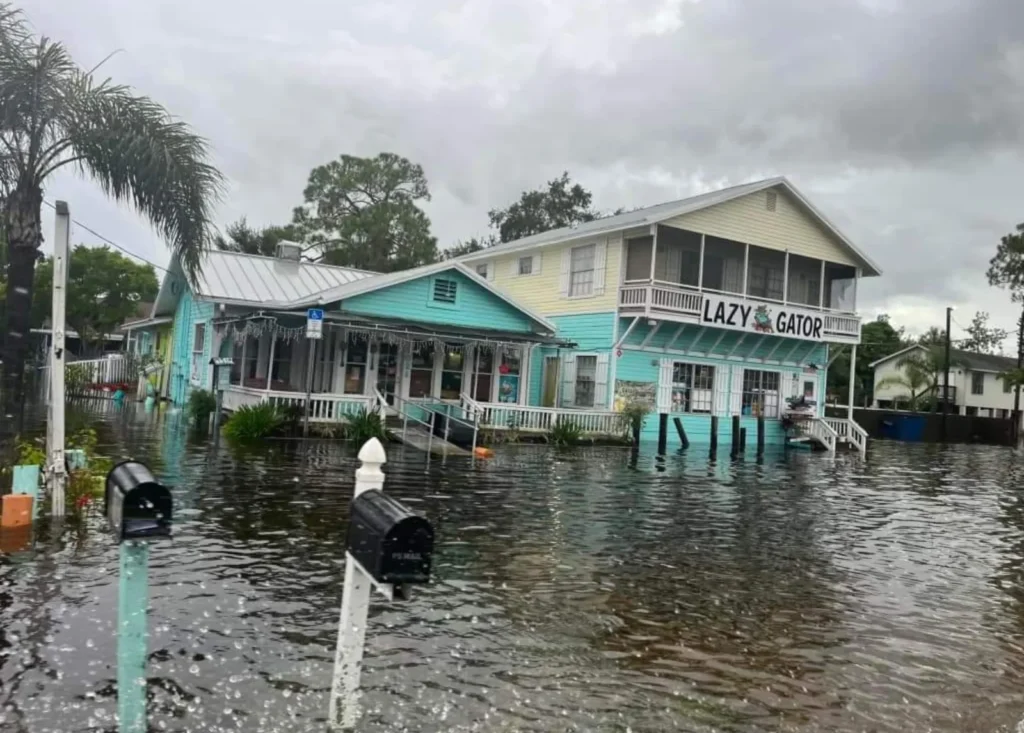
Older waterfront homes surrounded by storm surge.
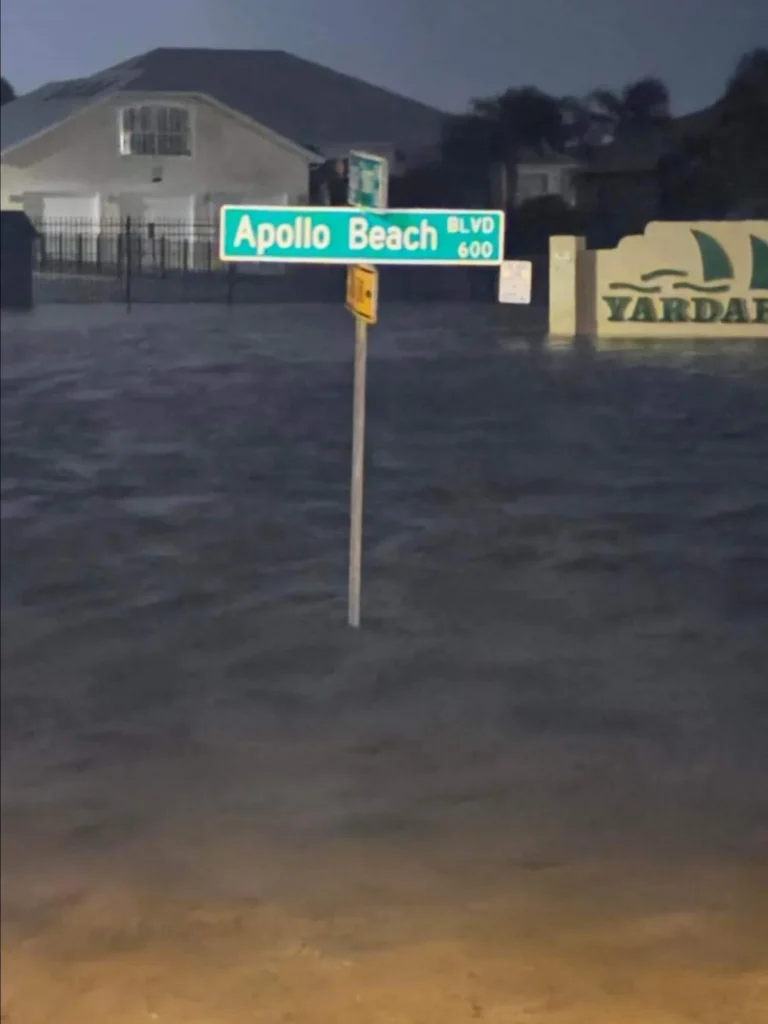
Helene’s surge came in at 4 to 6 feet at most, and really closer to 4. It was devastating for the older, lower parts of Apollo Beach. Streets like Apollo Beach Blvd sat under water, and afterward the curbs in those neighborhoods filled up with drywall and flooring.
Apollo Beach Blvd under water.
The communities built after 2000 were a different story. They sit at about 10 feet, and they were not impacted. You barely feel the hill when you drive between the two, but it is about six feet, and it made all the difference.
Why does elevation matter so much?
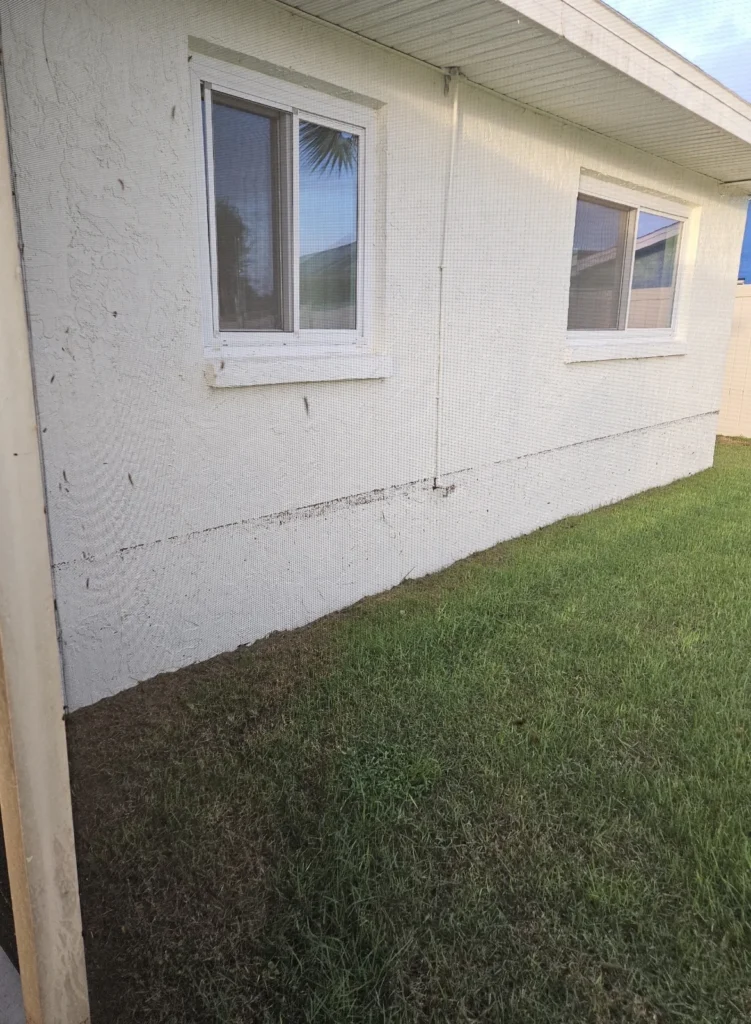
A flood water line on an older, lower home.
The original Apollo Beach was built where it landed, at roughly 1, 2 and 4 to 6 feet above sea level. The communities built from about 2000 on were raised to about 10 feet. That one difference is why two homes a few streets apart can both be in a flood zone and still be completely different to own and to insure. Since the 2002 Florida Building Code, new coastal homes need impact rated windows and doors or approved shutters, and either one helps your premium too.
So being in a flood zone is usually not the deal breaker people fear. What you want to know is how high the house sits, when it was built, and what the elevation certificate says.
What should you check before you make an offer?
Is flood insurance required by your lender, and what does the seller pay now?
Is there an elevation certificate? It is often the single most useful document for pricing flood insurance.
Has the home had any flood claims or storm damage?
Does it have impact windows and doors, or shutters?
Which evacuation zone is it in, and what is your route out to 41? Hillsborough County updated the zones for 2026, so check even if you looked last year.
Get the free Apollo Beach Flood Zone Guide
I put everything I tell buyers into one free guide: the US 41 rule, how elevation and the year a home was built affect your insurance, what Helene did here, my hurricane prep checklist and the new 2026 Hillsborough County evacuation zone map.
And if there is an address you are curious about, send it to me. I will pull the flood zone, the elevation and the insurance picture for you. I would love to hear what you are picturing, too. Is it a boat in the backyard, or a pool on a quieter street a little closer to 41?
If you are trying to determine whether you can afford a home in Apollo Beach, the mortgage payment is only the starting point.
The real cost depends on the home itself, its flood exposure, the age of the roof and major systems, whether it is in an HOA or Community Development District, whether it has a pool, and whether it sits on the water. Your cars, storage habits, landscaping expectations, and boating lifestyle matter too.
This is why two Apollo Beach homes with the same price can have very different monthly carrying costs. One may have newer construction, a CDD, lower routine maintenance, and resort-style amenities. Another may have no CDD but require more private upkeep. A waterfront property may offer an incredible boating lifestyle while adding flood coverage, seawall, dock, lift, mangrove, and boat-maintenance expenses.
The goal is not to make Apollo Beach sound expensive. It is to help you compare homes based on the complete lifestyle and budget instead of the list price alone.
The short answer: What should you include in an Apollo Beach housing budget?
In addition to principal and interest, plan for:
Property taxes based on what you are likely to pay after the purchase
Homeowners insurance
Flood insurance when required or advisable
HOA dues and CDD assessments
Electricity, water, sewer, trash, internet, and irrigation
Air-conditioning service and Florida-specific home maintenance
Lawn, fertilizer, pest, pool, and landscaping services
Roof, exterior, window, and storm-protection reserves
Waterfront expenses such as seawall, dock, lift, mangrove, boat, and fuel costs
Automobile insurance, which tends to cost more in Florida
Storage and lifestyle adjustments that many people overlook before moving south
The correct total is property-specific. Never rely only on a listing portal’s estimated payment, the seller’s current tax bill, or a generic online insurance average.
Property taxes: Do not budget from the seller’s current bill
This is one of the biggest surprises for buyers moving to Florida.
A longtime Apollo Beach owner may have a much lower tax bill than a buyer will have after purchasing the same home. Florida’s Save Our Homes benefit limits annual increases in the assessed value of a homesteaded property to the lower of 3% or the change in the Consumer Price Index. It does not freeze the tax bill, and it does not cap the tax rate itself.
When ownership changes, the property’s capped assessment generally resets to market value as of the following January 1. The new owner may then apply for homestead exemption, and eligible Florida homeowners may be able to transfer, or “port,” part of their Save Our Homes benefit from a prior Florida homestead.
That explains why two similar homes on the same street can show very different tax bills. The owner with the lower bill may simply have owned and homesteaded the property for many years. That low assessment does not automatically transfer to the buyer.
The Hillsborough County Property Appraiser specifically warns that a change in ownership resets assessed value to full market value. Before making an offer, estimate taxes using the expected purchase price, intended exemptions, and any portability benefit rather than copying the seller’s current payment.
CDD and HOA fees: Why an amenity-rich community may have a low HOA
An HOA is a private association that enforces community rules and pays for the services assigned to it. A CDD is a special-purpose unit of local government that can finance, operate, and maintain community infrastructure and amenities. CDD assessments generally appear as non-ad valorem charges on the annual property-tax bill.
In many local master-planned communities, the CDD carries much of the cost of infrastructure and major amenities. That is one reason a community can have an extensive amenity package and still charge a comparatively modest HOA fee. The CDD is not “free,” of course. Part of the community cost has simply moved to the tax bill.
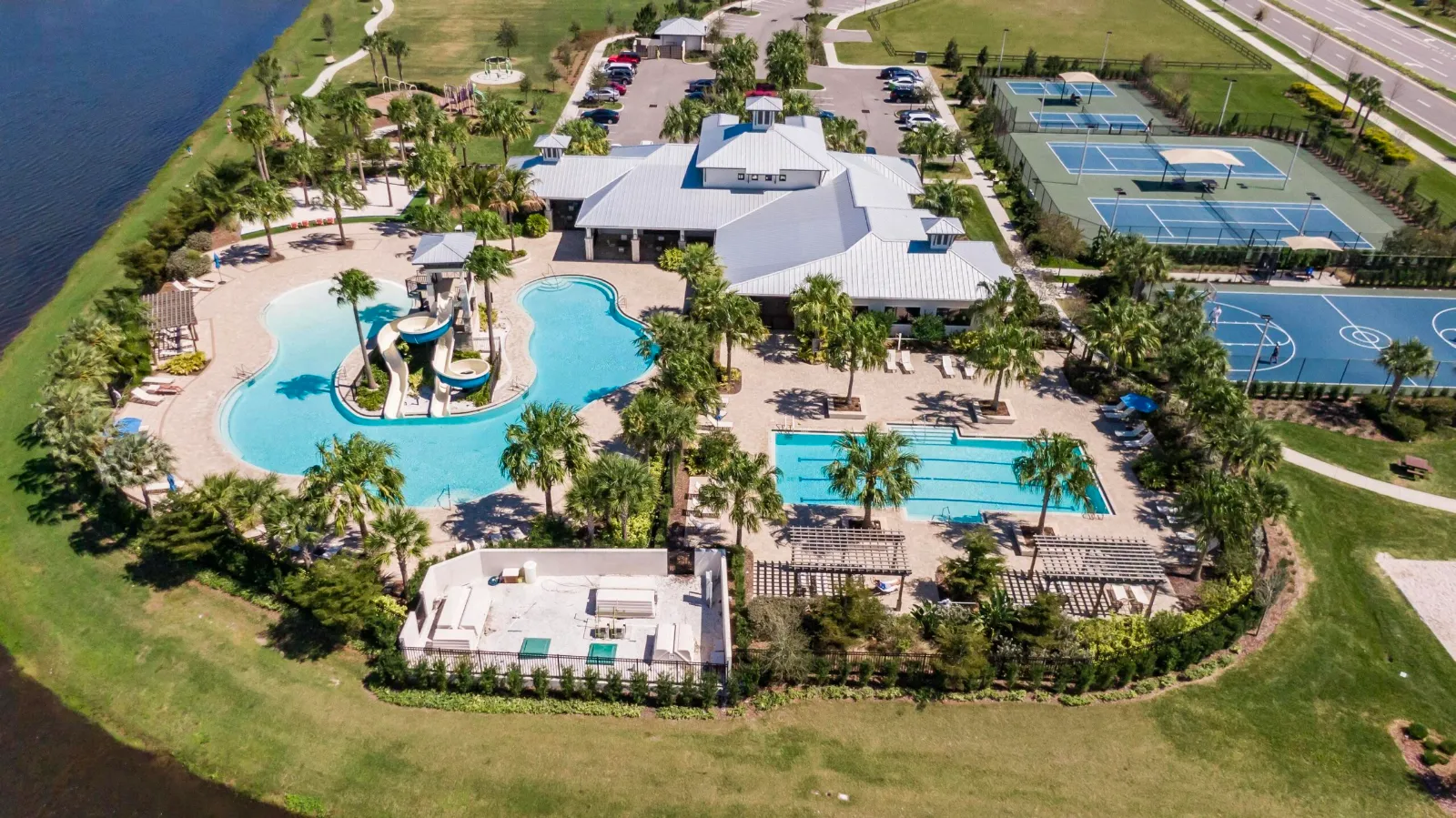
Waterset is a useful local example. The community’s own published FAQ states that it has three CDDs, a comparatively low annual HOA fee, and CDD charges that vary by home type and lot size. The community includes the kind of amenities buyers often describe as resort-style.
Here is the insider detail many buyers miss: CDD assessments are commonly allocated by a property’s assessment category, which may reflect lot width, lot size, home type, or an equivalent residential unit. They are not normally calculated as a percentage of the home’s resale price. The exact method is district-specific, so “CDD is always based on lot size” is too broad for every Florida district. In Waterset, however, home type and lot size are expressly part of the current published structure.
A larger lot or different product type can therefore carry a different CDD assessment even within the same overall community. Before comparing two homes, check the actual tax bill, identify the correct CDD, and review the district’s current assessment chart. Waterset, for example, has separate district sites and publishes adopted budgets and assessment schedules.
Also separate the CDD’s two basic cost concepts:
Debt service: Repayment of bonds used to build qualifying infrastructure
Operations and maintenance: The annual cost of operating and maintaining district facilities and services
Debt service may eventually end according to the applicable bond schedule. Operations and maintenance can continue and may change with the district budget.
Homeowners insurance: The address matters more than the average
Florida homeowners insurance can be a meaningful part of the monthly payment, but a statewide average is not a reliable quote for an Apollo Beach property.
Insurers may consider the home’s replacement cost, roof age and material, wind-mitigation features, opening protection, age and condition of electrical, plumbing, HVAC, and water-heater systems, prior claims, occupancy, and distance from the coast. A four-point inspection or wind-mitigation inspection may materially affect eligibility or premium.
The practical rule is simple: obtain a real insurance quote for the exact address before the inspection or insurance contingency expires. If the roof is older, request quotes immediately. Do not wait until the week of closing to discover that a carrier will not accept the roof or that the premium changes the debt-to-income calculation.
Impact windows, qualified shutters, roof-to-wall attachments, and other wind-mitigation features may help, but the credit depends on what an inspection documents and what the insurer recognizes.
Flood insurance: An assumable policy may be valuable, but verify the details
Flood insurance is separate from standard homeowners insurance. Whether it is required by a lender depends in part on the flood zone and loan, but a property can experience flooding outside a high-risk flood zone. Buyers should evaluate the home’s elevation, flood zone, flood history, prior claims, foundation, and storm-surge exposure even when a lender does not require coverage.
One of the most valuable and least understood opportunities is the possible assignment of an existing National Flood Insurance Program policy when title transfers. FEMA’s NFIP terminology recognizes written assignment of a policy when title transfers, subject to program rules and exceptions. FloodSmart guidance for insurance professionals also explains that building coverage may be transferred to a buyer, while the seller’s contents coverage does not transfer.
Why can that matter? Under FEMA’s risk-based pricing transition, an existing policy may still be moving gradually toward its full-risk premium. Statutory limits generally restrict how much many NFIP premiums can increase in a single year. If the policy is eligible for assignment, the buyer may be able to continue that policy’s existing transition path instead of immediately starting with a new policy at the current full-risk amount. On the right property, the difference can be meaningful.
However, buyers should not assume that every flood policy transfers or that a seller’s low premium is guaranteed to remain unchanged. Private flood policies follow their own contracts. NFIP policy assignment, coverage limits, elevation information, claims history, lender requirements, and future premium path must be confirmed in writing with the insurance agent or carrier.
Before relying on an existing policy, ask for:
The current declarations page
Confirmation of whether the policy is NFIP or private
Written confirmation that the policy can be assigned
The current premium and renewal date
Building and contents coverage details
Deductibles
Claims history and available flood-loss information
The elevation certificate, if available
A projection of the buyer’s premium after assignment
A separate new-policy quote for comparison
Do this before the offer or during the inspection period. An older, favorably transitioning NFIP policy may be an asset, but only after it is verified.
Car insurance belongs in the relocation budget too
Buyers often price the house, taxes, and homeowners insurance but forget to re-quote their automobiles before moving to Florida.
Florida vehicle coverage can be substantially different from what a household paid in another state. The Florida Legislature’s 2025 insurance analysis reported that Florida had the country’s highest average annual cost for minimum motor-vehicle coverage at the time, citing an average of $1,529 per vehicle. More recent marketplace data published by Experian in September 2026 estimated average Florida full coverage at approximately $2,738 per year, or $228 per month, although the actual cost varies widely by driver, vehicle, ZIP code, limits, deductibles, mileage, and claims history.
There has been some improvement. The Florida Office of Insurance Regulation reported that the state’s five largest auto-insurance groups indicated an average rate change of negative 6.5% for 2025 after much larger increases in earlier years. Even so, “rates are improving” does not mean your Florida quote will match what you currently pay elsewhere.
Get an Apollo Beach quote for every household vehicle before finalizing the relocation budget. Match the same liability limits and deductibles for a fair comparison.
Electricity, air conditioning, water, and irrigation
Air conditioning is not a seasonal luxury here. It is part of everyday home operation for much of the year, and it also helps control indoor humidity.
Electric costs vary with square footage, ceiling height, insulation, window exposure, thermostat preferences, HVAC efficiency, pool equipment, electric-vehicle charging, and whether the home has solar panels. Pool pumps, older HVAC systems, and large waterfront homes can change the bill substantially.
Ask the seller for the most recent 12 months of electric bills when possible. One summer bill is not enough, and an average from a vacant home may not reflect your household.
Water costs also depend on the property. A home with irrigated landscaping, a pool, several occupants, or a separate irrigation source will operate differently from a smaller low-maintenance property. Confirm whether the home uses public water and sewer, septic, reclaimed water, a well for irrigation, or another setup.
The Florida service list many relocating buyers do not expect
You can perform many of these tasks yourself, but owners often build a network of recurring service providers that they did not routinely use before moving to Florida.
Depending on the home and lifestyle, that list may include:
Lawn mowing and edging
Fertilizer and weed treatment
Interior and exterior pest control
Termite monitoring or treatment
Pool cleaning and chemical service
Periodic palm and landscape trimming, which may be separate from weekly lawn service
Irrigation inspection and repair
Air-conditioning maintenance
Housecleaning
Exterior and window washing
Roof and gutter cleaning where appropriate
Pressure washing for driveways, lanais, cages, and exterior surfaces
Mangrove trimming by a qualified provider when legally permitted
Boat refueling or mobile fuel delivery
Annual and scheduled boat, engine, lift, and dock maintenance
Not every homeowner hires every service. The point is to decide which jobs you will realistically do yourself and price the rest before choosing the home.
A pool home with extensive landscaping may require multiple vendors. The company that cuts the lawn may not fertilize it, treat pests, repair irrigation, or perform periodic landscape trimming. A clean weekly lawn bill can therefore represent only one part of the outdoor-maintenance budget.
Waterfront living has its own operating budget
Waterfront ownership is not just a higher purchase price. It may include ongoing and long-term costs for:
Seawall inspection, repair, and eventual replacement
Dock and decking maintenance
Boat-lift service and replacement components
Electrical and water service at the dock
Mangrove management under applicable rules
Boat insurance
Fuel or mobile refueling
Engine service and annual maintenance
Bottom cleaning, detailing, storage, or marina costs when applicable
Storm preparation and post-storm inspection
The best waterfront value is not necessarily the least expensive house. A property with the right canal depth, route to the bay, bridge clearance, seawall, permitted dock, correctly sized lift, and documented maintenance may be less expensive to own than a cheaper property that requires major marine work.
Storage and groceries: A lifestyle cost most relocation guides miss
Florida homes generally do not have basements, and many homes offer less interior storage than buyers are accustomed to in other parts of the country. Garages are valuable, but heat and humidity can make them a poor place for certain papers, fabrics, electronics, photographs, wine, and temperature-sensitive belongings.
This matters if you are moving from a home with a basement, large attic, oversized pantry, or extensive seasonal storage. You may need to:
Downsize before moving
Add garage cabinetry or climate-conscious storage
Rent an off-site storage unit
Choose a home with a larger pantry, closets, attic access, or three-car garage
Shop in smaller quantities because there is less space to store bulk purchases
Apollo Beach has everyday grocery options, but large-scale bulk shopping is less convenient than living beside a warehouse club. Many residents make planned trips outside the immediate area or shop more frequently for fresh food and smaller quantities.
That adjustment is not necessarily negative. Having fewer things can be liberating, especially when your Florida lifestyle shifts toward the lanai, pool, boat, and outdoors. It is simply better to make the decision intentionally than to discover after closing that everything from the basement does not fit.
Same-day and drone delivery are changing convenience in South Shore
South Shore’s location near major distribution facilities can make same-day delivery available for many items, depending on inventory and the delivery address.
Amazon also launched Prime Air drone delivery from Ruskin in 2026. Amazon says a hub can serve nearby communities within a limited radius, and current operations depend on exact address eligibility, item size and weight, daylight, and suitable weather. That means parts of the Apollo Beach area may qualify, but buyers should enter the exact address in Amazon rather than assume every home is eligible.
It is a genuine convenience for small, urgent purchases. It does not replace normal grocery planning, larger-item delivery, or the need to consider local storage.
A practical Apollo Beach cost worksheet
Before making an offer, calculate the following for the exact property:
Cost category
What to verify
Mortgage
Loan amount, rate, term, mortgage insurance, and lender fees
Property taxes
Estimated post-sale assessment, homestead eligibility, portability, and current millage
CDD
Correct district, lot or product category, debt service, operations and maintenance, and bond schedule
HOA
Current dues, what they include, pending increases, and special assessments
Homeowners insurance
Address-specific quote based on roof, systems, wind mitigation, and replacement cost
Flood insurance
Flood zone, elevation, history, NFIP or private quote, and possible policy assignment
Auto insurance
Florida quote for every vehicle using matching coverage limits
Electricity
Twelve months of bills, HVAC age, pool equipment, solar, and EV charging
Water and irrigation
Utility type, occupancy, pool, irrigation source, and landscaping
Routine service
Lawn, fertilizer, pests, termites, pool, HVAC, cleaning, windows, and pressure washing
Home reserves
Roof, HVAC, appliances, paint, storm protection, and general repairs
Waterfront reserves
Seawall, dock, lift, mangroves, boat insurance, fuel, and maintenance
Storage and shopping
Downsizing, shelving, storage unit, pantry capacity, and bulk-shopping trips
So, is Apollo Beach expensive to own?
Apollo Beach can offer tremendous value for buyers who want Tampa Bay access, boating, newer master-planned communities, resort-style amenities, pools, and more home than they may find closer to downtown Tampa or St. Petersburg.
But the smartest comparison is not simply Home A at $600,000 versus Home B at $600,000. It is the complete cost and lifestyle:
Which property will be easier to insure?
What will the buyer’s taxes be after reassessment?
Does the CDD fund amenities you would otherwise pay for elsewhere?
Is the lower HOA truly lower, or is part of the community cost on the tax bill?
Will you maintain the lawn and pool yourself?
Does the waterfront infrastructure already fit your boat?
How much storage do you actually need?
Are you prepared for higher auto insurance and a different pattern of home services?
When you compare those answers, the least expensive home to buy and the best home to own are not always the same property.
Frequently asked questions
Are CDD fees in Apollo Beach based on lot size?
Often, but the exact assessment methodology is district-specific. Waterset states that its CDD fees vary by home type and lot size. Other districts may use lot width, unit type, equivalent residential units, or another benefit-based category. Verify the property’s actual assessment and district schedule.
Why can a CDD community have a low HOA fee?
The CDD may finance or maintain infrastructure and amenities that would otherwise fall to the HOA. This can allow the HOA dues to remain comparatively low while the community offers extensive or resort-style amenities. Buyers must add both the HOA and CDD to understand the total cost.
Will I pay the same property taxes as the seller?
Probably not. A longtime homesteaded owner may have a capped assessed value under Save Our Homes. After a sale, the assessed value generally resets to market value the following January 1. Estimate taxes based on the purchase and your own exemptions or portability.
Can I assume the seller’s flood insurance policy and rate?
Some NFIP building policies may be assigned when title transfers, subject to program rules. This may preserve the policy’s existing transition toward the full-risk premium and can produce meaningful savings. It is not automatic. Confirm eligibility, premium, coverage, claims, and future increases in writing with the agent or carrier.
Is car insurance more expensive in Florida?
It often is. Florida has ranked among the country’s most expensive states for vehicle insurance, although recent rate filings have shown some improvement. Obtain address-specific quotes for every vehicle before moving.
What home services should I budget for in Apollo Beach?
Common services include lawn care, fertilizer, pest and termite service, pool service, landscaping, irrigation, HVAC maintenance, cleaning, window washing, and pressure washing. Waterfront owners may also need mangrove, dock, lift, seawall, refueling, and boat-maintenance providers.
Before you tour an Apollo Beach home
Send us the address before you tour. The Calvert Home Team can help you identify the questions to ask about taxes, HOA and CDD charges, flood zone, elevation, insurance, roof age, utilities, seawall, dock, lift, canal access, and whether the home fits your budget, boat, and lifestyle.
Property-specific details, insurance, taxes, permits, community fees, flood information, and boating conditions must always be independently verified before you rely on them.
If there’s one question I hear more than almost any other from people thinking about a move to Apollo Beach, it’s some version of: “Okay, but how bad is the commute?”
Fair question. You’re picturing a laid-back waterfront town (golf carts, boat docks, sunsets over the bay) and wondering if you’ll trade all of that for an hour stuck on I-75 every morning.
Here’s the good news: you won’t.
How long is the commute from Apollo Beach to downtown Tampa and MacDill?
From most of Apollo Beach, you’re looking at roughly 35 to 40 minutes to downtown Tampa, and about the same to MacDill Air Force Base. That’s a completely normal commute by Tampa Bay standards. For a lot of our military families and downtown professionals, it’s an easy trade for waterfront living, wide open roads to the interstate, and a mortgage that goes a lot further than it would closer into the city. If you want the bigger picture first, here’s what Apollo Beach is actually like to live in.
Apollo Beach from the water. This is what you come home to after the drive.
How far is Apollo Beach from the airports?
Apollo Beach sits in a genuinely unique spot on the map, almost dead center between three international airports. Tampa International is about 40 minutes away. So is Sarasota Bradenton International. So is St. Pete-Clearwater International.
Most people in Tampa Bay have to pick one airport and stick with it. Here, you’ve basically got three on-ramps to anywhere in the world, all roughly the same drive. If you fly for work, host out-of-town family, or just like having options when fares spike around the holidays, that’s a genuinely nice perk of where we sit.
What’s worth doing in Tampa on a night out?
Plenty. Tampa’s downtown has changed a lot in the last several years. Water Street Tampa and the Riverwalk turned the whole waterfront into somewhere you’ll actually want to walk around, Armature Works is a great food hall for date night, and there’s always something happening at Benchmark International Arena, home of the Lightning. Ybor City is a short hop away for nightlife and Cigar City history, and Busch Gardens is there when the grandkids come to visit.
What about St. Pete and Clearwater?
Head the other direction and you’re in St. Pete and Clearwater territory: the murals and rooftop bars along Central Avenue, the St. Pete Pier, the Dalí Museum if you’re feeling cultured, and Clearwater Beach if you just want your toes in the sand. All of it is roughly 40 minutes from your driveway.
So no, moving to Apollo Beach doesn’t mean giving up the city. It just means you get to leave it behind at the end of the night.
Do you even need to leave Apollo Beach?
Honestly, less and less. Apollo Beach has grown up a lot, and it isn’t slowing down. Walmart is already open, Target is coming in 2027, and Costco is on the way too. The everyday errands that used to mean a drive to Brandon are quickly becoming a five-minute trip. There’s a Starbucks for your morning fix, and the dining scene here has genuinely exploded.
Are there waterfront restaurants you can boat to near Apollo Beach?
Yes, three of them. Finn’s and Circles are right here in Apollo Beach, and Hooks is just down the shoreline at Little Harbor in Ruskin. At all three you can pull the boat right up to dinner, which still makes me smile every time I see it happen.
Sunset at the marina beside Circles in Apollo Beach.
Beyond those three, there are more than 15 other restaurants between Apollo Beach and Ruskin, covering everything from fine dining to casual family spots to the fast-food staples everyone needs in a pinch. Take a look at the full entertainment and shopping picture for more.
And if you’re in the mood for something a little more? Tampa, St. Pete, and Sarasota are all right there, about 40 minutes away, easy.
That’s Apollo Beach. Close enough to everything, far enough from the noise.
Who should you call about moving to Apollo Beach?
I’m Shawna Calvert, REALTOR and Team Leader of The Calvert Home Team at 27North Realty, and the #1 agent in Apollo Beach by total sales volume (Stellar MLS, Jan 2025-Aug 2026). If you’re weighing the commute, the airports, or which neighborhood fits your life best, I’m happy to talk it through.
If you have been searching online for an Apollo Beach waterfront home with a pool, dock, boat lift, beautiful updates and direct access to Tampa Bay for less than $1 million, you have probably seen a few results that make it look possible.
Here is the honest answer: you should not build your expectations around them.
An unusually low-priced listing may be a short sale, a major renovation project, a condo, a home without truly navigable water, or a property missing one or more of the features you assumed were included. Sometimes a legitimate outlier appears. That does not make it a realistic description of the broader Apollo Beach waterfront market.
I sell more than 50 waterfront homes a year, and the most helpful thing I can do for a buyer is explain what the different price ranges actually buy before we waste a weekend touring homes that cannot deliver the lifestyle they want.
What does an Apollo Beach waterfront home really cost?
The short answer is that Apollo Beach waterfront home prices start around $550,000 for genuinely navigable water, but the complete boating lifestyle most buyers picture generally costs considerably more.
Approximate budget
What buyers should realistically expect
Around $550,000
An older, smaller and dated home on navigable water, generally without a pool and with limited storage or living space
About $750,000–$980,000
More space, renovations or a pool may become possible, especially outside amenity communities, but buyers should expect tradeoffs
Around $1 million and above
Entry into more community waterfront choices, although a pool, private dock, boat lift, updates and ideal bay access rarely all arrive together at the bottom of this range
About $1.2 million–$1.9 million
The range where buyers are more likely to find a well-finished home in a well-maintained community with the pool, dock, lift, boating access and updates they actually want
These are practical expectations, not appraisal ranges or promises about a particular property. Waterfront value can change dramatically based on the canal, boat route, bridge clearance, elevation, seawall, dock, lift, home condition and neighborhood.
What can approximately $550,000 buy on navigable water?
It is sometimes possible to buy an Apollo Beach home with navigable access to Tampa Bay for around $550,000.
Entry-level waterfront: an older canal home on navigable water, no HOA, no pool.
At that price, expect substantial compromises. The home may be much older, smaller and outdated. It may have limited closet space, an older floor plan, deferred improvements and no pool. The seawall, dock, lift, roof, electrical system, plumbing, flood history and insurance options all need careful investigation.
For the right buyer, that can still be a wonderful opportunity. Some people care far more about keeping a boat behind the house than having a large kitchen or modern primary suite. The mistake is expecting an entry-level waterfront price to deliver both the premium land and a fully renovated home.
At this level, you are usually buying the water first and the house second.
What changes between approximately $750,000 and $980,000?
This range can open the door to a larger home, meaningful renovations, a pool or a better overall waterfront setup. It does not automatically buy every one of those things at once.
Mid-range: a no-HOA canal home with a pool, and no fixed bridges between the dock and the bay.
Many homes in this range are located in older canal neighborhoods with little or no homeowners-association oversight. Some buyers love that freedom. They may want fewer restrictions on boats, vehicles, rentals or how they use their property.
That freedom comes with a tradeoff. Neighboring homes can vary widely in condition and use, and short-term rentals may be possible where permitted by local law. The same lack of uniform standards that gives an owner flexibility can also make resale values less predictable and limit how high prices rise compared with a consistently maintained gated or amenity community.
This does not make these neighborhoods undesirable. It makes them a different product. Buyers should decide whether they value fewer restrictions more than community amenities, appearance standards and a more consistent resale environment.
Can I get a pool, dock, boat lift, updates and Tampa Bay access for under $1 million?
You should assume that you cannot, particularly if you also want a desirable community with amenities.
Could one unusual property appear? Yes. Real estate always produces exceptions. It may be a distressed sale, need significant work, have an inferior water route, carry an issue that is not obvious in the first photograph, or simply be priced aggressively enough to attract immediate competition.
That exception should not become your buying plan.
If your non-negotiable list includes all of the following, a sub-$1 million budget will usually require you to change either the location, condition, size or feature list:
Navigable access to Tampa Bay
A private pool
A private dock
A boat lift with the right weight capacity for your boat
Attractive, current renovations
Comfortable square footage and storage
A well-maintained community
Community amenities
Online search tools often suggest that this entire package exists for less because the word waterfront covers many very different properties.
Why online real estate apps create unrealistic expectations
On a property-search website, “waterfront” may describe a saltwater canal, freshwater pond, lake, retention area, lagoon, community waterfront or simply a water view. It does not necessarily mean you can keep your boat behind the house and reach Tampa Bay.
The seawall, the dock and the lift’s weight capacity are the things a listing photo will not tell you.
A “dock” may be private, shared, community-owned, unusable for your boat or located somewhere other than directly behind the home. A lift may not carry the weight of your boat. A canal may become difficult at low tide. A bridge may prevent the boat you own from reaching open water.
The route from the dock out to Tampa Bay. This is the part a listing never shows you.
Search results can also mix together:
Single-family homes, condos and manufactured homes
Navigable and non-navigable water
Private docks and community docks
Homes with lifts and homes where a lift might be allowed
Pools located at the property and community pools
Active, pending, distressed and stale listings
Updated homes and properties needing major renovation
That is why a low price in a search result is not proof that the complete lifestyle exists at that price. The individual property has to be investigated.
What does $1.2 million to $1.9 million buy?
This is where the search becomes more realistic for buyers who want an attractive home in a cared-for community along with a private pool, dock, boat lift, navigable access and meaningful updates. In Apollo Beach that usually means MiraBay, Symphony Isles or Andalucía.
The complete package: pool, lagoon frontage, a dock with a lift and a clear route out to Tampa Bay.
The final price still depends on taste and the details. A larger custom home, wider water view, shorter route to the bay, newer seawall, higher-capacity lift, better elevation, extensive renovation or premium lot can push the price toward the upper end or beyond it. In an amenity community, budget for the CDD as well as the HOA.
Buyers in this range generally have more control over their choices. Instead of asking, “Which major feature do I have to give up?” they can spend more time deciding which home, community and boating setup fit them best.
What if my budget is lower?
You can still buy a great Apollo Beach home. The key is adjusting the correct expectation.
A newer home in an amenity community is one of the trades buyers make when the private dock does not fit the budget.
You might choose:
Navigable water without a pool
A smaller or older waterfront home that you improve over time
A pool home off the water with access to a community boat ramp or marina
A waterfront condo or villa instead of a detached house
A home with a water view rather than private boating access
A newer home in an amenity community without a private dock
A nearby community where your money buys a different balance of features
There is nothing wrong with making a compromise. The expensive mistake is buying before you understand which compromise you are making.
Questions to answer before touring Apollo Beach waterfront homes
Before I build a waterfront search for a buyer, I want to know:
What kind of boat do you own or plan to own?
What are its length, beam, draft, height and loaded weight?
Must the boat remain behind the house?
Is a private pool required, or would a community pool work?
Are renovations required, or would you update the home gradually?
Do you want a gated or amenity community?
How much do neighborhood rules and appearance standards matter to you?
Are you comfortable with a neighborhood where short-term rentals may be allowed?
Have you budgeted for flood insurance, homeowners insurance, seawall and dock maintenance, HOA fees and possible CDD assessments?
Which matters more: the best house, the best community or the best boating access?
Those answers tell us far more than checking the “waterfront” box on an app.
The honest Apollo Beach waterfront search
Apollo Beach offers an extraordinary boating lifestyle, but waterfront homes are not interchangeable. Two houses with similar square footage and asking prices can have completely different boat access, insurance considerations, neighborhood environments and long-term resale potential.
My job is not to convince you that every waterfront listing is a good opportunity. It is to identify which properties genuinely match your boat, budget, lifestyle and expectations, and to tell you when something that looks attractive online does not hold up in person.
Sunset off Apollo Beach. This is the part nobody argues about.
If you are considering an Apollo Beach waterfront home, tell me your budget, boat requirements, preferred features and tolerance for renovations. I will give you an honest picture of what is realistic and help you build a search around homes that can actually work.
Market conditions and available inventory change. Price ranges in this article describe general buyer expectations and are not appraisals, guarantees or substitutes for property-specific due diligence. Rental rules, boating access, flood information, insurance availability, HOA restrictions and CDD assessments must be verified for each property.
Most advice about how to find a realtor in Florida tells you to look for letters after someone’s name. I have been selling real estate here for years, and not one buyer has ever asked me about a designation. Not once.
When I see a long list of certifications on an agent’s profile, what I read is an agent with a lot of free time. The ones I respect are busy because they are working. What you actually need to know is simpler than any of that: does this person do this every week, in the places you are looking, with the kind of property you want to buy?
Here is what I would check if I were hiring an agent from another state, and the questions I would ask on the first call.
How do you find a realtor in Florida who actually knows this market?
Florida stacks up things that do not exist in most markets. Flood zones assigned parcel by parcel. Windstorm and flood insurance as separate policies from your homeowners coverage. CDD assessments that sit on the tax bill alongside HOA dues. Homestead exemption timing that depends on when you close. And on the water, canal depth, bridge clearance, lift capacity and community dock rules that decide whether the boat you own even fits behind the house.
If you are buying from out of state, you are relying on someone else to raise the things you do not know to ask about. A local buyer who misses something can drive back and look again. You cannot. That is the whole job, and it is why a friendly agent with no local depth is a genuine risk to your money.
Do real estate designations actually matter?
In my experience, no. Buyers do not ask about them, and I have never seen one change the outcome of a transaction. Coursework does not tell you whether an agent has stood on a seawall, pulled a community master dock plan, or explained a CDD to a buyer who was three days from closing. Volume and location do.
There is one exception worth knowing about. Some designations are national and some are issued by a single local association, so an impressive looking certification may have nothing to do with the market you are buying in. If an agent leans on a credential, ask who issued it and what it required. The answer is usually a weekend.
What should you actually check before you hire someone?
When you are working out how to find a realtor in Florida who is worth hiring, start with how much they close and where. Ask for a number: how many transactions last year, and how many of those were in the communities you are considering. An agent who works the same handful of neighborhoods every week knows which ones carry a CDD, which canals have a bridge problem, and how quickly a listing moves in each one. An agent whose closings are scattered across four counties is learning your market at your expense.
If you are buying waterfront, ask specifically how many waterfront transactions they closed, not just how many homes. Waterfront is its own skill set. For reference, I close more than 100 homes a year and more than 50 of those are waterfront, which is why I can tell you what a seawall costs before you order the inspection.
There is an easier way to check all of this than asking. The Homes.com app shows an agent’s actual transaction history and the communities they work in, so you can see for yourself how much someone closes and where, instead of taking their word for it. Look up whoever you are considering before the first call. Look me up too.
There is an easier way to check all of this than asking. The Homes.com app shows an agent’s actual transaction history and which communities they work in, so you can see for yourself how much someone closes and where, instead of taking their word for it. Look up whoever you are considering before the first call. Look me up too.
How do you verify a Florida agent’s license?
Every Florida license is public. Go to MyFloridaLicense.com, the state Department of Business and Professional Regulation site, and use the license search. Enter the agent’s name, confirm the license is active, see which brokerage holds it, and check whether there are any disciplinary actions on the record. It takes about five minutes and it is worth doing before you hand anyone your time.
What should you ask on the first call?
Ask questions with real answers, and listen for specifics rather than reassurance. Ask what the difference is between an HOA fee and a CDD fee, and how each one shows up in a monthly payment. A good answer explains that a CDD sits on the tax bill, funds the community and pays down the development bonds, and is usually based on lot size.
If you want a boat, ask how they check that it will actually work. A good answer covers the depth at the dock at low tide with the lift down, the bridges between you and open water, the community master dock plan, and the pound capacity of any lift already there. If the answer is that the listing says direct access, keep looking.
Ask how flood zone works and what it will cost on the specific house you are considering. A good answer sends you to the parcel, not to an average. Ask about homestead exemption timing, because closing in December instead of January changes when the benefit shows up. And ask what happens when you cannot be here in person, for a showing, an inspection, or a walkthrough. You want to hear a process, not a promise.
What does the brokerage name tell you?
Almost nothing. A recognizable brand means a marketing budget, not local knowledge, and any large franchise has both excellent agents and agents who are out of their depth. The name on the sign does not tell you which one you are talking to. The transaction history does.
What are the warning signs?
Pressure to sign a buyer agreement before your questions have been answered. Vague answers about flood zones, insurance or CDD fees. Reviews that are all generic praise with no mention of a specific deal, or a cluster of reviews from one month and nothing since. And the biggest one: an agent who treats your questions as an inconvenience. That does not improve once you are under contract. It gets worse, at the exact moment you need answers.
Should you just call the listing agent?
Buyers from other states are often told never to do this. In Florida I think it is frequently the better move, and I work both sides of a deal more than most agents do. The legal term here is transaction broker. Under Florida statute 475.278 that means I deal honestly and fairly with both of you, account for the money and disclose what materially affects the property. What I do not do is argue one of you down on behalf of the other.
The advantages to you are real. I already know what the seller wants, and I do not just mean the price. That includes whether they need time in the house after closing, whether they have somewhere lined up, and what they will fix and what they will not. Getting that home sold is what I am there to do. And I can show it to you without a buyer broker agreement, so you can walk through the house you actually called about without signing a contract with an agent you met ten minutes ago.
What you give up is an advocate arguing only your side, and some buyers want that. That is a fair thing to want, and if it is what you want, hire someone for it. But if you are looking at one specific house and you want straight answers about it quickly, calling the agent who already knows that house is not a trap. Ask which relationship you are in, get it in writing, and ask directly what changes about the advice you get. Any agent worth hiring will answer that without flinching.
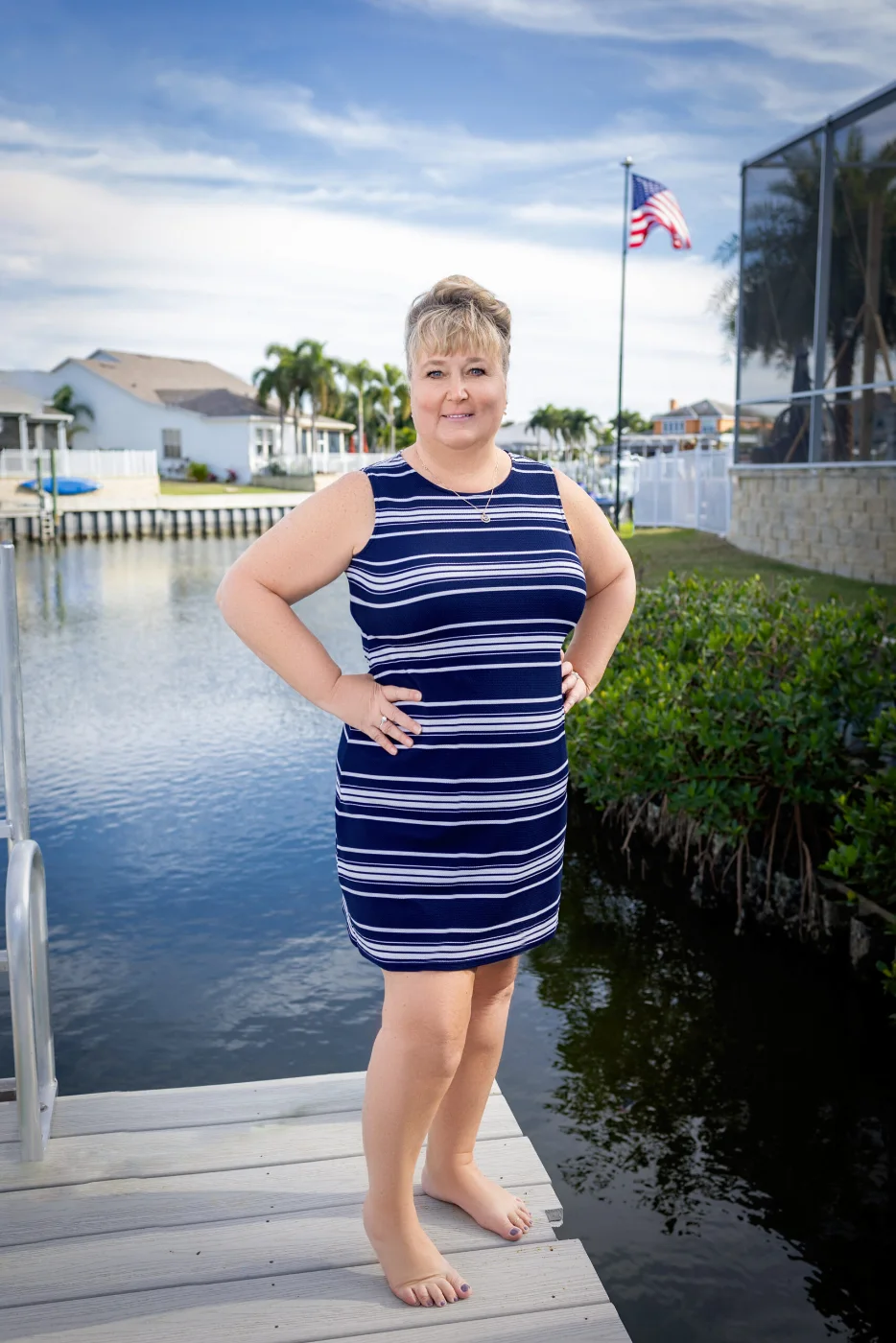
Shawna Calvert on the water off Apollo Beach. Knowing the market means knowing the water.
What does it look like when someone gets it right?
Everything about how to find a realtor in Florida comes down to one behavior. The right agent tells you the uncomfortable things early, while you can still walk away cheaply. Flood zone and a real insurance quote before you are emotionally attached. The full monthly number, including taxes, insurance, HOA and CDD, before the list price sets in your head. An honest read on what a community is actually like to live in rather than what the brochure says. That is not a sales approach. It is just the job done in the right order.
Where should you start?
That is how to find a realtor in Florida who is worth your time. If you are moving to the Tampa Bay area, Southshore, or anywhere else in the state, call me before you start looking at houses. We will go through flood zones, what the monthly cost really is, which communities fit how you want to live, and if there is a boat involved, whether the water behind the house works for it. You can also read how I work with buyers on my relocation services page.
Buying a waterfront home in Apollo Beach is not the same as buying any other house. You are buying the seawall, the dock, the lift, the canal behind the house and every rule that comes attached to the water. None of that shows up in listing photos, and it is where waterfront buyers get hurt.
This post is the due-diligence checklist — the things to inspect, ask and price out before you write an offer on a waterfront house. If you are still deciding which community to look in, start with the waterfront communities guide and come back here once you have a house in mind.
I sell more than 100 homes a year and more than 50 of those are waterfront. The problems I run into on waterfront deals are almost never the house.
Here is the version that keeps happening. A buyer flies in, falls for a canal home with a dock and a lift, writes the offer that afternoon and starts shopping for a boat before the inspection is even scheduled. Then they find out the lift is not rated for the boat they just fell in love with. Or the community master dock plan limits what that particular lot can keep on the water. Or they run out toward the bay for the first time and realize the hardtop was never going to clear the bridge. None of that is bad luck. All of it was findable before the offer.
Here is what I check on every waterfront property, and what you should be asking before you write one: canal depth against your boat, the community master dock plan, the lift, the seawall, the flood zone and a real insurance quote, and what the HOA and CDD actually cost on that specific lot.
What are you really buying when you buy a canal home?
You are buying the house, and you are also buying the seawall, your right to use the water behind it, and the dock and lift if there are any. Every one of those pieces has an age, a cost and a lifespan. A seawall can look fine from the deck and be undermined below the waterline. A lift can be far too small for the boat you plan to buy. All of it becomes yours at closing.
A canal like this one in Bradenton is what buyers picture. What matters is depth at low tide, bridge clearance and the condition of the seawall.
Is the property actually on navigable water?
This is the first question, and the answer is not always what the listing implies. Around Southshore we have on-water neighborhoods and off-water neighborhoods, and both are full of good homes. On water does not automatically mean you can get a boat to Tampa Bay, either. Some homes sit on lakes and ponds. Some sit on canals with a clear run to open water. Ask directly whether the water is navigable, ask what sits between the dock and the bay, and do not let a pretty water photo answer the question for you.
How do you know the canal is deep enough for your boat?
Why does canal depth matter when you lower the lift?
Canal depth is not about whether your boat floats in the middle of the canal. It is about whether there is water under your boat when you lower the lift at low tide. Your draft and the depth at the seawall at low water are the two numbers that matter. Get the depth measured at the dock rather than out in the channel, and find out how much the tide moves in that canal.
Will your boat clear every bridge between the dock and the bay?
Fixed bridge clearance is measured at high water, and it does not care what the listing calls the property. Direct access language does not tell you whether your specific boat, with your hardtop or tower on it, will fit under every bridge on the route out. Run the route if you can. If you cannot, get the clearance numbers before you commit.
What is a community master dock plan, and why should you ask for a copy?
This is the document most buyers never hear about. Many waterfront communities have a master dock plan that governs what can be built and what size boat a specific lot can keep on a lift. The restrictions usually come down to the size of the lot and whether a boat has the room it needs to navigate, turn around and let people board and get off the lift. Some smaller lots are limited because of it. Ask for a copy of the master dock plan and find out whether the lot you are looking at carries a restriction, before you are under contract with a boat you cannot keep there.
What should you check on an existing boat lift?
Start with the pound capacity, because that is what decides whether your boat can go on it. A lift can be replaced or upsized later and buyers do it all the time. It is simply easier and cheaper when the lift already there fits the boat you want to own. Ask for the capacity, the age and any service history, and look at the pilings, cables and motors while you are standing on the dock.
Who inspects the seawall, and what do the big repairs cost?
Your general home inspector does not inspect the seawall. A marine contractor does, and that inspection covers the cap, the panels, the tie back anchors, the weep holes and the soil behind and beneath the wall where voids and erosion start. These are the two numbers worth knowing before you write an offer: a new seawall runs roughly $800 to $1,000 per square foot, and a dock replacement runs $37,000 to $75,000. Neither one is a surprise you want after closing. Ask for the age of the wall and any repair history, and look at the walls on either side of it while you are there.
How do you check the flood zone before you make an offer?
Go to the FEMA Flood Map Service Center and enter the address. That gives you the flood map panel and the flood zone for that parcel. Zones AE and VE are high risk, which means your lender will require flood insurance as a condition of the loan. Zone X is moderate to low risk. Flood zone is assigned parcel by parcel, so never assume the house you are looking at carries the same designation as the one down the street.
Then get an actual quote on that specific address instead of a number someone quoted for a different house. An elevation certificate, which shows where the lowest finished floor sits relative to the base flood elevation, can change what you pay. Insurance is part of your monthly payment, so it affects what you qualify for now and what your buyer will qualify for when you sell. Florida sellers are also required to disclose flood history and past claims, so read that disclosure closely.
Does the age of the neighborhood affect flood insurance?
It does, and this is one of the easiest things to check. A neighborhood built after 2000 was usually built up to a higher elevation, and higher elevation brings the flood insurance premium down. That difference is worth weighing when you are comparing an older canal home to a newer one. Either way, plan on carrying it. If you have a mortgage on a waterfront home, you are going to need flood insurance.
Wide canals mean easier turning and bigger boats. Narrow ones limit both.
What boating restrictions will the listing not tell you?
Deed restrictions and HOA documents can limit boat size, prohibit living aboard, restrict the type of lift you install and require board approval before you make a change at the dock. Many canal communities also sit inside manatee protection zones with posted speed limits on how you run your boat. None of this is hidden. It is all in writing, and it just takes someone willing to read it and confirm it in writing before you close.
What is the difference between an HOA fee and a CDD fee in Florida?
HOA dues go to a private association that maintains shared amenities and enforces the community rules. A CDD is different. It is the portion of your tax bill that goes back to the community, funding the operation and maintenance of the community and paying off the original development bonds. You do not write a separate check for it, it shows up on the tax bill, and it belongs in your monthly number from the start.
A CDD is also not the penalty buyers assume it is. Communities with a CDD usually have a very low HOA, and they tend to be amenity rich or come with enhancements other neighborhoods do not have, like natural gas or gated entries. The bond portion does eventually get paid down.
Here is what surprises buyers: very few waterfront communities carry a CDD at all. Around here it is really just Antigua Cove in Ruskin, which most people know as Little Harbor, and MiraBay. Off water is the opposite, where plenty of neighborhoods do carry one. Where a CDD exists it is usually based on lot size, so two houses in the same community can pay very different amounts. In MiraBay a 50 foot lot runs around $2,300 yearly while lots over 100 feet run between $6,000 and $7,000. Get the exact figure for the specific parcel before you decide what you can afford.
What should you verify before you write the offer?
Buying a waterfront home in Apollo Beach comes down to a short list: whether the water is navigable and what your boat needs to get out, the depth at the dock at low tide, the master dock plan and any restriction on that lot, the lift capacity, the seawall condition and age, the flood zone and a real insurance quote for that address, and the HOA and CDD numbers for that exact parcel. Most of it can be confirmed inside your inspection period if someone starts on it the day you go under contract.
Is buying a waterfront home in Apollo Beach worth it?
Every time. Dolphins and manatees in your back yard, sunsets from your own dock, and your boat in the water five minutes after you decide to go. I sell these homes because I believe in them and because I know this water. Nothing in this guide is an argument against buying waterfront. It is an argument for understanding what you are buying before you are emotionally committed to it. A generalist agent can open the door. Someone who works this water every week can tell you whether your boat fits, what the seawall is likely to cost you in five years, and whether the CDD makes the deal work.
If you are buying a waterfront home in Apollo Beach, Ruskin, anywhere across Southshore or anywhere else in Florida, reach out before you make an offer. I will walk the dock and the seawall with you, get you the community master dock plan, and make sure the water and the lift actually fit the boat you want.
Southshore is not one place. When someone searches Southshore Tampa, they are usually picturing a single town. It is actually six or more communities, and they do not price the same, flood the same, or feed into the same schools. The gap between the label and the address is where most relocations go wrong.
I work with out-of-state buyers every week who are trying to make this decision from a thousand miles away. Most of them start by asking where Southshore is. The better question is which Southshore community fits the way you actually live. That is the question this article answers.
Below I cover what each community is actually like, real commute numbers, how school zones get assigned, what your flood zone does to your insurance bill, the monthly costs nobody puts on the listing sheet, and how to buy here without flying down first.
What does Southshore actually mean?
The six communities you are really choosing between
Southshore is a regional nickname, not a city. It covers the communities south of Tampa: Apollo Beach, Ruskin, Riverview, Wimauma, Sun City Center and Gibsonton, running down to the Manatee County line. You will see ZIP codes 33534, 33569, 33570, 33572, 33573, 33579 and 33598 across the area, and some of those spill into neighboring places. A buyer looking for a canal home with a boat lift in Apollo Beach and a buyer looking for new construction in a Riverview master-planned community are not shopping the same market, even though both will say they are moving to Southshore.
Matching the community to how you live
Apollo Beach is where the boaters land. Canal homes with direct access to Tampa Bay, lifts in the back yard, and a slower marina feel. Riverview pulls growing families, mostly newer construction in master-planned communities with easy access to shopping and healthcare. Ruskin and Wimauma are the most affordable way into the area, which is why budget-focused buyers end up there. Sun City Center is its own world, built for active adults 55 and up, with golf cart streets, resort amenities and a social calendar nothing else down here comes close to.
Why the address matters more than the community name
Your lender, the school district, FEMA and your insurance underwriter all work off a specific address. None of them care what the community is called. Buyers who pick an area by name and skip the address-level check get surprised by their school assignment, their flood zone or their insurance requirement. Two houses in the same subdivision can land differently on all three. Start with an address, check each system on its own, and assume nothing.
Community layout tells you a lot before you ever tour a house — where the water is, where the amenities sit, how far the commute starts.
What does the commute really look like?
Getting to downtown Tampa
Plan on 25 to 40 minutes off-peak and 30 to 50 or more at rush hour from most of Southshore to downtown Tampa. The Selmon Expressway is the fastest way in. Where you land inside Southshore matters more than people expect. Northern Riverview sits noticeably closer to the on-ramp than southern Ruskin or Wimauma, and you feel that difference every weekday morning.
Getting to the airport and the job corridors
Tampa International runs about 25 to 35 minutes off-peak, taking I-75 north to I-275 west, and can stretch to 55 at peak depending on where you start. USF, Westshore and the South Tampa medical corridors follow the same pattern. If you are commuting to downtown or the airport side of town, northern Riverview buys you real time back compared with the southern edge of Southshore.
How do you verify the school before you pick the house?
How Hillsborough County assigns schools
Every Southshore community is in Hillsborough County Public Schools, one of the largest districts in the country. Assignments are made by address, not by neighborhood. Two houses across the street from each other can feed different elementary schools. Families assume the community name settles it more often than you would think. Run your exact target address through the district’s school finder before you get attached to anything.
Schools serving Apollo Beach, Riverview and Ruskin include Apollo Beach Elementary, Thompson Elementary, Eisenhower Middle, East Bay High and Lennard High, among others. There are charter options too, including Waterset Charter School and Dorothy C. York PK-8 Magnet. Your parcel decides, not your subdivision.
Look past the rating number
Boundaries move faster here than in established neighborhoods because Southshore keeps growing. New construction in Riverview and Apollo Beach has driven new school builds and boundary changes in recent years. Ask your agent about boundary history and current capacity in the area you are considering. A zone that was accurate six months ago may already be different.
How do flood zones and insurance work here?
How the zones break down here
Zone AE sits inside the 1% annual-chance floodplain, and if you have a federally backed mortgage on an AE property, flood insurance is required. Zone X is lower risk with no federal requirement, which is not the same thing as flood-free. In Southshore, the waterfront and canal-adjacent homes in Apollo Beach and Ruskin are the ones most likely to be AE or coastal VE. Inland Riverview and Wimauma more often fall in Zone X, and the insurance picture there is completely different.
What flood insurance actually costs
On Apollo Beach canal-front and waterfront homes, 2026 NFIP premiums commonly run anywhere from around $1,500 into the $12,000 range, driven by elevation, foundation type and how close you sit to open water. Inland Riverview homes in Zone X generally run $400 to $1,200 a year, with a lot of low-risk properties landing between $650 and $900. That spread is the single biggest cost surprise for buyers coming from out of state.
Put flood insurance into your monthly number before you write an offer, not after. On any waterfront or canal-front home, ask the seller for the elevation certificate. It can lower your premium, and either way it tells you what you are actually buying before you are under contract.
Evacuation zones are a separate thing
FEMA flood zones and hurricane evacuation zones are two different systems run by two different agencies. Evacuation zones are set by state and local emergency management, not FEMA. Waterfront and canal homes in Apollo Beach and Ruskin usually sit in higher-priority evacuation zones because of storm surge. Look up both the flood zone and the evacuation zone for the specific address using the Hillsborough County lookup tool. The community name will not tell you.
Master-planned communities like Waterset trade water access for amenities and lower entry prices.
What does it cost to buy in Southshore?
Southshore Tampa housing market: price ranges by community
Apollo Beach as a whole has been running roughly $485,000 to $510,000 in median price across current data sources, and canal-front and bay-front homes sit well above that depending on the water access. Riverview new construction covers a wide range, and builder incentives come and go with the market. Ruskin and Wimauma are the most accessible entry points down here. Whatever the community, the number that matters is your total monthly cost, not the price on the listing sheet.
CDD fees, HOA dues and property taxes
Florida master-planned communities often carry a Community Development District fee and an HOA, and buyers mix the two up constantly. In Waterset, in Apollo Beach, plan on roughly $300 to $400 a month combined for HOA and CDD in many sections, with the CDD assessment itself running about $1,590 to $4,148 a year depending on the section and the lot size. Riverview master-planned communities land in a similar range, with CDD fees around $1,750 a year as a benchmark in some neighborhoods.
Out-of-state buyers who plug a price into a basic mortgage calculator and leave out CDD and HOA routinely underestimate their payment by hundreds of dollars a month. Going the other way, Florida’s homestead exemption lowers your assessed value and takes a real bite out of the tax bill after your first full year. File for it as soon as you close and establish Florida as your primary residence.
Can you buy from out of state without flying down?
The remote process that actually works
Buying remotely is normal here now, not a workaround. Most of my out-of-state buyers come from the Northeast, the Midwest and the West Coast. What works is a sequence: virtual community tours first, then address-level flood and school verification, then detailed video walkthroughs, then inspection reports we go through together so you know what the findings actually mean. The difference is having someone on the ground looking at the house for you, not just handling paperwork after you have already picked one.
Your Southshore pre-move checklist
Work this sequence and you will stay ahead of the things that catch relocating buyers off guard:
Pick your community by lifestyle and life stage before you start looking at listings.
Verify the school zone with the Hillsborough County school finder using a specific address.
Pull the FEMA flood zone designation for every property on your shortlist.
Get flood insurance quotes early, before you are under contract.
Ask for a clear breakdown of CDD versus HOA fees in every community you consider.
Request the elevation certificate on any waterfront or canal-front home.
File for homestead exemption as soon as you close and establish Florida residency.
Working with someone local before you get here
This is the work my team and I do at 27North Realty. Community matching, flood zone education, CDD breakdowns and school verification are not extras we add when a buyer asks for them. They are where every relocation conversation starts. That matters most for buyers who cannot fly down three times and need one local source of truth instead of stitching together answers from national websites that do not know the difference between a Zone AE canal home in Apollo Beach and a Zone X subdivision in Wimauma.
If you are thinking about the move, get connected with someone local early. You want address-level answers before you write an offer, so that by the time you are standing in your first showing you are already confident in the community, the numbers and the decision.
It comes down to five verifications
Southshore is not one place, and the right fit depends on your lifestyle, your budget, how much commute you will tolerate and how you feel about flood risk. Before you commit to a community, verify five things: the community personality against your life stage, the school zone for that exact address, the FEMA flood zone and the evacuation zone, the total monthly cost including CDD and HOA, and the real commute from that address to where you work.
Run your all-in numbers with a Florida lender who understands CDD fees and flood insurance line items, and talk to someone local who can give you address-level answers. That is the work I do every week with buyers who are still sitting in another state, no flight to Tampa required.
I hear this one constantly: “We’d love to buy, but it’s just too expensive right now.” Maybe. But before you settle that question, do the math on what renting will cost you over the same three years — because that number surprises people.
Buying isn’t automatically smarter than renting, and renting isn’t automatically throwing money away. Anyone who tells you otherwise is selling something. The right answer is the one that fits your budget, your timeline, and the life you’re actually living — without stretching you so thin that a broken A/C ruins your year.
Quick Answer: Should You Rent or Buy in Tampa Bay?
Buying may make sense when your income is stable, you’ve cash left after closing, the complete payment fits comfortably, and you expect to stay long enough to absorb the costs of purchasing and eventually selling. Renting may be stronger when you need flexibility, have a short timeline, are still learning the area, or would have little emergency savings after buying.
Don’t compare rent only with principal and interest. Compare rent with the complete monthly ownership cost and include the cash required before closing.
Renting keeps you flexible. Buying starts building equity. Three years is usually where the math flips.
How do you calculate three years of renting?
Start with your current monthly rent, estimate reasonable annual increases, and include renter’s insurance, moving costs, parking, pet charges, and other required fees. Use your actual lease history and local options rather than assuming every landlord will raise rent by the same percentage.
Rental cost
How to estimate it
Base rent
Monthly rent multiplied by the months in each lease year
Possible increases
Use written renewal offers or a clearly labeled planning assumption
Renter’s insurance
Use a current quote
Required fees
Parking, pets, amenities, application, or renewal charges
Moving costs
Include another move if the lease or property may not fit for three years
Refundable deposit
Track it separately because its final cost depends on the lease and property condition
A Simple Three-Year Renting Example
Assume rent begins at $2,200 per month and, only for planning purposes, increases 3 percent at each annual renewal. The rent would total approximately:
Year one: $26,400
Year two: $27,192
Year three: $28,008
Three-year base rent: about $81,600
This is an illustration, not a forecast. Your rent could stay level, rise by a different amount, or change because you move. Add renter’s insurance and required fees to create your own total.
How do you calculate three years of owning?
Ownership requires a wider worksheet. Separate upfront costs, recurring costs, unpredictable costs, and potential benefits so one optimistic assumption doesn’t hide the real cash flow.
Ownership category
Items to include
Upfront cash
Down payment, inspections, appraisal, closing costs, prepaid taxes and insurance, moving, and immediate repairs
Monthly housing
Principal, interest, property taxes, homeowners insurance, flood insurance when appropriate, mortgage insurance, HOA, and CDD obligations
Maintenance
Routine service, landscaping, pest control, pool care, and a reserve for repairs
Florida property risks
Roof, HVAC, plumbing, electrical, moisture, wind mitigation, seawall, dock, boat lift, and storm preparation when applicable
Potential financial benefits
Principal reduction and possible appreciation, neither of which should be treated as guaranteed cash
Exit costs
Possible selling, moving, repair, and transaction costs if you sell after three years
Why is the monthly payment not the whole answer?
Suppose a renter pays $2,200 and the complete estimated cost of owning a particular home is $2,900 per month. The $700 difference matters, but it doesn’t answer the entire question. Part of a mortgage payment may reduce principal, while rent pays for the right to occupy the property. Ownership also requires upfront cash, exposes the owner to repair and resale risk, and reduces flexibility.
Ask what you’ll do with the difference if you rent. If it will be saved or invested consistently, that belongs in the comparison. If it will simply disappear into other spending, the practical result may be different.
Which Florida costs change the comparison?
Homeowners and Flood Insurance
Get property-specific quotes early. Roof age, construction, wind-mitigation features, prior claims, replacement cost, location, and carrier underwriting can affect availability and price. Flood coverage is a separate consideration from a standard homeowners policy.
Property Taxes
Don’t rely on the seller’s current tax bill as your future bill. Assessed value, exemptions, the purchase price, taxing authorities, and non-ad valorem assessments can change the amount. Ask for a property-specific estimate and review the county property appraiser and tax collector records.
HOA and CDD Obligations
Two homes with similar prices can have very different recurring community costs. Review current HOA dues, special assessments, CDD debt service, CDD operations and maintenance charges, and any planned changes. Read our Florida CDD fee guide before comparing master-planned communities.
Maintenance and Property Condition
A low list price can lose its advantage when the roof, HVAC, plumbing, electrical system, pool, or waterfront improvements need major work. A professional inspection doesn’t predict every future repair, but it helps the buyer identify current conditions and decide what specialist reviews may be needed. See our Florida home inspection guide.
Does new construction or resale change the math?
Southshore buyers often compare a resale home with new construction. A builder may offer closing-cost assistance, an interest-rate incentive, or included upgrades, but the details and eligibility matter. A resale property may offer an established location, mature landscaping, completed amenities, different lot characteristics, or negotiating room.
Compare the complete payment, future HOA or CDD obligations, insurance, taxes after reassessment, included features, warranty limits, construction timeline, and the value of any incentive. A temporary rate buydown shouldn’t be confused with a permanently lower payment.
When is buying the better fit?
You expect to remain in the area for a meaningful period.
Your employment and income are reasonably stable.
You can close while keeping an emergency and repair reserve.
The total payment fits without sacrificing essential savings.
You understand the property’s condition, insurance, taxes, HOA, and CDD costs.
You value control over the home, stability, privacy, or customization.
You’re prepared for the responsibilities of maintenance and eventual resale.
When is renting the better fit?
Your job, household, or location needs may change soon.
You’re new to Tampa Bay and want time to compare communities.
Buying would use nearly all available savings.
The complete ownership payment would be uncomfortable.
You prefer predictable maintenance responsibility under a lease.
You may need to relocate before purchase and selling costs have time to be absorbed.
A Seven-Step Tampa Bay Comparison
Choose the monthly housing amount that feels comfortable, not simply the maximum a lender may approve.
Calculate three years of rent using your current lease and clearly labeled assumptions.
Request current loan estimates using the same purchase price and timeline.
Obtain property-specific insurance and tax estimates.
Add HOA, CDD, flood, maintenance, utilities, and commute differences.
Review upfront cash and the emergency reserve remaining after closing.
Compare lifestyle, flexibility, and likely ownership timeline before deciding.
Frequently Asked Questions
Is renting always cheaper than buying in Tampa Bay?
No. The answer depends on the property, financing, rent, insurance, taxes, HOA or CDD costs, maintenance, timeline, and future market conditions. Renting can cost less each month while buying may build principal equity, but neither result is guaranteed to be better.
How many years should I stay before buying makes sense?
There’s no universal break-even period. Upfront costs, future selling costs, mortgage terms, appreciation or decline, and maintenance all matter. Run several timelines rather than relying on one rule of thumb.
Should I wait for mortgage rates to fall?
Future rates are uncertain. Decide whether today’s complete payment works. If it doesn’t, waiting and strengthening savings may be appropriate. A possible future refinance should be treated as an option, not a promise.
Does the down payment count as a cost?
It’s cash required at closing and becomes equity in the property, subject to transaction costs and market value. Track it separately from expenses so you understand both liquidity and net worth.
Can first-time buyers use a low-down-payment loan?
Some qualified buyers may be eligible for FHA or conventional low-down-payment options. Program rules, mortgage insurance, credit, income, property eligibility, and lender requirements vary. Compare our FHA versus conventional loan guide with written lender estimates.
Make the Decision With Local Numbers
The goal isn’t to rush someone into buying. It’s to replace a vague fear about affordability with a clear comparison. Shawna Calvert at 27North Realty helps buyers compare Apollo Beach, Ruskin, Riverview, Wimauma, and surrounding Tampa Bay options while licensed lenders, insurance professionals, inspectors, and tax professionals provide their specialized estimates.
This article provides general real estate information and an illustrative planning framework. It isn’t lending, financial, tax, legal, insurance, or investment advice. Costs and market conditions change. Use current property-specific estimates from qualified professionals.
Nobody who’s lived through a Florida hurricane season panics about it. We just get ready, and then we go about our lives.
That’s the difference between newcomers and folks who’ve been here a while. If you’re new to Apollo Beach or Southshore, here’s what actually matters — and what you can stop worrying about.
Want it all in one place? Grab my free, printable Apollo Beach Hurricane Prep Kit, with a supply checklist, a storm card for your family, local numbers and a boat and dock plan.
Quick Answer: What Should Apollo Beach Homeowners Do First?
Check your 2026 Hillsborough County evacuation zone.
Know the difference between an evacuation zone and a FEMA flood zone.
Build or refresh a household emergency kit.
Review homeowners, wind, flood, boat, and other applicable insurance.
Inspect shutters or impact protection and practice installing removable panels.
Create plans for family members, pets, vehicles, medications, and communication.
Prepare waterfront improvements and secure or relocate a boat early.
Follow official Hillsborough County and National Hurricane Center information.
A squall building over the bay. Most of what you need to do happens well before one of these has a name.
When Is the 2026 Atlantic Hurricane Season?
The Atlantic hurricane season runs from June 1 through November 30. NOAA identifies September 10 as the climatological peak, with most Atlantic activity occurring from mid-August through mid-October.
NOAA’s August 6, 2026 update maintained a 75 percent chance of a below-normal Atlantic season, a 20 percent chance of a near-normal season, and a 5 percent chance of an above-normal season. A seasonal outlook doesn’t predict whether a particular community will be affected. One storm can create serious local impacts during an otherwise quiet season.
What is the difference between an evacuation zone and a flood zone?
This distinction matters in Apollo Beach, Ruskin, and other coastal areas.
Evacuation zones help emergency officials identify areas that may need to leave because of storm-surge risk. Hillsborough County uses zones A through E, and some properties are outside a designated evacuation zone.
Flood zones describe mapped flood risk used for insurance and building requirements. Every property is in a flood zone, but the level and type of risk vary.
A home can be in a lower-risk FEMA flood zone and still be in an early evacuation zone because storm surge and general flood mapping serve different purposes. Check both designations by address and recheck the evacuation map each year. Hillsborough County expanded some evacuation zones for 2026.
How do you make a household evacuation plan?
Decide where you’ll go, how you’ll travel, what you’ll take, and how every person will communicate if mobile service is limited. Hillsborough County advises residents to consider evacuating tens of miles rather than hundreds when a safe option is available, which can reduce travel time and traffic.
Your plan should include:
A friend, relative, hotel, or other safe location outside the called evacuation zone
A backup destination if the first choice becomes unavailable
Transportation and fuel planning
Medication, mobility, medical equipment, and special-needs planning
Pet-friendly lodging or shelter options, carriers, records, food, and medications
A family communication plan and an out-of-area contact
Paper copies of essential phone numbers and addresses
Multiple safe routes and an understanding of local bridge or road conditions
County shelters open only when announced and vary by event. They’re a last-resort safety option, not a hotel. Check official status before traveling to any shelter.
What belongs in a Florida hurricane kit?
Ready.gov recommends water, food, and other basic supplies for several days. Household needs vary, and local planning guides may recommend preparing for a longer period. Build the kit for the people and pets in your home rather than relying on a generic shopping list.
Water for drinking and sanitation
Nonperishable food and a manual can opener
Prescription medications and basic first aid
Flashlights, batteries, and a battery-powered or hand-crank radio
Portable phone chargers and charging cables
Cash in small bills
Hygiene, sanitation, masks, and cleanup supplies
Pet food, water, medications, crates, leashes, and vaccination records
Copies of insurance, identification, medical, ownership, and financial records
Weather-appropriate clothing, sturdy shoes, bedding, and comfort items
Tools needed to shut off utilities if officials direct you to do so
Keep original documents protected and maintain secure digital copies. Review expiration dates and household needs at least once a year.
How do you prepare the house before a storm?
Identify every opening that requires a shutter or panel.
Label panels and confirm all hardware and tools are available.
Trim vegetation responsibly and remove dead limbs before storm conditions.
Clean gutters and drainage paths.
Secure patio furniture, grills, umbrellas, planters, toys, and decorations.
Photograph every room, exterior elevation, major system, and valuable item.
Back up important computer files.
Test smoke and carbon-monoxide alarms.
Review pool, irrigation, and outdoor-equipment procedures with qualified professionals.
Know how to shut off water, electricity, and gas if officials or utility providers direct it.
Don’t make last-minute structural changes or climb on a roof as dangerous weather approaches. Use qualified professionals and complete work well before a storm.
How do you use a generator safely?
Generators can cause fatal carbon-monoxide poisoning when operated inside a house, garage, carport, or other enclosed or partially enclosed space. Follow the manufacturer’s instructions, keep the generator outdoors and away from doors, windows, and vents, and use appropriate equipment installed or reviewed by qualified professionals.
Never connect a portable generator to household wiring in a way that can backfeed the utility system. Plan fuel storage and operation safely, and test equipment before hurricane season.
What should waterfront owners do with the boat and dock?
Waterfront properties require more than standard household preparation. Begin early because marine vendors, haul-out capacity, and storage options can become limited.
Review the boat’s written hurricane plan and insurance requirements.
Decide whether to relocate, haul, store, or secure the boat according to professional guidance.
Inspect the dock, boat lift, pilings, electrical service, and visible fasteners.
Remove dock furniture, hoses, fishing gear, decorations, and loose equipment.
Photograph the seawall, cap, dock, lift, boat, motors, and marine accessories.
Protect ownership, registration, service, and insurance records.
Move vehicles and golf carts if flooding or surge is possible.
Never remain on a vessel during a hurricane or evacuation order.
Don’t assume every canal, elevation, seawall, or boat-lift installation faces the same risk. Property-specific marine and insurance advice matters.
A waterspout off Bahia Beach. Summer storms here are routine — hurricane season is the one you plan for.
Why review insurance before a storm is named?
A standard homeowners policy typically doesn’t cover flood damage. Wind, named-storm, hurricane, flood, boat, and umbrella coverages can involve different policies, deductibles, exclusions, waiting periods, and claim procedures.
Ask your licensed insurance professional to review:
Dwelling and replacement-cost limits
Wind or hurricane deductibles
Flood insurance and contents coverage
Coverage for docks, seawalls, lifts, pools, screened enclosures, landscaping, and detached structures
Temporary living expenses
Boat and marine-property coverage
Required photographs, inventories, receipts, and claim contacts
Insurance availability and changes can be restricted when a storm threatens. Review coverage when there’s still time to ask questions and consider options.
What changes if you are buying or selling during hurricane season?
Florida homes close throughout hurricane season, but a developing storm can affect inspections, appraisals, insurance binding, lender requirements, walk-throughs, utilities, moving companies, title offices, and the practical ability to close.
Buyers and sellers should review the signed contract, maintain communication with the lender and closing agent, and document any agreed extension in writing. Don’t assume that a storm automatically changes contractual deadlines. Ask qualified real estate and legal professionals how the specific contract applies.
What should you do after a storm?
Wait for official clearance before returning to an evacuated area.
Avoid floodwater, downed lines, unstable trees, and damaged structures.
Photograph damage before cleanup when it’s safe.
Take reasonable steps to prevent additional damage without risking personal safety.
Keep receipts and a record of calls, claim numbers, and temporary repairs.
Use licensed, insured professionals and verify Florida licenses when required.
Be cautious of unsolicited contractors, pressure, large upfront payments, and promises that appear unrealistic.
Frequently Asked Questions
Is Apollo Beach in an evacuation zone?
Many Apollo Beach properties are in designated evacuation zones, but the zone varies by address and maps can change. Use Hillsborough County’s current address-based lookup.
Does Zone X mean I don’t need to evacuate?
No. A FEMA flood-zone label and a hurricane evacuation zone are different. Follow the current county evacuation map and official orders.
Does homeowners insurance cover storm surge?
Flooding and storm surge are generally addressed through flood insurance rather than a standard homeowners policy, but coverage depends on the actual policies. Ask a licensed insurance professional to review them.
How early should I move or secure my boat?
Follow the written hurricane plan, marina or storage requirements, insurance conditions, and professional marine guidance. Begin well before local conditions deteriorate or services reach capacity.
Should I evacuate if my zone is called?
Follow official evacuation orders. Conditions and risks vary by storm, and emergency officials use current forecasts and surge information when calling zones.
Prepare Early and Use Official Information
Neighbors are an important part of Southshore life, but social-media posts and group texts shouldn’t replace official emergency information. Know your zones, build the kit, review insurance, and make the waterfront plan before hurricane season reaches its peak.
27North Realty provides local real estate guidance for buyers, sellers, and homeowners navigating Apollo Beach, Ruskin, and Southshore property questions. Emergency, insurance, marine, engineering, and legal decisions should be made with the appropriate public agency or qualified professional.
This guide provides general preparedness and real estate information. It isn’t emergency, insurance, engineering, marine, legal, electrical, medical, or construction advice. Follow current government orders and qualified professional guidance for your household and property.
The question isn’t “is now a good time to buy?” Nobody can answer that for you, and anyone who tries is guessing.
The real question is whether this specific house gives you the life you want at a cost and a risk level you can live with. Apollo Beach has a mix that’s genuinely hard to find anywhere else on Tampa Bay — established canal streets, newer master-planned neighborhoods, 55-plus communities, villas, family houses, and waterfront running from modest canals to wide-open bay views. That range is the whole appeal, and it’s also why you have to compare these houses one at a time.
Apollo Beach offers a mix that’s difficult to duplicate elsewhere around Tampa Bay: established canal neighborhoods, newer master-planned communities, 55-plus options, villas, family-sized homes, and waterfront properties ranging from modest canals to open-bay views. Those choices are a strength, but they also make property-by-property comparisons essential.
What is the Apollo Beach market doing?
As of June 2026, Realtor.com described Apollo Beach as a balanced market. Its market page reported a median listing price of $540,000, a median sold price of $493,499, and a median 66 days on market. Homes sold for about 98% of asking price on average, or roughly 1.8% below the final list price.
Those figures are a snapshot, not a promise about an individual home. They do suggest that buyers have more room for inspections, property-specific research, repair discussions, seller concessions, and financing comparisons than they had during the most frantic pandemic-era market.
A balanced market rewards preparation. Buyers can negotiate, but the strongest homes still command attention when price, condition, location, elevation, and water access line up.
The broad citywide median also blends very different properties. A villa away from the water, a newer home in a planned community, an older direct-canal house, and a premium bayfront estate shouldn’t be evaluated as if they compete on price alone.
Sunset over the skyline from Bahia Beach. Whether 2026 is your year depends less on the market than on how long you plan to stay.
Why do buyers keep choosing Apollo Beach?
Apollo Beach has grown while retaining a strong owner-occupant base. U.S. Census Bureau estimates for 2020–2024 report 11,961 households, an owner-occupied housing rate of 85.7%, and a median household income of $127,617. The same data estimates a mean commute time of 35.3 minutes, which is an important reminder to test your real routes rather than judging distance from a map.
The community now supports more everyday services, recreation, and dining while remaining close to Tampa Bay. The county-operated SouthShore Sportsplex and Apollo Beach Park and Recreation Center add nearby options for sports and activities. For some buyers, however, the main appeal is still the water: private docks, canals, boating, sunsets, and the possibility of making Tampa Bay part of an ordinary weekend.
What should you answer before you buy?
1. Does the complete monthly cost feel comfortable?
Start with principal and interest, then add property taxes, homeowners insurance, flood insurance when applicable, HOA fees, CDD assessments, utilities, and a reserve for maintenance. A lower purchase price can be offset by higher insurance, an aging roof, a recurring CDD, or responsibility for a seawall.
2. Does the neighborhood fit your actual lifestyle?
Apollo Beach neighborhoods aren’t interchangeable. One may have resort amenities, clubs, a social calendar, and golf-cart activity. Another may be quiet, independent, and free of an HOA or CDD. One may prioritize low-maintenance living; another may offer a larger yard and more individual responsibility.
Drive the neighborhood at the times you’ll use it. Test the commute, school or activity routes, grocery run, dinner trip, and route to the water. Price matters, but a less expensive house isn’t a bargain if it pulls you away from the lifestyle that made you choose Apollo Beach.
3. If boating matters, can the waterway support your boat?
A waterfront label doesn’t confirm usable boating access. Review low-tide depth, the boat’s loaded draft, canal width, turning radius, bridges, idle-speed zones, dock placement, lift capacity, and the time required to reach open water. Community rules may also limit vessel size or use of a shared lift.
4. What do the flood, elevation, and insurance records show?
Flood risk can change from one parcel to the next. Don’t rely on a road, neighborhood reputation, or a neighbor’s recollection. Check the effective FEMA flood zone, county flood information, evacuation zone, elevation certificate when available, permit history, disclosed prior damage or claims, and a current property-specific insurance quote.
5. Who’s responsible for the seawall, dock, and lift?
Ownership and maintenance responsibility vary. In some communities, shared infrastructure may be funded through a CDD or association. In other canal neighborhoods, the individual homeowner is responsible for the seawall behind the property.
Inspect the seawall, dock, and lift as seriously as the roof and major systems. Ask about age, permits, repairs, engineering, shared boundaries, and remaining useful life. A beautiful view can hide a large future obligation.
6. Are the HOA and CDD delivering value for you?
A CDD isn’t automatically good or bad. Review what it funds, how much debt remains, the current operating budget, and which responsibilities shift away from the individual owner. Then review the HOA rules, reserves, restrictions, and recent meeting information.
The right comparison is total cost plus actual value. A buyer who uses pools, fitness facilities, trails, security, recreation, or boating amenities may evaluate the same fee differently from someone who wants fewer rules and more independence.
7. Are you buying for several years or trying to time the market?
No one can guarantee the next interest-rate move or perfectly identify a market bottom in real time. A more durable decision considers how long you expect to own, whether the payment leaves room for savings and repairs, and whether the home will still serve you if work, family, or boating plans change.
When does buying now make sense?
The complete monthly cost fits comfortably.
You’ll retain emergency and maintenance reserves after closing.
You’ve compared several neighborhoods and property types.
The insurance and flood information are acceptable for the exact property.
Water access works for the boat and lifestyle you actually want.
You expect to own long enough for the transaction to make sense.
The inspection, permits, title, HOA, CDD, seawall, dock, and lift information support the price.
When is waiting the smarter move?
The payment would leave you stretched or without reserves.
Your job, location, or household plans may change soon.
You’re relying on an unverified development announcement or future resale assumption.
You haven’t received property-specific insurance estimates.
You’re compromising on the neighborhood or water access that brought you to Apollo Beach.
You feel pressure to overlook condition, flood history, or recurring costs.
Frequently asked questions
Is Apollo Beach a buyer’s or seller’s market in 2026?
Realtor.com classified Apollo Beach as balanced in June 2026, meaning supply and demand were roughly in balance. Conditions vary by price range, neighborhood, property condition, elevation, and water access, so use current property-specific data when you’re ready to buy.
Is every Apollo Beach home in a flood zone?
No. Flood designations vary by parcel, and a property’s evacuation zone is a separate determination. Verify both with official tools and obtain a current insurance quote rather than relying on a general rule about one side of a road or one neighborhood.
Are CDD communities more expensive?
A CDD adds an assessment, but the useful comparison includes what that assessment funds and which infrastructure or amenities the owner would otherwise fund directly. Review the tax bill, bond schedule, operating budget, HOA costs, and total monthly carrying cost.
What’s the first step if I’m considering Apollo Beach?
Set a comfortable complete housing budget, identify the lifestyle and neighborhood features you won’t compromise on, and compare several representative properties. Waterfront buyers should also bring their boat specifications before touring seriously.
Make the decision with property-specific facts
Apollo Beach deserves serious consideration in 2026, but the right answer depends on the home, waterway, elevation, costs, and neighborhood. If you’re comparing properties, contact Shawna Calvert at 27 North Realty. We can evaluate the house and the lifestyle together before you make a decision.
This article is for general educational purposes and isn’t financial, tax, legal, engineering, insurance, or floodplain advice. Market data and property conditions change. Verify current information for the exact property and consult qualified professionals.
Every buyer I meet wants to know the same thing: is the Fed about to drop rates, and should we wait? Here’s the honest answer — the Fed doesn’t set your mortgage rate. It never has.
What does the Fed actually control?
Your rate comes from the bond market, your loan program, your lender, your credit, the property itself, whether you buy points, and what day you happen to lock. I’ve watched rates move before a Fed meeting, after one, and straight in the opposite direction of what everybody predicted. Trying to time one announcement is a great way to lose the house you wanted.
That’s why a headline saying the Fed held or lowered rates doesn’t guarantee that a lender will offer a lower mortgage rate the next morning.
The Fed sets short-term rates. Mortgage rates follow the bond market, which is a different animal.
Can you count on the rate you see advertised?
Freddie Mac reported that the national average for a 30-year fixed-rate mortgage was 6.66% on August 27, 2026. That survey is a useful market reference, but it isn’t a quote for every borrower. Your actual rate, annual percentage rate, fees, and payment can be different based on the details of your application.
What should Florida buyers compare instead?
1. The complete monthly housing payment
Don’t compare principal and interest alone. In Florida, your realistic housing budget may also include property taxes, homeowners insurance, flood insurance when applicable, HOA dues, CDD assessments, and maintenance. Waterfront homes can add seawall, dock, lift, pool, and marine-maintenance planning.
2. The same-day loan options
Ask a licensed lender to show options on the same day using the same purchase price and down payment. Compare the interest rate, APR, discount points, lender fees, cash needed at closing, mortgage insurance, and payment. A lower advertised rate may require more cash upfront.
3. A seller concession versus a price reduction
Depending on the contract, loan program, appraisal, and lender rules, a seller concession may help with allowable closing costs or a temporary or permanent rate buydown. Ask the lender to calculate the payment and break-even point. In some cases, a concession can improve near-term affordability more than a modest price reduction. In other cases, the price reduction is the better long-term choice.
4. Your waiting scenario
Waiting isn’t free. Compare the cost of continued rent, a possible change in home prices, the chance that inventory or seller flexibility changes, and the savings you expect to build. Also compare what happens if rates rise instead of fall. A decision should still work if the market doesn’t cooperate with the forecast.
5. Whether the payment is comfortable today
Refinancing may be possible later, but it isn’t guaranteed. Future rates, equity, credit, income, property condition, and closing costs will matter. Buy only when the current payment and reserves make sense without depending on a future refinance.
A practical mortgage-rate checklist
Get a written Loan Estimate when available and compare it carefully.
Ask whether the rate is locked, for how long, and what could change it.
Compare APR and total lender costs, not just the note rate.
Ask the lender to price a concession, a buydown, and a price reduction side by side.
Include taxes, insurance, HOA, CDD, flood coverage, and maintenance in the budget.
Does a Fed rate cut automatically lower mortgage rates?
No. Fed policy influences financial conditions, but lenders don’t simply copy the federal funds rate. Mortgage markets may already have priced in an expected decision.
Should I wait for mortgage rates to fall before buying?
It depends on your finances, time horizon, available homes, and complete payment. Compare a buy-now scenario with a realistic wait scenario rather than relying on a forecast.
Is a rate buydown always better than a price reduction?
No. The answer depends on the cost, loan rules, time in the home, payment impact, and break-even point. Ask the lender to show both options in writing.
Can I refinance later?
Possibly, but no one can promise that a future refinance will be available or worthwhile. The purchase should be affordable under the loan you’re accepting now.
Mortgage rates and loan terms change frequently. This article is educational and isn’t lending, legal, tax, or financial advice. Consult a licensed mortgage professional for quotes and advice specific to you.
Planning a Florida purchase? I help buyers compare the home, neighborhood, waterfront details, and complete ownership picture while their licensed lender handles loan advice.
Summer closings in Florida have a rhythm all their own, and it isn’t a relaxed one. Everybody’s juggling vacations, school calendars, movers, insurance, financing, inspections, and usually the sale of another house — and every professional touching your file is doing the same thing.
A busy season doesn’t have to turn into a chaotic closing. Treat your contract date as a real deadline, build a backup plan before you need one, answer requests the day they land, and never assume a phone call changed something that’s written down. That last one has cost more people more money than anything else on this list.
Quick Answer: How Do You Avoid a Summer Closing Delay?
Choose realistic contract dates and confirm major participants’ availability.
Submit lender documents promptly and avoid unexplained financial changes.
Request insurance quotes and resolve property-condition questions early.
Schedule inspections, appraisal access, surveys, and association applications immediately.
Reserve movers with flexible terms and backup dates.
Review the Closing Disclosure as soon as it’s received.
Verify wire instructions through a trusted telephone number.
Put every approved deadline change in writing.
Summer closings run into afternoon storms, vacation schedules and slower insurance binders.
Why do summer closings feel so busy?
School and Household Timelines Converge
Families often try to close after one school year ends or before another begins. That can create a narrow target for selling, buying, enrolling, moving, and starting work. A small delay in one transaction can affect storage, travel, temporary housing, and childcare.
Vacations Affect Every Part of the Transaction
Buyers, sellers, agents, lenders, processors, underwriters, inspectors, appraisers, association managers, title professionals, attorneys, vendors, and movers all take time away. Well-run companies have coverage plans, but a decision or document may still require a specific person.
Moving Companies and Rentals Reach Capacity
Popular dates, weekends, and month-end periods can book early. Long-distance moves add route schedules, truck availability, delivery windows, storage, and weather to the plan.
Florida Weather Can Change Logistics
Heavy rain, tropical weather, lightning, flooding, and extreme heat can affect inspections, repairs, moving, insurance, travel, utility work, and final walk-throughs. Hurricane season runs through the entire summer closing period.
New Construction Has Its Own Timeline
Construction completion, certificates, municipal inspections, lender conditions, punch-list work, utility activation, and builder scheduling can move. Don’t give irreversible notice or schedule a nonrefundable move based only on an estimated completion date.
What is a realistic contract timeline?
The closing date isn’t simply a preference. It must allow enough time for financing, inspections, title work, surveys, insurance, association approval, repairs, appraisal, final documents, and any related sale.
Before signing, discuss:
Lender turn times and loan-program requirements
Inspection and repair deadlines
Appraisal access and review
HOA or condominium application and approval timing
Survey requirements
Title, lien, permit, probate, trust, or entity issues
Insurance availability and property-condition requirements
Seller occupancy, buyer possession, and moving needs
Holidays, vacations, and planned travel
Whether another sale or closing must occur first
A fast closing can be attractive, but a date that leaves no recovery time can create unnecessary risk.
Buyer Checklist for a Smoother Summer Closing
Keep Financing Boring
Mortgage approval is based on documented information that can be checked again before closing. Avoid opening or closing credit accounts, financing furniture or a vehicle, changing jobs without discussion, moving unexplained money, depositing undocumented cash, or making large transfers without asking the lender how to document them.
When the lender asks for a document, send the complete item through the lender’s secure process and confirm that it was accepted. A screenshot or partial page may not satisfy underwriting. Keep recent pay statements, bank statements, identification, tax documents when requested, insurance contacts, and gift-fund documentation organized.
Order Insurance Early
Florida insurance questions can affect both affordability and loan approval. Roof condition, electrical panels, plumbing, wind-mitigation features, prior claims, flood risk, and property use may matter. Obtain property-specific quotes during the inspection period when possible.
Schedule Every Buyer Task Immediately
General inspection, four-point or wind-mitigation inspections, pool, sewer, septic, seawall, dock, survey, association application, and other specialist work can require separate appointments. The signed contract controls the available time.
Keep Closing Funds Accessible
Ask the closing agent and lender when final funds will be known, what form of payment is accepted, and when the funds must arrive. Bank-transfer limits and processing times can surprise buyers. Never rely on emailed wire instructions without independent verification.
Seller Checklist for a Smoother Summer Closing
Complete Disclosures and Documents Early
Provide requested ownership, loan, association, permit, lease, solar, repair, and other property information promptly. Missing records can slow title review, association estoppels, insurance, or buyer due diligence.
Plan Repairs Around Access and Weather
Qualified vendors may have tight summer schedules. Clarify scope, receipts, permits, access, completion standards, and any reinspection needs in writing. Don’t wait until the final walk-through to address an agreed repair.
Do Not Pack Away What the Closing Needs
Keep keys, remotes, permits, warranties, receipts, appliance information, access codes, association documents, and identification available. Protect confidential records during showings and moving.
Prepare for the Final Walk-Through
The property should be in the contractually required condition, with agreed personal property present and unwanted items removed. Confirm utilities remain on when required so systems can be checked.
What happens at the closing disclosure and final loan review?
For most covered mortgage loans, the lender must provide the Closing Disclosure at least three business days before closing. The document shows final loan terms, projected payments, and closing costs. Buyers should compare it with the Loan Estimate and ask about unexpected changes immediately.
Some changes can require a new review period. Don’t wait until the signing appointment to question the interest rate, loan type, cash to close, credits, taxes, insurance, or fees.
How do you protect yourself from wire fraud?
Real estate wire fraud often uses an email that appears to come from a trusted professional. Treat any new or changed instruction as suspicious.
Obtain the closing agent’s trusted phone number from an independent source early in the transaction.
Call that number and verbally verify the recipient name, bank, routing number, account number, and amount.
Don’t use a telephone number supplied only in the wire-instruction email.
Be cautious of urgency, secrecy, changed accounts, unusual grammar, or last-minute instructions.
After sending funds, confirm receipt using the trusted number.
If you believe a wire was misdirected, contact the financial institution and law enforcement immediately. Speed matters.
Build extra days into a July or August contract. Everyone you need is also on vacation.
How do you plan the move without betting on one date?
A signed closing date is important, but travel and moving plans should still include contingencies. Before committing to nonrefundable arrangements, ask what happens if the closing moves by one or more days.
Choose movers with clear rescheduling, storage, and delivery terms.
Keep essential medication, documents, clothing, chargers, pet supplies, and work equipment with you.
Maintain a temporary-housing option when two transactions must align.
Don’t put closing documents, identification, or valuables in the moving truck.
Confirm utility start and stop dates with enough overlap for the final walk-through and move.
Plan for heat, rain, pets, children, and hydration on moving day.
What Happens if the Closing Date Must Change?
A delay doesn’t automatically extend a contract. The parties should communicate through their agents and closing professionals, identify the actual cause, and determine what written agreement may be appropriate. Depending on the contract and circumstances, legal advice may be needed.
Possible issues include:
Final underwriting conditions
Appraisal review
Insurance binding or repair requirements
Title, lien, permit, probate, or survey questions
Association approval or estoppel timing
Storm closures or unsafe travel
Delayed funds or documents
A related sale that hasn’t closed
Focus on the solution rather than blame. Clear information, realistic options, and professional cooperation protect the transaction better than dramatic messages.
Confirm movers, utilities, travel, signing location, identification, and backup plans
Three business days before
Buyer reviews the Closing Disclosure when applicable and asks questions
Two days before
Verify final walk-through timing, property condition, keys, remotes, and agreed personal property
One day before
Confirm final funds and independently verify wire instructions
Closing day
Bring identification, follow signing instructions, confirm funding and recording before assuming completion
Frequently Asked Questions
Is the scheduled closing time the moment I receive the keys?
Not always. Signing, lender funding, funds receipt, title requirements, and recording can affect when a transaction is complete and possession is delivered. Follow the contract and closing agent’s instructions.
Can a hurricane delay a Florida closing?
Yes. A storm can affect insurance, inspections, utilities, travel, offices, funding, and safe access. The contract doesn’t necessarily change automatically, so written coordination is important.
Should buyers schedule movers for the morning of closing?
That can create risk if funding or recording is delayed. Discuss possession timing and choose arrangements that allow flexibility.
What should I do if I receive new wire instructions?
Stop and call the closing agent at a previously verified telephone number. Don’t reply to the message or use contact information found only inside it.
Why is the lender asking for another document at the end?
Underwriters may need updated information or clarification before final approval. Respond quickly through the lender’s secure process and avoid financial changes until the transaction is complete.
Keep the Closing Calm and Coordinated
Summer closings involve many people who are trying to meet the same goal. A strong real estate team anticipates pressure points, communicates clearly, and protects the client’s contract rather than turning a solvable delay into a battle.
27North Realty helps buyers and sellers coordinate Tampa Bay and Southshore transactions with practical local guidance from contract through closing.
This article provides general real estate information. It isn’t legal, lending, title, tax, insurance, cybersecurity, or moving advice. Contract rights and deadlines depend on the signed agreement and transaction facts. Consult the appropriate qualified professionals.
Swedish Death Cleaning sounds grim. It isn’t. Nobody’s planning a funeral between trips to the donation center.
It’s just a practical way of sorting through what you own so your home, your move, and the next chapter feel lighter. If you’re getting ready to sell, downsize, combine households, or move across the country to Florida, it turns one overwhelming job into a hundred small decisions you can actually make.
Quick Answer: What Is Swedish Death Cleaning?
Swedish Death Cleaning is the practice of thoughtfully reducing possessions so you keep what’s useful, meaningful, or genuinely enjoyed and release what no longer serves you. The idea includes consideration for the people who may eventually have to sort your belongings, but you don’t have to be older or facing a major life event to benefit from it.
In real estate terms, it can also make a home easier to photograph, show, pack, move, and settle into after closing.
Döstädning is less morbid than it sounds — it is deciding what comes with you before someone else has to decide for you.
Why does decluttering help before selling a Florida home?
Buyers need to see the home, not the volume of belongings inside it. A crowded room can make square footage feel smaller, hide storage, interrupt sightlines, and pull attention away from architectural features.
Thoughtful decluttering can help you:
reduce the number of boxes and the cost of moving them;
make rooms and closets easier for buyers to understand;
identify repairs or maintenance hidden behind stored items;
separate valuables and important documents before showings;
make photography and staging more effective;
avoid moving unwanted items into the next home;
reduce the emotional and physical pressure of a last-minute cleanout.
Decluttering doesn’t mean stripping the home of personality. The goal is to create enough breathing room for buyers to imagine living there while protecting the belongings that matter most to you.
Where should you start?
Don’t begin with family photographs, inherited jewelry, or a box of letters you haven’t opened in thirty years. That’s how a simple Saturday project becomes an emotional archaeological dig.
Start with low-sentiment items:
expired pantry goods and toiletries;
duplicate kitchen tools;
worn towels and linens;
clothes that don’t fit your current life;
old manuals, empty boxes, and outdated electronics;
broken patio items and unused pool accessories;
garage supplies that can’t safely make the move.
Early progress builds confidence. Save highly personal categories for later, when your decision-making rhythm is stronger.
How do you sort what to keep?
Group
What belongs there
Keep
Items you use, need, love, or have a clear place for in the next home.
Give
Items for family, friends, donation organizations, or community groups.
Sell
Items with enough value to justify the time, fees, photographs, and buyer coordination.
Dispose
Broken, unsafe, expired, damaged, or unusable items that can’t be donated.
Add a short deadline to the sell category. If an item isn’t worth listing within a week or two, it may belong in the give category. Otherwise, the sell pile can become a new form of clutter with better intentions.
What is a realistic room-by-room plan?
Week 1: Kitchen and Pantry
Remove expired goods, duplicate utensils, unused small appliances, mismatched containers, and serving pieces you no longer use. Keep the counters mostly clear for photography and showings.
Week 2: Closets and Bedrooms
Pack out-of-season clothing, donate items you no longer wear, and leave visible space in closets. Buyers will look at storage. An overfilled closet communicates limited capacity even when the closet is generous.
Week 3: Bathrooms and Laundry
Remove expired products, extra bottles, old towels, and visible personal-care items. Keep daily essentials in one container that can be moved quickly before a showing.
Week 4: Garage, Lanai and Outdoor Storage
Florida homes often collect hurricane supplies, fishing gear, beach equipment, pool items, paint, tools, and lawn products. Keep usable emergency supplies, but dispose of hazardous materials through appropriate local programs. Don’t place chemicals, batteries, fuel, or paint in ordinary trash unless local rules allow it.
Week 5: Papers, Photos and Sentimental Items
Now handle the harder categories. Work in short sessions. Label family items with names or stories. Scan selected photographs or documents when a digital copy is appropriate, but keep original legal and identity documents secure.
What should stay accessible during the move?
Create one clearly marked, secure group that never goes into general donation boxes or an unattended moving truck:
identification, passports, deeds, estate documents, and closing records;
medications and medical information;
insurance policies and emergency contacts;
jewelry, cash, keys, access codes, and small valuables;
pet records, leashes, carriers, food, and medication;
chargers, basic clothing, toiletries, and supplies for the first few nights.
Shred papers containing sensitive financial, medical, or identity information. Wipe personal data from electronics before selling or donating them.
How Much Should You Remove Before Listing?
There’s no universal percentage. The right amount depends on the home’s size, storage, furnishings, architectural features, and who’s likely to buy it.
A useful goal is to make each room’s purpose immediately clear, create open pathways, show usable storage, and remove items that distract from the property. If a piece of furniture blocks a doorway, window, water view, or the natural flow of a room, consider storing or removing it before photography.
For waterfront homes, clear sightlines to the canal, dock, pool, lanai, or sunset view. Those features may be central to the buyer’s decision.
What should you avoid doing?
Don’t throw away another household member’s belongings without permission.
Don’t donate important documents, family heirlooms, firearms, medication, or hazardous materials through ordinary channels.
Don’t spend weeks trying to sell low-value items while the listing timeline stalls.
Don’t rent a storage unit without a plan and deadline for everything placed inside.
Don’t depersonalize so aggressively that the home feels cold or unlivable.
Don’t wait until the week before closing to begin.
Frequently Asked Questions
Is Swedish Death Cleaning only for seniors?
No. It can help anyone preparing to move, downsize, sell, renovate, combine households, or simplify daily life.
Should I remove every family photograph?
Not necessarily. A few well-placed personal items can keep a home warm. Remove excessive collections or highly private material and let the room remain the focus.
Should I declutter before calling a Realtor?
You can call first. An experienced Realtor can help identify which rooms, furniture pieces, and visible items matter most, saving you from doing work that doesn’t improve the sale.
What if the project feels emotionally overwhelming?
Use short sessions, begin with easy categories, and invite a trusted person or professional organizer to help. Give sentimental decisions more time than ordinary household sorting.
Will decluttering increase my home’s value?
It doesn’t change the home’s physical square footage or guarantee a higher price, but it can improve presentation, buyer understanding, photography, and the overall showing experience.
Make the Move Lighter
The best version of Swedish Death Cleaning isn’t gloomy. It’s a gift to your future self: fewer boxes, fewer rushed decisions, and a home that’s easier to market and enjoy.
Shawna Calvert can walk through your home before listing and help prioritize what to pack, what to keep visible, and where preparation will make the greatest difference.
This article provides general home-preparation information. Follow local rules and qualified professional guidance for hazardous materials, legal documents, valuables, data security, and specialized property.
Almost every first-time buyer mistake I see in Florida happens before anybody looks at a house. Shopping without a lender strategy. Budgeting off the sticker price. Forgetting that insurance and community assessments are part of the payment. Waiting too long to dig into the property itself.
Looking at listings is the fun part, and I’d never take that away from you. But after walking a lot of buyers through this across Tampa Bay and Southshore, I can tell you the ones who end up happiest knew their real monthly payment, their cash to close, and their due-diligence plan before they ever wrote an offer.
1. Starting the home search before understanding the financing
Scrolling through homes can help you learn the market, but serious touring should begin with a realistic financing conversation. A lender can review income, credit, debts, available funds, and loan options. That information helps establish a payment and price range before emotions become attached to a property.
A preapproval isn’t a promise that every home or loan scenario will qualify. Taxes, insurance, HOA dues, CDD assessments, property condition, appraisal results, and loan requirements can change the numbers. Ask the lender to update the estimate when the target property changes.
The beach is why people move here. The mistakes on this list are what keep them from enjoying it.
2. Shopping by purchase price instead of total payment
Two homes with the same price can produce very different monthly costs. Buyers should compare principal and interest together with projected property taxes, homeowners insurance, mortgage insurance when applicable, flood insurance when applicable, HOA dues, CDD assessments, and other recurring housing expenses.
This is especially important in Southshore Florida. A newer master-planned home may include HOA and CDD costs. A canal-front home may have different flood, insurance, seawall, dock, and maintenance considerations. A condominium may include substantial services in its association fee, but the buyer still needs to review the association’s financial condition, insurance responsibilities, and potential assessments.
3. Using every available dollar for the down payment
The down payment is only one part of the cash needed to buy. Closing costs, prepaid taxes and insurance, inspections, appraisal costs, moving expenses, utility deposits, immediate repairs, and basic home needs can require additional funds.
The Consumer Financial Protection Bureau explains that closing costs commonly range from 2 to 5 percent of the purchase price, excluding the down payment, although the actual amount depends on the loan, property, lender, location, and transaction. A lender’s Loan Estimate provides the property-specific projection.
Keeping a reasonable reserve after closing can be more valuable than stretching to the absolute maximum down payment. Ask the lender to compare multiple down-payment scenarios and explain the effect on the rate, mortgage insurance, cash to close, and monthly payment.
4. Treating the lender’s maximum as the buyer’s budget
A loan approval is based on lending guidelines. It doesn’t know how much you want to save, travel, invest, spend on childcare, maintain a boat, or keep available for emergencies. The right housing budget should work with your life, not merely fit a qualification formula.
Choose a monthly amount that remains comfortable after including utilities, routine maintenance, and realistic lifestyle expenses. Then ask the lender what price range supports that payment under current assumptions.
5. Searching for the perfect house instead of the right fit
First-time buyers sometimes combine every favorite feature from every house they’ve seen into one impossible target. A better approach separates true needs from preferences.
Non-negotiables: Items the home must have for safety, function, accessibility, location, or household needs.
Strong preferences: Features that add meaningful value but may have workable alternatives.
Cosmetic wishes: Paint, fixtures, landscaping, and finishes that may be changed later.
Flexibility doesn’t mean ignoring important priorities. It means recognizing that location, lot, layout, and structural limitations are usually harder to change than cosmetic finishes.
6. Falling in love with the home but ignoring the location
You can renovate a kitchen. You can’t move the lot. Evaluate the commute, traffic patterns, nearby services, planned development, community rules, noise, access routes, and daily routine.
Visit the area at different times when practical. A neighborhood can feel different during weekday traffic, evenings, and weekends. Buyers should conduct their own research on schools, public services, crime information, and other personal priorities through appropriate official sources.
7. Waiting too long to investigate Florida insurance
Insurance can materially affect affordability and loan approval. Request quotes early enough to understand the likely premium, deductibles, coverage limitations, wind requirements, roof considerations, prior claims information when available, and whether flood insurance is required or advisable.
For homes west of US 41 in Apollo Beach and nearby waterfront areas, flood-zone and elevation due diligence should be expected even though the official FEMA zone and property-specific facts must always be verified. An elevation certificate and the finished-floor elevation may be important to the insurance analysis.
8. Confusing an inspection with a pass-or-fail test
A home inspection is a decision tool. It helps the buyer understand the property’s visible condition and identify areas that may require additional evaluation. The findings should be considered with the contract, repair priorities, available reserves, insurance requirements, and the buyer’s tolerance for future work.
Specialized inspections or evaluations may be appropriate depending on the property. Florida buyers may need to consider items such as roof condition, plumbing, electrical systems, HVAC, pool equipment, seawalls, docks, boat lifts, elevation, flood history, permits, septic systems, wells, termites, or condominium and association documents.
9. Making financial changes during underwriting
The lender may verify financial information again before closing. Buyers should speak with the lender before opening or closing credit accounts, financing furniture or a vehicle, changing jobs, moving money between accounts, making large deposits, or taking on new debt.
Even a purchase that appears affordable can affect qualification or create documentation requirements. Keep financial records organized and respond promptly to lender requests.
Tour the amenities and the CDD line on the tax bill in the same visit.
10. Accepting one loan option without comparing the details
Rate matters, but it isn’t the only loan cost. Compare the interest rate, annual percentage rate, points, lender credits, mortgage insurance, estimated cash to close, projected payment, rate-lock terms, and loan features.
The Loan Estimate is a standardized form designed to make comparisons easier. Review it carefully and ask questions about anything that differs from expectations. A low advertised rate may be tied to points, a particular down payment, a short lock period, or other conditions.
11. Focusing only on the offer price
A strong offer is a complete package. Price is important, but so are financing strength, deposit structure, inspection terms, appraisal risk, requested concessions, closing date, occupancy needs, and the buyer’s ability to perform.
The best strategy depends on the property and current competition. In a slower market, buyers may have room to negotiate repairs, credits, or seller contributions. A well-positioned home can still attract multiple buyers. Local market evidence should guide the offer instead of a generic rule.
12. Choosing guidance based only on who opens the door
A buyer’s representative should do more than schedule showings. The job includes helping the buyer interpret local market data, evaluate property-specific risks, structure an offer, coordinate due diligence, communicate with the lender and title company, and keep the transaction moving toward closing.
For Southshore and waterfront buyers, local experience is especially valuable. Canal routes, bridge clearance, water depth, seawalls, docks, boat lifts, flood exposure, CDD infrastructure, HOA rules, and insurance considerations can make two nearby homes very different purchases.
A first-time Florida homebuyer checklist
Choose a comfortable monthly housing budget.
Meet with one or more reputable lenders and compare loan options.
Estimate down payment, closing costs, and the reserve you want after closing.
Define location needs, non-negotiables, and flexible preferences.
Tour homes using total ownership cost, not price alone.
Request early insurance guidance for serious candidates.
Review HOA, condominium, and CDD information when applicable.
Build inspection and specialized due diligence around the specific property.
Review the Loan Estimate and ask whether the rate is locked.
Avoid financial changes without first speaking with the lender.
Read the Closing Disclosure and compare it with the most recent Loan Estimate.
Keep a post-closing reserve for moving, maintenance, and surprises.
First-time Florida homebuyer FAQ
Do I need 20 percent down to buy my first home?
No. Some loan programs permit lower down payments for qualified borrowers. Lower down-payment options may include mortgage insurance or other costs. Ask a licensed lender to compare the available choices for your circumstances.
How much should I expect in closing costs?
The CFPB says closing costs often range from 2 to 5 percent of the purchase price, not including the down payment, but actual costs vary. Use the lender’s Loan Estimate for a transaction-specific projection.
Should I talk to a lender before contacting a real estate agent?
You may contact either professional first, but financing should be clarified before serious touring or making an offer. A good agent and lender can coordinate the early planning.
Do I need flood insurance if the lender doesn’t require it?
A lender’s requirement isn’t the same as a complete risk decision. Review the official flood zone, elevation information, insurance options, property history, and your own risk tolerance with qualified professionals.
Should a first-time buyer purchase a new-construction home?
New construction can be a strong option, but buyers should compare incentives, financing terms, lot and upgrade costs, future phases, HOA and CDD obligations, completion timing, inspections, warranties, and resale competition. The builder’s representative works for the builder.
Shawna Calvert and 27North Realty help first-time buyers understand the Tampa Bay and Southshore market before the search becomes overwhelming. The goal isn’t to push a buyer toward the maximum price. It’s to build a clear strategy, compare the full costs, and identify a home that works for the buyer’s life.
Thinking about buying your first home in Apollo Beach, Ruskin, Riverview, Wimauma, Gibsonton, Sun City Center, or the surrounding Tampa Bay area? Contact Shawna Calvert to begin with a practical buying plan. This article provides general information and isn’t legal, tax, insurance, or lending advice.
FHA or conventional isn’t really a question about down payments, no matter what the internet tells you.
It comes down to your credit, the cash you actually have, what you can carry every month, the condition of the house, mortgage insurance, how long you plan to stay, and what lenders will genuinely offer you today. The only comparison worth making is side by side, same purchase price, same taxes, same homeowners and flood insurance, same HOA or CDD fees, same closing date. Anything less than that isn’t a comparison — it’s a guess.
Quick Answer: Is FHA or Conventional Better for a First-Time Buyer?
An FHA loan may be a strong option for a buyer who needs a lower down payment, has a credit profile that receives better FHA pricing, or benefits from FHA underwriting flexibility. A conventional loan may be stronger for a buyer with solid credit who wants more property flexibility, competitive mortgage insurance, or a clearer path to removing private mortgage insurance.
Neither option is automatically cheaper. Ask lenders to compare the interest rate, annual percentage rate, mortgage insurance, cash to close, lender fees, monthly payment, and five-year cost for both programs.
FHA financing shows up most often in the newer master-planned neighborhoods, where price points start lower.
FHA and Conventional Loans at a Glance
Feature
FHA loan
Conventional loan
Government backing
Insured by the Federal Housing Administration
Not insured or guaranteed by a government agency
Low-down-payment option
As low as 3.5 percent for eligible borrowers
Some eligible programs allow as little as 3 percent
Mortgage insurance
Upfront and annual FHA mortgage insurance generally apply
Private mortgage insurance commonly applies below 20 percent down
Insurance cancellation
Duration depends on the original loan-to-value ratio and loan terms
Federal law provides cancellation and automatic termination rights for many borrower-paid PMI loans when requirements are met
Property review
FHA appraisal includes minimum property requirements, but it isn’t a home inspection
Appraisal focuses on value and lender requirements; property rules vary by loan and lender
Best fit
Depends on borrower, property, lender, and total cost
Depends on borrower, property, lender, and total cost
How do FHA loans work?
FHA doesn’t lend money directly to most homebuyers. An FHA-approved lender makes the loan, and the Federal Housing Administration insures it. That insurance can allow lenders to approve qualified borrowers with a smaller down payment or a credit profile that may be more difficult under some conventional programs.
HUD states that an FHA down payment can be as low as 3.5 percent for eligible borrowers. A buyer still must qualify with an approved lender, document income and assets, meet applicable credit standards, and purchase an eligible property.
Potential FHA Advantages
A low minimum down payment for eligible borrowers
Flexible allowable sources for some down-payment funds, subject to program documentation
Underwriting that may work better for certain credit or debt profiles
The ability to finance the upfront mortgage insurance premium into the loan, subject to program rules
Availability for eligible one-to-four-unit primary residences
Potential FHA Tradeoffs
Upfront and annual mortgage insurance affect the cost of the loan.
Mortgage insurance doesn’t always disappear automatically after reaching 20 percent equity. Its duration depends on the original loan-to-value ratio, term, and applicable FHA rules.
The property must satisfy FHA minimum property requirements before the lender can close.
FHA loan limits apply and vary by county and year.
A strong conventional offer may produce a lower total cost for some borrowers.
How do conventional loans work?
A conventional mortgage isn’t insured or guaranteed by a federal government program such as FHA, VA, or USDA. Many conventional loans follow standards associated with Fannie Mae or Freddie Mac, although lender and product requirements vary.
The old idea that every conventional buyer needs 20 percent down is incorrect. Fannie Mae and Freddie Mac offer eligible low-down-payment options, including programs that may allow 3 percent down. Eligibility, income limits, education requirements, property type, occupancy, pricing, and underwriting results can differ by program.
Potential Conventional Advantages
Some qualified first-time buyers can purchase with a low down payment.
Borrowers who put 20 percent down generally avoid borrower-paid private mortgage insurance.
For many loans, PMI may be cancelled at the borrower’s request when legal and servicer requirements are met, and it generally must terminate automatically at a later scheduled point if the borrower is current.
Conventional financing may accommodate a wider range of property conditions or loan structures, depending on the lender and program.
Buyers with stronger credit may receive attractive pricing and mortgage-insurance options.
Potential Conventional Tradeoffs
Pricing can be more sensitive to credit score, loan-to-value ratio, occupancy, property type, and other risk factors.
Low-down-payment programs can have income, education, occupancy, or first-time-buyer requirements.
PMI adds to the monthly cost when required.
A buyer who technically qualifies may still find FHA more affordable after comparing actual lender quotes.
How does mortgage insurance differ between them?
Mortgage insurance protects the lender, not the buyer. It can make a smaller down payment possible, but it must be included in the payment and long-term cost comparison.
FHA Mortgage Insurance
FHA loans generally include an upfront mortgage insurance premium and an annual premium collected through monthly payments. The annual premium amount and duration depend on the loan terms and current FHA policy. Buyers should ask the lender to show the exact upfront amount, monthly amount, and expected duration for the proposed loan.
Conventional Private Mortgage Insurance
Conventional PMI varies with the borrower, property, loan-to-value ratio, insurer, and lender. The Consumer Financial Protection Bureau explains that many borrowers may request cancellation when the scheduled principal balance reaches 80 percent of the home’s original value and other requirements are satisfied. Automatic termination generally occurs at 78 percent of the original value when the borrower is current, although exceptions and different rules can apply.
Don’t compare an FHA rate with a conventional rate while ignoring insurance. Compare the complete monthly payment and the cost over the period you expect to own the loan.
What credit score and debt-to-income do you need?
Online articles often present one universal credit score for each loan type. Real lending is more complicated. Government or agency minimums, automated underwriting, lender overlays, loan-level pricing, reserves, recent credit events, income stability, and the property can all influence approval.
A lower credit score doesn’t automatically make FHA the winner, and a higher score doesn’t automatically make conventional cheaper. The only reliable answer comes from current, property-specific loan estimates.
Debt-to-income ratio works the same way. A program may permit a certain range, but the final decision can depend on compensating factors, cash reserves, credit history, payment shock, and automated underwriting results.
Can the property condition change which loan you use?
An FHA appraisal isn’t a substitute for a buyer’s home inspection. The appraiser evaluates value and checks for applicable minimum property requirements. If an issue must be corrected for FHA financing, the lender may require repair before closing.
Conventional financing isn’t free of property requirements. An appraiser or lender can still identify conditions that affect safety, soundness, marketability, insurability, or collateral value. The difference isn’t simply that FHA cares about condition and conventional doesn’t.
For Florida buyers, property-related financing questions can involve:
Roof condition and remaining useful life
Active leaks or visible water intrusion
Electrical, plumbing, and HVAC concerns
Unpermitted additions or conversions
Condominium project eligibility
Homeowners and flood insurance availability
Seawalls, docks, boat lifts, and waterfront improvements
Appraisal repairs and the time available before closing
The loan you choose changes your monthly payment far more than a small change in list price does.
Why compare cash to close instead of the down payment?
A buyer’s cash requirement can include the down payment, closing costs, prepaid interest, lender escrows, insurance premiums, inspections, appraisal, association charges, and other transaction expenses. Seller credits and lender credits may reduce some costs when allowed, but they aren’t guaranteed and can affect pricing or the interest rate.
Ask each lender to use the same purchase price and closing assumptions. A useful comparison includes:
Interest rate and annual percentage rate
Principal and interest payment
Monthly mortgage insurance
Upfront mortgage insurance or financed fees
Estimated property taxes
Homeowners and flood insurance estimates
HOA and CDD obligations
Total estimated cash to close
Total cost after three, five, and seven years
How a future refinance or PMI cancellation could change the cost
A Florida-Specific Example
Assume two buyers are considering the same Southshore home. The first buyer has limited savings and a credit profile that receives better FHA pricing. The second has stronger credit, more reserves, and qualifies for an eligible low-down-payment conventional program.
The first buyer may benefit from FHA even after including mortgage insurance. The second may prefer conventional because of pricing and the potential to remove PMI later. If the roof, insurance quote, condominium approval, or appraisal creates a problem, the comparison can change again.
The right loan is the one that works for the buyer and the property, not the one with the most appealing headline.
What should you ask a lender before choosing?
Do I qualify for both FHA and conventional financing?
What assumptions did you use for taxes, insurance, HOA, CDD, and flood coverage?
What’s the total monthly payment for each option?
How much cash will I need at closing?
How long will mortgage insurance last under each scenario?
Are there income, education, occupancy, or first-time-buyer requirements?
Could the property type or condition affect either approval?
What loan limits apply in this county?
Which fees or rates can change before locking?
What’s the estimated cost if I keep the loan for five years?
Frequently Asked Questions
Do first-time buyers have to use FHA?
No. First-time buyers may qualify for FHA, conventional, VA, USDA, state or local assistance, and other lender programs. Eligibility and costs vary.
Do conventional loans require 20 percent down?
No. Some eligible conventional programs allow down payments as low as 3 percent. A down payment below 20 percent commonly requires PMI.
Does FHA mortgage insurance always last for the life of the loan?
No. Duration depends on the original loan-to-value ratio, term, and applicable FHA rules. Buyers should ask the lender for the exact duration shown for their loan.
Can conventional PMI be removed?
Many borrower-paid PMI loans have cancellation and automatic termination rights under federal law when the requirements are met. Review the PMI disclosure and ask the servicer about the specific loan.
Is an FHA appraisal a home inspection?
No. Buyers should still consider an independent inspection and any specialized inspections appropriate for the home.
Which option makes a stronger offer?
Sellers often evaluate the entire offer, including price, financing, appraisal terms, deposit, contingencies, timeline, and the buyer’s documented ability to close. Loan type is only one part of that analysis.
Make the Decision With Real Numbers
FHA and conventional loans can both be useful paths to homeownership. The decision should be based on current written estimates, realistic Florida ownership costs, and the condition and eligibility of the home you plan to buy.
If you’re comparing homes in Apollo Beach, Ruskin, Riverview, or the surrounding Tampa Bay and Southshore area, Shawna Calvert at 27North Realty can help you coordinate the property and contract questions while your licensed lender compares financing.
This article provides general real estate information and isn’t lending, financial, tax, legal, or insurance advice. Mortgage guidelines, lender overlays, rates, fees, loan limits, and eligibility can change. Obtain current written estimates from a licensed mortgage professional.
Awards are worth something when they come from clients and closings. They’re worth nothing as a reason to hire somebody, and I’d honestly rather you call three people I’ve sold for than read a plaque.
For what it’s worth: RateMyAgent named me its 2026 Florida State Agent of the Year, and in 2025 I was included in Newsweek and Statista’s Florida’s Top Real Estate Professionals. Both programs come down to the same question — did clients feel taken care of, and did the deals close. That’s the part that means something to me.
Verified recognition
RateMyAgent lists me as its 2026 Florida state winner. The award program evaluates agents through customer satisfaction and transaction performance. In 2025, I was also honored to be included in the Newsweek and Statista Florida real estate recognition program, which Statista describes as a program recognizing licensed professionals who help buyers and sellers navigate real estate transactions.
Awards are review-based. What they measure is whether past clients would do it again.
I appreciate both honors. Still, a badge doesn’t explain how an agent handles a complicated inspection, evaluates waterfront access, communicates during underwriting or responds when a closing changes at the last minute. Those are the moments that define the client experience.
What does this recognition mean for buyers?
For a buyer, strong representation begins with questions. Which canal works for the boat you own? Is the advertised water access practical at different tides? What should you investigate about a seawall, dock, lift, flood zone, insurance or permitting history? Which neighborhood fits your daily life after the excitement of moving wears off?
My work is especially grounded in Apollo Beach, Southshore and Tampa Bay waterfront living. That local experience helps buyers compare properties that may look similar online but function very differently in real life. If you’re beginning that search, start with my Apollo Beach waterfront home buying guide and my guide to Apollo Beach neighborhoods and waterfront communities.
What does this recognition mean for sellers?
Sellers need more than a sign and a set of photographs. They need honest pricing guidance, a clear positioning strategy, careful preparation, responsive communication and a plan for handling inspection, appraisal and closing issues. Waterfront properties add another layer because buyers evaluate boating access, dock and seawall condition, insurance, elevation and maintenance along with the home itself.
Check current licensing and experience. Ask where the agent actively works and which property types they handle regularly.
Read reviews for patterns. Look for repeated comments about communication, problem-solving, honesty and follow-through.
Ask for a clear process. A good agent should be able to explain what happens before, during and after an offer or listing.
Discuss representation in writing. Understand the brokerage relationship, services and compensation before you commit.
Choose the right fit. Credentials matter, but so do responsiveness, judgment and the ability to listen.
Awards are a starting point, not the finish line
I’m grateful for every recognition, but I never want an award to become the whole story. The work is still personal. It’s answering the call, explaining the fine print, spotting the issue that deserves more investigation and helping a client make a confident decision.
Frequently asked questions
What RateMyAgent award did Shawna Calvert receive?
RateMyAgent lists Shawna Calvert as its 2026 Florida state Agent of the Year winner.
Does an award guarantee a successful transaction?
No. Awards are one useful signal, but buyers and sellers should also review experience, licensing, client feedback, local knowledge, services and the written representation agreement.
What areas does Shawna Calvert serve?
Shawna provides Florida relocation guidance with especially strong local experience in Apollo Beach, Southshore, Tampa Bay and nearby waterfront communities.
This one’s purely for fun. Your birth month isn’t going to pick your next house.
But it might tell you which feature you notice first when you walk in the door — the water view, the bold modern lines, the garden, the lanai built for a party, or the lock-and-leave simplicity. Here’s your Florida dream-home match, and the very real search preference hiding inside it.
January: The classic estate
You appreciate timeless architecture, substantial rooms and a home that feels established. Your practical priority may be quality construction, flexible formal spaces and a neighborhood with a strong sense of place.
Not science. Still fun — and the neighborhoods behind each one are real.
February: The artsy modern loft
You want personality, natural light and room to create. In Florida, your match may be a contemporary townhome, an open-plan condo or a distinctive home close to restaurants, galleries and community activity.
March: The tranquil waterfront villa
Water settles your spirit. You picture coffee by the canal, sunset from the lanai and a boat behind the house. Your real checklist should include water depth, bridge clearance, tide conditions, seawall, dock, lift, flood zone and insurance.
April: The architectural showpiece
You’re energized by original design, strong lines and modern technology. Look for a floor plan that functions as well as it photographs, and inspect specialty systems with professionals who understand them.
May: The classic garden manor
Your dream begins outdoors. You want mature landscaping, shaded seating and a peaceful view from inside the home. In Florida, ask about irrigation, drainage, plant maintenance, tree placement and how the yard performs during the wet season.
June: The beachfront entertainer’s paradise
You want doors open, music playing and friends gathered around the pool. A large lanai, outdoor kitchen, guest space and easy indoor-outdoor flow may matter more than a formal dining room.
July: The classic Southern home
For you, home means a welcoming porch, generous gathering spaces and room for traditions. Your practical priorities may be a comfortable kitchen, guest rooms, storage and a neighborhood where people know each other.
August: The sky-high luxury penthouse
You love a view and want convenience without constant exterior maintenance. Compare condo fees, reserves, structural reports, insurance, parking, pet rules, leasing restrictions and what the association actually covers.
September: The minimalist luxe retreat
You want calm, clean lines and less to manage. A newer home, low-maintenance villa or thoughtfully renovated property may fit, especially if storage and daily function are designed well.
October: The chic European villa
You notice courtyards, arches, tile, texture and romantic outdoor spaces. Your Florida version might pair old-world character with hurricane protection, modern mechanical systems and a manageable maintenance plan.
November: The lodge-inspired escape
You crave privacy, warmth and a connection to nature. In Florida, that can translate to a preserve view, oversized homesite, quiet street, substantial porch or a community near trails and parks.
December: The glimmering lakeside château
You want sparkle, celebration and a memorable setting. A lake view, dramatic entry, high ceilings and room for holiday gatherings may be at the top of your list.
Turn the fun answer into a useful home-search plan
Whatever your month says, the best home is the one that supports the way you actually live. Before browsing listings, rank these priorities:
Waterfront, water view or no water requirement
Boating access and boat specifications
Gated, HOA, CDD or no-HOA preference
Single-family home, villa, townhome or condo
New construction, renovated or ready for a project
Outdoor living, pool and entertaining space
Maintenance tolerance and monthly carrying costs
Commute, schools, healthcare and everyday conveniences
Is this birth-month guide serious real estate advice?
No. It’s a fun way to think about preferences. Your budget, location needs, insurance options, property condition and long-term plans should guide the real decision.
Which birth month is best for waterfront living?
March gets the waterfront villa in this list, but any month can choose the boating life. The property-specific details matter more than the theme.
How do I compare Florida neighborhoods?
Start with daily-life priorities, then compare housing type, amenities, boating access, HOA and CDD obligations, commute, insurance and total monthly cost.
Can Shawna help match a lifestyle to a neighborhood?
Yes. That’s one of the most useful parts of a relocation consultation, especially when online listings make very different communities look similar.
Florida’s Homestead Exemption, Save Our Homes, and portability get talked about like they’re one thing. They’re three, they don’t work the same way, and none of them happens on its own.
The short version: if you owned the home and made it your permanent residence by January 1, you generally file with your county property appraiser by March 1. And if you’re coming from another Florida homestead, ask about portability in the same conversation — it’s a separate application, and people miss it all the time.
What does the Florida homestead exemption do?
The exemption reduces taxable value, not the market value of the home. Florida’s application materials describe a first portion that applies broadly, including to school district taxes, and an additional portion that applies only to non-school taxes and to assessed value above a stated threshold.
Beginning in 2025, Florida adjusts the additional non-school portion annually for positive inflation. That’s why homeowners shouldn’t rely on an old article that treats the total exemption as one permanently fixed number. Use the current Florida Department of Revenue guidance and your county property appraiser’s calculation for the filing year.
The exemption is based on eligibility and permanent residency. It isn’t a discount that follows the house from one owner to the next.
Portability lets you carry your Save Our Homes benefit to the next Florida homestead — it is not automatic, you have to file.
How are homestead exemption, Save Our Homes and portability different?
Homestead Exemption: reduces taxable value for an eligible Florida primary residence.
Save Our Homes: limits the annual increase in assessed value after the property receives homestead status. The cap is the lower of 3 percent or the applicable Consumer Price Index change.
Portability: may allow an eligible homeowner to transfer some or all of the difference between just value and assessed value from a former Florida homestead to a new one, subject to Florida rules and limits.
A homeowner can qualify for the exemption without having a large portability benefit. Portability depends on the assessment history of the former homestead and the value relationship between the old and new homes.
Who should file for it?
Review the application if you owned Florida real property on January 1 and made it your permanent residence, or the permanent residence of a qualifying legal or natural dependent. Your county property appraiser decides eligibility and may request evidence such as a Florida driver license, voter registration, vehicle registration, address used for federal income tax purposes, and other indicators of permanent residency.
Buying a home in February doesn’t usually create homestead eligibility for that same tax year because the January 1 status date has passed. A buyer who closes during the year should still prepare to apply for the following year and should never assume the seller’s tax bill predicts the buyer’s future bill.
Why is the seller’s tax bill misleading?
A longtime owner may have a large Save Our Homes benefit. After a sale, the property is generally reassessed under Florida law, and the new owner’s taxes can look very different from the amount shown in the listing or the seller’s latest bill. Millage rates, non-ad valorem assessments, exemptions, the purchase price, and the county’s assessment all matter.
Once a property qualifies as homestead, the Save Our Homes limitation controls how much its assessed value can increase from one year to the next. It doesn’t guarantee that the tax bill stays flat. Taxing authorities can change millage rates, assessments can change within the cap, and non-ad valorem charges can change separately.
Another point that surprises people is that assessed value can rise even when market value is flat or lower. If assessed value remains below just value, an increase may still occur within the legal limitation.
How does portability work when you move within Florida?
Portability concerns the accumulated Save Our Homes assessment difference, not the exemption dollars themselves. Florida’s current application materials say an applicant may qualify when the previous homestead was held in one of the three immediately preceding years. Portability requires a separate application, commonly Form DR-501T, and the county property appraiser calculates the eligible amount under Florida law.
The transfer can work differently when a homeowner moves to a property with a higher just value than the former home versus a property with a lower just value. Don’t estimate the result by subtracting two tax bills. Ask the property appraiser for guidance and build a conservative tax estimate into your move.
What do you need to file?
Identify the property appraiser for the county where the new homestead is located.
Confirm the January 1 ownership and permanent-residency requirements for the filing year.
Gather the residency and ownership documents requested by that office.
Apply for Homestead Exemption by March 1 unless the property appraiser gives you different late-filing instructions.
If you had a prior Florida homestead, ask whether you qualify for portability and submit the required portability form.
Keep confirmation records and respond quickly to requests for supporting documents.
Review the Notice of Proposed Property Taxes, often called the TRIM notice, when it arrives.
Tell the property appraiser if ownership, residency, rental use, marital status, or another fact affecting eligibility changes.
Relocation situations that deserve extra attention
You kept the former home
Keeping a prior property doesn’t automatically prevent a new application, but residency, ownership and exemption claims must be accurate. Discuss your specific facts with the property appraiser.
The new home is in a trust or entity
Trust and entity ownership can affect homestead qualification, creditor protection and estate planning. Coordinate the title decision with a Florida attorney and the property appraiser before recording documents.
You plan to rent the home
Rental use can affect homestead eligibility. Short absences and rental arrangements can be fact-specific, so don’t rely on a general online rule.
You’re separating, divorcing or combining households
Spousal residency, ownership and prior homestead benefits can change the analysis. Get advice before assuming two benefits can be combined or transferred.
Common questions
Does Homestead Exemption transfer automatically?
No. Apply for the new property. If portability may apply, file the separate portability application as well.
Does portability lower the home’s market value?
No. It affects assessed value for property-tax purposes, not the home’s market value or contract price.
Do I need to apply every year?
Approved exemptions are often renewed automatically, but homeowners must keep their information accurate and comply with county requests. Confirm your status with the county property appraiser.
Where should I file?
File with the property appraiser in the county where the home is located. The Florida Department of Revenue provides statewide forms and guidance, while the county office processes the application.
This article is general educational information, not legal or tax advice. Rules and individual circumstances can change. Confirm eligibility, deadlines and calculations with the county property appraiser and qualified tax or legal professionals.
Planning a Florida move?
Property taxes are part of the real cost of choosing a home. I help buyers compare neighborhoods, likely reassessment, CDD and HOA costs, insurance considerations and the practical details that don’t fit neatly into a listing.
“You’re in underwriting.” Nobody ever explains what that means, and then a week later somebody asks you for a bank statement you already sent twice.
Here’s what’s actually happening. Underwriting is the lender formally checking three things — you, the loan, and the house — to decide whether everything in your application holds up. It isn’t personal, and another document request usually isn’t a red flag.
Underwriting is mainly the lender checking risk and whether you qualify. It doesn’t replace your own budget, inspection, insurance shopping, title work or homework on the property. Still, knowing how it works can help you avoid delays you didn’t need to have and make better decisions before closing.
Quick Answer: What Does a Mortgage Underwriter Check?
An underwriter usually looks at your credit, income, job, savings, debts, down payment, cash reserves and paperwork. They also look at the home itself: the appraisal, title requirements, insurance, whether you will live there, and whether the home qualifies for the loan program you picked.
A preapproval is not final approval. The Consumer Financial Protection Bureau describes a preapproval letter as a lender saying it is tentatively willing to lend you up to a certain amount, as long as everything checks out. Final approval comes after a full review of you and the specific home.
Underwriting happens behind the scenes, but your lender and agent should be telling you what stage you are in.
What Is Mortgage Underwriting?
Underwriting is how the lender decides whether your mortgage application meets its rules and the loan program’s rules.
Your file may be reviewed by a computer system, a person or both. Fannie Mae describes its Desktop Underwriter as an automated system that helps lenders judge credit risk and decide whether a loan qualifies. A human underwriter may then go through your documents, the conditions and the property details before making the final call.
The underwriter is really asking two big questions:
Does the borrower appear able and willing to repay the mortgage under the program’s requirements?
Is the property acceptable collateral for the loan being requested?
That’s why a buyer with great finances can still run into a problem with the house, and why a great house can’t make up for trouble with income, savings, credit or debt.
What is the difference between prequalification, preapproval and final approval?
People toss these terms around loosely, but they mean different things.
Prequalification
A prequalification is often based mostly on what you tell the lender. Depending on the lender, nobody may have fully checked your documents or credit yet.
Preapproval
A preapproval normally involves a more detailed review and may include credit, income, assets, and debts. It can strengthen an offer because it shows the seller that a lender has completed an initial evaluation.
It still comes with conditions. The CFPB specifically warns that a preapproval letter is not a guaranteed loan offer. The home, any changes in your situation and the remaining loan conditions all still matter.
Conditional Approval
Conditional approval means the underwriter is ready to approve your loan once you take care of a short list of items. That might be an updated bank statement, proof of where a deposit came from, a letter explaining something, insurance information, a fix to the appraisal or another document.
Clear to Close
Clear to close usually means the lender has everything it needs and is ready to move toward closing. Still read your final loan terms and Closing Disclosure carefully, and don’t make any financial changes until the sale is complete.
What does underwriting actually review?
Credit History
The lender looks at your credit report, your payment history, what you owe and anything else the loan program cares about. The CFPB notes that lenders may pull your credit when you apply and again shortly before closing.
That’s one reason to talk to your lender before you open a new credit card, finance furniture or a car, co-sign for someone or make any other credit change before closing.
Income and Employment
The underwriter checks that your income is documented, steady and counts under your loan program. What paperwork you need depends on how you earn your living.
That can include pay stubs, W-2s, tax returns, benefit statements, business records, profit and loss statements, or proof of rental income and other income that counts.
If you’re self-employed, paid on commission, own a business or have income that changes with the season, expect to provide more paperwork. That isn’t a red flag. The lender just needs enough information to figure your income the way the program requires.
Assets, Down Payment, and Reserves
The lender must verify the funds used for the transaction. That may include the down payment, closing costs, required reserves, earnest money deposit, and the source of any gift funds.
Large or unusual deposits can generate questions because the lender may need to document where the money came from. Buyers should avoid moving funds between accounts without first asking how the transfer should be documented.
The CFPB’s guidance on loan application paperwork lists bank statements, proof of where your down payment is coming from and gift letters among the things you may need.
Debts and Monthly Obligations
The lender adds up your monthly debts and figures your debt-to-income ratio under your loan program. Different loan types can have different limits.
The most a lender will approve shouldn’t automatically become your budget. The lender decides whether the loan fits its rules. You decide whether the full monthly cost feels comfortable once you add taxes, insurance, HOA or CDD fees, utilities, upkeep, savings and the way you like to live.
The Property and Appraisal
The appraisal helps the lender evaluate the property and the value supporting the requested loan. It isn’t the same as a home inspection and doesn’t replace one.
The lender may also look at whether the home qualifies, whether you’ll live there, title issues, insurance, required repairs, condo or HOA information and other things your loan program requires.
The CFPB lists a low appraisal as one reason you might get a revised Loan Estimate. Depending on your contract and loan, a low appraisal can lead to more review, a renegotiation, you bringing more cash or a chance to cancel. The right move depends on your contract and your situation.
Why do Florida properties raise extra underwriting questions?
In Florida, expect the home’s insurance and its physical condition to come up early in the loan process.
Homeowners and Wind Insurance
A great price doesn’t guarantee a home will be affordable or insurable. The roof’s age and condition, the electrical, the plumbing, past claims, storm protection and other details all affect whether you can get coverage and what it costs.
Get an insurance quote for the specific home early, so you know your real monthly payment and can meet the lender’s requirements.
Flood Insurance and Elevation
If you have a mortgage, a waterfront or low-lying home may require flood insurance, depending on the official flood zone and what your lender requires. Even when it isn’t required, think about the risk and look at your coverage options.
In Apollo Beach, west of US 41 is a good rule of thumb that you’ll be dealing with flood zones, but it doesn’t replace checking the specific lot. Look at the official flood map, the elevation certificate if there is one, the finished floor elevation, any past flooding and insurance quotes for that home.
Roof, Four-Point, and Wind-Mitigation Information
Florida insurers pay close attention to the roof and major systems. Depending on the home and the insurer, you may be asked for a four-point inspection, a wind mitigation inspection, roof records, permits or repair information.
An inspection requested by an insurer isn’t the same as the buyer’s full home inspection. Each has a different purpose.
Condominiums and Associations
With a condo, the lender may need to approve both your unit and the whole building or community. The association’s insurance, budget, reserves, special assessments, lawsuits, how many units are rented and other details can affect whether it qualifies.
For HOA and CDD communities, buyers should also include assessments in the total carrying cost. A CDD assessment may appear on the property tax bill rather than as a monthly association payment.
Waterfront Improvements
Docks, boat lifts, seawalls, additions, converted rooms and other improvements can raise questions about their condition, who owns and maintains them, insurance and whether additions were done with permits. They don’t always get in the way of a loan, but look into them before you’re financially and emotionally committed.
Common Underwriting Conditions
Being asked for one more document doesn’t mean your loan is in trouble. Common requests include:
Updated pay stubs or bank statements
Verification of employment
Documentation of a large deposit or transferred funds
Gift-fund documentation
A letter explaining a credit inquiry, address, employment gap, or account activity
Tax returns or business records for self-employed income
Evidence that earnest money cleared the buyer’s account
Updated insurance information
Appraisal clarification or required repair documentation
HOA or condominium documents
Title-related documents
Proof that a debt was paid or an account was closed when required
The underwriter has to be able to match what’s on your application to real paperwork. Quick, complete answers help keep things moving.
Clear to close is the moment the front door actually becomes yours.
What Buyers Should Do During Underwriting
Respond Quickly, but Do Not Guess
Send documents the way your lender asks, through its secure system. If a request is unclear, ask what the underwriter needs instead of sending something partial or unrelated.
Keep Financial Activity Predictable
Ask the lender before:
Opening or closing credit accounts
Financing a vehicle, furniture, appliances, or another large purchase
Co-signing for someone else
Changing jobs, compensation structure, or employment status
Moving large sums between accounts
Depositing cash or undocumented funds
Paying off a debt specifically to qualify
Changing the source of the down payment
The correct action depends on the file. The point isn’t that all changes are prohibited. It’s that the lender should evaluate them before they create an unexpected underwriting problem.
Keep Every Page of Requested Documents
If the lender asks for a statement, send the whole statement, not a few screenshots, unless they say otherwise. Keep records that show where any moved money came from and where it went.
Avoid Sending Financial Information by Ordinary Email When a Secure Portal Is Available
Your mortgage file is full of private information. Use your lender’s secure upload process, and always confirm any surprise wiring or payment instructions by calling a number you already trust. Closing fraud can cost you a lot of money.
Review Revised Loan Documents
Compare revised Loan Estimates with prior versions and ask why material terms or costs changed. Review the Closing Disclosure before closing and make sure the loan matches what you expect.
Underwriting Delays That Buyers Can Help Prevent
The CFPB advises buyers to provide requested income, asset, and financial documentation promptly. Delays can affect the closing date and may also create problems if a rate lock expires or a purchase contract deadline is missed.
Helpful steps include:
Complete a document-based preapproval before shopping seriously.
Tell the lender about self-employment, variable income, other real estate, gift funds, and unusual financial circumstances early.
Choose the property only after considering insurance and loan-program eligibility.
Send the purchase contract and amendments to the lender promptly.
Order inspections and property-specific insurance quotes early.
Keep the real estate agent, lender, title company, and insurance professional informed of material developments.
Don’t wait until the final week to resolve documentation questions.
Mortgage Underwriting and Investment Underwriting Are Not the Same
The word underwriting also gets used when someone sizes up an investment property.
Mortgage underwriting decides whether you, the loan and the home meet the lender’s rules. Investment underwriting is your own look at whether the investment makes sense.
An investor may evaluate:
Realistic rent and vacancy assumptions
Taxes, insurance, HOA or CDD costs, and utilities
Repairs, maintenance, management, and capital reserves
Financing terms and cash required
Net operating income and cash flow
Market demand and competing rentals
Exit strategies and downside scenarios
A loan approval doesn’t prove an investment will make money. Check the numbers yourself and talk with the right financial, tax, legal, insurance and property management pros.
Frequently Asked Questions
How long does mortgage underwriting take?
It depends on the lender, the loan program, your paperwork, the home, the appraisal, insurance and how many conditions come up. A complete file and quick answers help, but go by the timeline your lender gives you for your loan, not a general estimate.
Does preapproval mean my mortgage is guaranteed?
No. A preapproval is tentative. It still depends on verification, underwriting, the home you choose and the rest of the loan requirements.
Why is the lender asking for the same document again?
The earlier document may have expired, covered the wrong dates, omitted pages, been unclear, or created a new question. Ask the loan officer exactly what must be updated and why.
Can I change jobs before closing?
Changing jobs can affect the income you qualify with and your final approval. Talk to your lender before you make a change if you can. If you can’t avoid it, tell your lender right away.
Can the property fail underwriting even if I qualify?
Yes. The appraisal, insurance, title, the home’s condition, condo approval, whether you will live there and loan program rules can all affect approval, no matter how strong your finances are.
Is clear to close the same as owning the home?
No. The sale isn’t done until the closing documents are signed, your funds have been sent using verified instructions, the lender has funded if you have a loan, and the closing is complete.
Build the Financing Strategy Before the Offer
The best time to understand underwriting is before you pick a house. A solid preapproval, a realistic payment target, an insurance plan and a close look at the property can save you surprises once you’re under contract.
At 27North Realty, my job is to help you understand the real estate side of all this, work with the other professionals involved, and look at how the home, the community, insurance and your total monthly cost fit the move you’re planning.
If you’re buying in Apollo Beach, Ruskin, Riverview or anywhere around Tampa Bay and the Southshore area, reach out to Shawna Calvert for local guidance.
This article is general information. It isn’t a loan commitment or financial, lending, tax, legal, insurance, appraisal or investment advice. Loan programs, underwriting rules, property requirements and personal situations vary, so talk with the right licensed professionals about your specific purchase.
You’re going to start seeing offers to turn your home equity into cash without a monthly payment. They sound wonderful. Read them slowly.
The one getting the most attention is the Home Equity Agreement — also sold as a home equity contract, home equity investment, or shared equity agreement. Cash now, no traditional monthly payment, settle up later. The Consumer Financial Protection Bureau has warned that what you eventually owe can be hard to predict and sometimes far larger than what you received. It is not a HELOC. A HELOC is revolving credit secured by your home; a Home Equity Agreement is a contract requiring a future lump sum based on a formula and what your house is worth then. Neither one should be judged by the headline offer.
What’s a Home Equity Agreement?
Under a typical agreement, a company gives the homeowner a lump sum in exchange for a contractual right to a future payment. The settlement may be triggered by the sale of the home, the end of the contract term, a refinance, a transfer, default or another event described in the contract.
The amount owed isn’t necessarily a simple percentage of appreciation. Some contracts use an adjusted starting value, a share of future value, a multiple, caps, appraisal rules or other formulas. The homeowner usually remains responsible for the mortgage, property taxes, insurance, repairs and maintenance.
No regular monthly payment doesn’t mean no cost. It means the payment is deferred and may be harder to predict.
Equity agreements and HELOCs solve different problems. The cost difference shows up years later.
What’s a HELOC?
A home equity line of credit is revolving credit secured by the home. The lender approves a credit limit, and the homeowner may borrow, repay and borrow again during the draw period, subject to the agreement. HELOCs often have variable interest rates, so required payments can change.
If the home already has a first mortgage, the HELOC is generally a second mortgage. Failure to repay secured credit can put the home at risk. A borrower should understand the draw period, repayment period, variable-rate terms, fees and maximum possible payment.
What’s a home equity loan?
A home equity loan usually provides a fixed lump sum with scheduled principal-and-interest payments. It’s also secured by the home and is typically a second mortgage when a first mortgage remains. Compared with a HELOC, it may offer a more predictable payment if the interest rate is fixed, but it doesn’t provide the same revolving access to funds.
What’s a cash-out refinance?
A cash-out refinance replaces the existing first mortgage with a larger new mortgage and gives the homeowner part of the difference in cash. It changes the rate, term, balance and closing costs of the primary mortgage. It may be unattractive if the new rate is materially higher than the current mortgage, but the full comparison depends on all terms and the homeowner’s goals.
What is the difference between a home equity agreement and a HELOC?
Monthly payments
A HELOC generally requires payments while money is owed. A Home Equity Agreement may not require traditional monthly payments, but it creates a future settlement obligation.
Cost certainty
A HELOC’s cost depends on the interest rate, balance, fees and repayment schedule. A Home Equity Agreement’s cost depends on its valuation and settlement formula, future home value, timing and contract triggers. Both can change, but in different ways.
Qualification
Providers may evaluate income, credit, equity, property condition and other factors differently. Easier qualification shouldn’t replace a careful cost comparison.
Refinancing and selling
Both arrangements can complicate a future refinance or sale because they create an obligation secured by or connected to the property. A Home Equity Agreement may require a valuation and settlement before a new loan or transfer can close.
Home appreciation
With a loan, the homeowner generally keeps appreciation after repaying principal, interest and fees. Under a Home Equity Agreement, the provider’s settlement may rise with the home’s value under the contract formula.
What risks does the headline offer hide?
Uncertain payoff: the future settlement may be hard to estimate.
Appraisal disputes: the contract may control who values the home and how disagreements are handled.
Refinance friction: another lender may require the agreement to be paid or subordinated.
Sale pressure: a homeowner may need to sell if cash isn’t available when settlement is due.
Renovation questions: the provider’s formula may not credit improvements the way the homeowner expects.
Contract triggers: moving out, transferring title, renting, missing taxes or insurance, or failing to maintain the home may have consequences.
Nonstandard disclosure: agreements can be harder to compare than conventional loan products.
What should you ask before signing?
How much cash will I actually receive after every fee?
What exact formula determines the amount I owe?
Can you show settlement examples if my home value rises, stays flat or falls?
What’s the contract term, and what events trigger early settlement?
Who selects and pays the appraiser?
How are renovations, deferred maintenance or storm damage treated?
Can I refinance or obtain another mortgage while this agreement exists?
Is there a lien, security instrument or memorandum recorded against the property?
What happens if I can’t pay the settlement at the end of the term?
Can I buy out the agreement early, and how is that price calculated?
What happens if the homeowner dies or the property enters an estate or trust?
What are my alternatives, including a HELOC, home equity loan, cash-out refinance, sale, downsizing or waiting?
How do you compare these safely?
Start by naming the purpose of the cash and the time horizon. A short-term repair, debt consolidation, retirement income and a major renovation are different problems. Then request written proposals that use the same cash amount and comparable timelines.
Ask a housing counselor, attorney, tax professional and licensed lender to review the options from their own areas of expertise. For an agreement with a complex payoff formula, independent legal review is especially important. Don’t rely only on the provider’s calculator or sales explanation.
Common questions
Is a Home Equity Agreement a loan?
Providers may market these contracts as investments rather than loans, but labels don’t explain the homeowner’s legal and financial obligations. Review the actual contract, recorded documents and applicable law with qualified professionals.
Can I lose my home?
Any obligation tied to the home deserves careful review. The result depends on the contract, the homeowner’s compliance and the ability to settle when required. Ask the reviewing attorney to explain the default and enforcement provisions in plain language.
Is no monthly payment better?
Not automatically. It may help current cash flow, but deferred settlement can be expensive or difficult to fund. Compare total cost, flexibility and worst-case outcomes.
Does an HEA make sense if I plan to sell soon?
A short holding period doesn’t guarantee a low cost. Upfront fees, valuation adjustments, minimum returns or other contract terms may matter. Request a written short-term payoff example.
This article is general educational information, not legal, tax, lending or investment advice. Product terms and laws change. Review the complete contract and your circumstances with independent qualified professionals before signing.
Thinking about your next move?
Sometimes the best equity decision is connected to a larger real estate plan. I can help you understand current property value, likely selling costs and housing options so you can compare those facts with the financial products your licensed advisers review.
Boating in Apollo Beach usually starts the same way. You walk out the back door, step onto your boat and you are headed for Tampa Bay. No trailer, no ramp, no waiting. That part is every bit as good as it sounds. What nobody explains is what comes with it once the boat is actually yours.
This one is the day-to-day: what owning a canal home actually feels like once the novelty wears off. For why Apollo Beach is the place to do it, read why Apollo Beach is a boating town. For which communities have the water to support it, see the waterfront communities guide.
I sell more than 100 homes a year and more than 50 of those are waterfront, so I spend a lot of time standing on docks with people who are about to own their first boat lift. Here is what matters once you are the one using it.
What does it really mean to keep a boat behind your house?
It means you go out for an hour because you feel like it. No ramp line, no trailer to store, no deciding the night before whether the trip is worth the hassle. It also means the boat becomes part of the house. The lift, the dock and the seawall all need attention, salt gets into everything, and the day you stop using the boat is the day it starts costing you money for nothing. People who use their boat love canal living. People who buy a boat only because the house came with a dock tend to sell it.
How does the tide decide when you can leave the dock?
This is the part that catches new boat owners. Boating in Apollo Beach runs on the tide. What matters is not how deep the canal looks in the middle. It is how much water sits under your hull at the seawall at low tide, with the lift down. Your boat’s draft and that low water depth are the two numbers to put side by side. Some canals give you all day. Some give you a window. Find out how much the tide swings behind that particular house before you commit to a boat, because the boat is easier to change than the canal.
Do you really have to worry about bridge clearance?
Yes, and it is measured at high water, which is exactly when you are most likely to be heading out. Count your hardtop, your tower, your antennas and anything else standing up on that boat. A listing that says direct access is telling you the water connects. It is not telling you your boat fits. Run the route before you buy if you can, and if you cannot, get the clearance numbers for every fixed bridge between the dock and open water.
How big a boat can you actually keep there?
Not always as big as the dock suggests. Many communities have a master dock plan that governs what can be built and what size boat a given lot can keep on a lift. The limits usually track lot size and whether there is room for a boat to navigate, turn around and let people board and get off safely. Ask for a copy of that master dock plan and find out whether the lot carries a restriction. It is a short document and it answers a question that otherwise costs you a boat.
A boat lift viewed from the lanai of an Apollo Beach canal home.
What should you know about the boat lift itself?
Start with the pound capacity, because that is the number that decides everything. Weigh the boat the way you actually use it, with fuel, water, gear and everything you leave on board, not the dry weight on the brochure. Then look at the hardware while you are standing there: cables, motors, switches, bunks and how the cradle is set for that hull. Lifts can be replaced or upsized and people do it all the time. It is just easier and cheaper when the one already hanging there fits the boat you want to own.
Should the boat live in the water or on the lift?
On the lift, almost always. Warm salt water grows things on a hull fast, and a boat left floating needs bottom paint and regular cleaning to keep up. That is why nearly every canal home here has a lift rather than a slip. Getting the boat up out of the water after every trip is the single easiest thing you can do to keep the maintenance bill down.
What are the speed rules between your dock and open water?
Expect no-wake and manatee protection zones. The posted limits get stricter in the cooler months, when the manatees move into the warm water. The Florida Fish and Wildlife Conservation Commission publishes the rules and the zone maps. Your wake is your responsibility. A fast exit through a residential canal is how you damage a neighbor’s boat and meet that neighbor on the same day. Learn the zones on your route before the first trip, not after somebody flags you down.
What happens to your boat when a storm is coming?
Decide this before hurricane season, not while you are watching a cone move. A lift is not a storm plan by itself. Some owners haul the boat and trailer it inland, some move it to a more protected spot, and some strip and secure it in place. All of that takes time you will not have when everyone else in the neighborhood is doing the same thing. Have your plan written down and know who you would call.
What surprises people new to boating in Apollo Beach?
Salt. It gets into hardware, batteries, electronics and every fastener on the lift, and the fix is boring: rinse things, look at them, and service the lift on a schedule instead of when it stops working. The other surprise is a good one. People who thought they would go out a few times a summer end up on the water constantly, because the barrier to going is gone.
Is a canal home worth it if you only boat once in a while?
Honestly, if you would use a boat three times a year, a ramp or a dry stack does that job cheaper. But that is not usually why people buy here. They buy for the water itself, the sunsets, the dolphins and manatees showing up behind the house, and the option to go out whenever they want. The boat is part of it, not the whole reason.
Where should you start?
Tell me what boat you own, or the one you are planning to buy, before we look at houses. Draft, length, beam and the height of the tallest thing on it. I will check depth at the dock at low water, the bridges on the route out, the master dock plan for that lot and the capacity of whatever lift is hanging there, You will know before you make an offer whether the house and the boat go together. Boating in Apollo Beach is a lot better when the boat fits the water behind the house.
Waterfront isn’t about bedrooms, square footage and a pretty view. The questions that actually matter are different, and most of them are about water.
Will your boat fit the route out? What’s the bridge clearance at high tide? How much life is left in that seawall — and who pays when it goes? Were the dock and lift ever permitted? What will elevation, flood risk and insurance really add to the monthly number? I bring those up early, before anybody falls in love, because I live in MiraBay and I’ve watched what happens when nobody asks.
Quick Answer: Why Work With Shawna Calvert?
Waterfront buyers and sellers choose Shawna for a combination of high-volume transaction experience, local canal and boating knowledge, direct communication, relocation guidance, and a practical approach to property-specific risk.
Her business reports more than 110 transactions in a typical year, including more than 50 waterfront home sales annually. Volume alone isn’t the reason to hire an agent, but repeated exposure to inspections, appraisals, insurance questions, title issues, seawalls, docks, lifts, flood zones, and negotiations creates useful pattern recognition.
Waterfront transactions turn on elevation, flood insurance and water access. That is the work.
Why does local knowledge go beyond the community name?
Two homes in the same waterfront community can offer very different boating experiences. Shawna helps buyers look beyond the listing description and investigate the route from the property to open water.
That review may include:
canal depth and how tides may affect a specific boat;
fixed bridges, bridge clearance, and route restrictions;
canal width, turning room, and travel time to Tampa Bay;
dock design, pilings, lift capacity, electrical service, and permits;
seawall age, visible condition, maintenance history, and responsibility;
flood zone, elevation, prior claims, drainage, and insurance questions;
HOA, condominium, CDD, marina, architectural, and leasing rules;
whether a slip is deeded, assigned, leased, transferable, or available at all.
A listing may say “waterfront” without explaining whether the water is navigable, whether the dock can support the buyer’s boat, or whether the route includes a limitation that changes the experience. Those distinctions should be understood before the buyer becomes emotionally committed.
Waterfront sellers need more than attractive sunset photographs. The marketing should help the right buyer understand what makes the property usable and distinctive while avoiding claims that haven’t been verified.
Shawna works with sellers to organize information such as:
dock, lift, seawall, roof, pool, and major-system records;
available surveys, elevation information, permits, and warranties;
boat-route details and known access considerations;
insurance and flood information that may help buyers ask informed questions;
community amenities, fees, rules, and boating features;
improvements that add meaningful value for the likely buyer.
That preparation can reduce confusion during due diligence and help the marketing focus on usable lifestyle value instead of vague waterfront language.
Apollo Beach and Southshore Community Perspective
Shawna’s home base in MiraBay gives her a resident’s view of Apollo Beach, but her work isn’t limited to one neighborhood. She helps clients compare gated waterfront communities such as MiraBay, Symphony Isles, Andalucia, Bimini Bay, Caribbean Isles, Treviso, and developing Hammock Bay options.
She also works with established canal neighborhoods and waterfront pockets including Cobia Cay, Beach Club Estates, Dolphin Cove, Shagos Bay, Bal Harbour, Hemingway Estates, and older no-HOA canal-front homes. Hemingway Estates is waterfront but isn’t gated.
For buyers who don’t need direct saltwater access, the comparison may include master-planned, gated, active-adult, condominium, townhome, and suburban options. The right choice depends on the buyer’s boat, lifestyle, commute, maintenance preferences, insurance comfort, fees, and future plans.
Relocation Guidance Built Around Real Decisions
Many of Shawna’s clients are moving to Florida from another state. Relocation buyers often need more context than a local move provides. They may be comparing several counties, unfamiliar insurance requirements, homestead rules, CDD fees, flood zones, construction styles, commute patterns, and the practical realities of heat, storms, pests, salt air, and year-round outdoor living.
Shawna’s process helps buyers narrow the search by decision criteria before spending an entire visit touring homes that don’t fit. A useful first conversation covers:
preferred cities and acceptable drive times;
direct boating needs versus water view or community marina access;
boat dimensions, draft, lift requirements, and storage plans;
new construction versus established homes;
HOA, CDD, condominium, or no-HOA preferences;
insurance, tax, flood, maintenance, and renovation budget;
primary residence, seasonal use, multigenerational living, or investment goals.
The goal isn’t to sell every buyer the same version of Florida. It’s to identify which version actually fits.
Recognition and Transaction Experience
Shawna’s public professional profiles document a substantial sales history and waterfront focus. RateMyAgent named her its 2026 Florida Agent of the Year, and her profile includes client reviews and sales information. She also appears in RealTrends and Homes.com professional profiles.
Awards and rankings should be read with context. Results can vary by year, geography, transaction reporting, eligibility, review requirements, and the methodology used by each organization. No award replaces a conversation about your property, communication expectations, strategy, and the services included.
What a Waterfront Consultation Should Accomplish
If you’re buying
If you’re selling
Define boat and water-access requirements before touring.
Identify the property’s verified waterfront features and buyer audience.
Compare total ownership cost, not just purchase price.
Organize records that may reduce buyer uncertainty.
Flag due-diligence questions for inspectors and specialists.
Prepare for likely inspection, insurance, appraisal, and permit questions.
Compare communities based on lifestyle and restrictions.
Build marketing around specific, supportable advantages.
Create a realistic visit, offer, and closing plan.
Choose pricing and negotiation strategies grounded in current competition.
Frequently Asked Questions
Does Shawna only sell waterfront homes?
No. Waterfront and boating properties are a major specialty, but Shawna also helps clients with relocation, luxury homes, new construction, suburban communities, condominiums, townhomes, and non-waterfront properties.
Does Shawna work outside Apollo Beach?
Yes. Her strongest on-the-ground coverage includes Southshore, Tampa Bay, the Sun Coast, Sarasota, and surrounding Florida markets, with statewide relocation support through 27North Realty.
Can a Realtor determine whether my seawall or dock is structurally sound?
A Realtor can identify questions, review available records, and coordinate due diligence, but structural condition, permitting, engineering, marine construction, insurance, and legal conclusions should come from the appropriate qualified professionals and government offices.
Can Shawna guarantee flood insurance or boating access?
No responsible agent should guarantee either. Conditions, maps, underwriting, policy terms, tides, sediment, structures, permits, and boat specifications can change. The role is to help clients verify the right facts with reliable sources.
What should I bring to the first waterfront buyer call?
Bring your target locations, timeline, financing plan, monthly comfort range, preferred home style, and boat dimensions, including length, beam, draft, height, and approximate weight if a lift is needed.
Talk With Shawna About Your Florida Move
Whether you’re comparing Tampa Bay waterfront communities, selling a canal home, or relocating to Florida without knowing where to begin, a focused conversation can replace guesswork with a practical plan.
Transaction counts, awards, rankings, community information, and market conditions can change. Confirm current details and review the methodology and scope of any third-party recognition.
Southshore is easy to fall for online. Waterfront, new construction, palm trees, a price that makes sense after wherever you’re coming from.
The part that decides whether you’re happy here isn’t in the photos. It’s water access, flood and insurance costs, HOA and CDD rules, what your Tuesday actually looks like, and where you expect to be in five years. Here are the seven questions I’d want answered before I moved my own family.
At 27 North Realty, we help buyers cut through the noise with practical local guidance. Here are seven smart questions that can help you make a more confident move to Apollo Beach, Ruskin, Riverview, Wimauma, Sun City Center, or Gibsonton.
1. Do you want true waterfront access or just a water view?
In Florida, “waterfront” can mean very different things. Some homes offer open bay access, some sit on canals with bridge limits or depth concerns, and others simply overlook a pond or conservation area. If boating matters to you, details like canal depth, dock setup, lift capacity, and boat size restrictions should be part of your search from day one. Our Apollo Beach waterfront buying guide explains the full due-diligence checklist.
Seven questions worth answering before you pick a Southshore community.
2. How will flood zones and insurance affect your budget?
Two homes with similar prices can carry very different long-term costs depending on elevation, flood zone, and insurance requirements. Buyers moving from out of state are often surprised by how much these factors can shape affordability. Looking at the full monthly picture early helps you avoid frustration later.
3. What kind of community rules are you comfortable with?
CDD fees and HOA rules, gated access, boat storage limits, and exterior restrictions can all vary from one neighborhood to the next. Some buyers want a highly maintained community with strong amenities. Others want more freedom and fewer rules. Neither is wrong, but the right fit depends on your lifestyle.
4. Which area matches the way you actually live?
Apollo Beach, Ruskin, Riverview, Wimauma, Sun City Center, and Gibsonton each offer a different pace, housing mix, and daily experience. Some areas appeal to waterfront buyers. Others are better for newer master-planned communities, commuter convenience, or active adult living. A smart move isn’t just about the house. It’s about how the area fits your routine.
5. Are you buying for today or for the next five years?
Your next home should support more than your immediate move. Think about guest space, home office needs, school preferences, storm preparation, storage, and whether you may want a pool, dock, or more outdoor living later. A home that works now but limits you quickly can become an expensive short-term solution.
6. How much local guidance will you need during the search?
Relocation buyers often need more than listing alerts. They need straight answers about neighborhoods, insurance, taxes, commute patterns, waterfront details, and the tradeoffs between one community and another. Working with a local expert can save time, reduce second-guessing, and help you spot issues that are easy to miss from a distance.
7. Are you getting advice from someone who knows this market deeply?
Southshore Tampa Bay isn’t a market where broad advice is enough, especially for waterfront buyers. 27 North Realty is built around practical local knowledge, relocation support, and real experience helping buyers make informed decisions. When the goal is a confident move, local insight matters.
The best Florida move starts with clear answers, not guesswork.
Frequently asked questions
What areas are considered Southshore Tampa Bay?
Southshore commonly refers to communities in southern Hillsborough County around Tampa Bay, including Apollo Beach, Ruskin, Riverview, Wimauma, Sun City Center, and Gibsonton. Each has a different housing mix, commute pattern, and lifestyle.
What should an out-of-state buyer compare first?
Start with the complete monthly cost, insurance and flood details, commute, community rules, property condition, and the neighborhood’s fit with your daily routine. Then compare individual homes.
Is every waterfront home suitable for the same boat?
No. Canal depth, tides, bridges, dock configuration, lift capacity, and the route to open water can all limit practical boating access. Confirm property-specific details before making an offer.
Ready to explore Southshore Tampa Bay?
If you’re comparing communities, weighing waterfront options, or trying to understand the real cost of moving to Florida, contact Shawna at 27 North Realty. You’ll get practical guidance to move forward with more clarity and less stress.
You researched the communities. You compared the homes. You survived the move. And then you tried to get somebody out to look at your pool.
Welcome to Florida Time. It’s real, it’s in every zip code from Hillsborough to Sarasota, and it isn’t rudeness — it’s what happens when one of the fastest-growing states in the country runs short of skilled hands. The fix isn’t lowering your standards. It’s getting referred, asking the right questions up front, describing the job properly, calling earlier than you think you need to, and never relying on just one person for anything that matters.
Quick Answer: How Do You Find Reliable Florida Home Service Providers?
Ask established local contacts for specific referrals.
Confirm that the provider regularly handles your type of property and project.
Verify required Florida and local licenses.
Request proof of appropriate insurance.
Get the scope, price, payment schedule, materials, permits, and timeline in writing.
Check recent references and completed work.
Avoid high-pressure decisions and unusually large upfront payments.
Keep a home-vendor file and backup contacts before an emergency.
New neighbors are the fastest way to find a good lawn service, a roofer or an AC company.
Why is scheduling contractors different in Florida?
Demand Is Seasonal
Pool, lawn, air-conditioning, roofing, pressure-washing, marine, and storm-preparation companies can become especially busy at predictable times. Schedule routine work before peak heat, hurricane preparation, or holiday periods when possible.
Storms Can Change Priorities
After severe weather, safety, active leaks, electrical hazards, tree damage, and homes that can’t be occupied take priority. A routine project may move while contractors respond to urgent work. This is one reason to build relationships before a storm.
Parts, Permits, and Specialty Labor Matter
A vendor may diagnose a problem quickly but still wait for equipment, manufacturer approval, engineering, municipal review, association approval, or a specialist. Ask what controls the timeline instead of assuming silence means no work is happening.
Waterfront Homes Require Specialized Experience
A general home-repair referral may not be appropriate for a seawall, dock, boat lift, marine electrical system, dredging question, or canal-access concern. Ask for professionals who understand waterfront property, applicable permits, tidal conditions, materials, and local construction.
Where should you start looking?
A trusted introduction is valuable because it identifies someone who has completed similar work for a real local customer. Ask the person giving the referral:
What exact work did the provider complete?
How recently was it done?
Did the final cost match the written scope?
Did the provider communicate changes?
Would you hire the same person again?
Was the work permitted and inspected when required?
A referral is a starting point, not a substitute for due diligence. The right vendor for a neighbor’s small repair may not be licensed, insured, staffed, or equipped for your larger project.
How do you verify a Florida license?
The Florida Department of Business and Professional Regulation provides an official license search. Depending on the work, licensing may involve state, county, city, specialty, or trade-specific requirements. Some providers can legally perform one type of service but not another.
Before hiring:
Ask for the individual’s and business’s legal names.
Ask what license applies to the proposed work.
Search the official DBPR record by name or license number.
Confirm the license status, business relationship, and discipline information shown.
Check local contractor, permit, and business requirements.
Ask who will obtain permits and schedule inspections.
Don’t rely only on a logo, vehicle, business card, advertisement, or screenshot of a license. Verify the current record through the official source.
What insurance should a contractor carry?
“Licensed and insured” isn’t a complete answer. Ask for current proof and confirm that the business name matches the contract. Appropriate coverage depends on the project and may include general liability, workers’ compensation, commercial automobile, marine, or other specialized insurance.
For a substantial project, ask your insurance professional or attorney what documentation is appropriate and whether certificates or additional protections should be requested. A certificate alone doesn’t explain every term or exclusion.
Why write a scope before comparing prices?
Three prices aren’t comparable when each provider is pricing a different job. A useful written scope identifies:
The exact area, system, or problem
Measurements, quantities, models, colors, and materials
Preparation, protection, removal, and cleanup
Permits, engineering, surveys, association approval, or utility coordination
Who supplies equipment and materials
Start assumptions and estimated duration
Payment milestones
Warranty terms and exclusions
How hidden conditions or change orders will be handled
Who’s responsible for damage or unfinished work
Photographs and a short written description can help a provider determine whether the request fits before scheduling a visit.
What should you ask before hiring?
How often do you perform this exact type of work?
Who will supervise and who will be on the property?
Will any work be subcontracted?
What license and insurance apply?
Are permits or inspections required?
What conditions could change the price or schedule?
What deposit is required and why?
When are progress and final payments due?
What warranty is provided in writing?
How will updates be communicated?
Can you provide recent local references?
What are the warning signs?
Pressure to sign immediately because the offer disappears today
A request for a large cash payment before a clear scope
Refusal to identify the legal business or license holder
A license number that belongs to another person or business
Instructions to obtain a permit as the homeowner without explaining the consequences
No written contract for substantial work
A price far below every comparable proposal without a clear reason
Frequent changes to the payment recipient or bank account
Promises that permitting, engineering, insurance, or association rules don’t matter
Requests to misrepresent project value, scope, or damage
Urgent storm repairs can create pressure, but urgency makes verification more important, not less.
How to Improve the Chance of a Fast Response
Reliable vendors are more likely to respond efficiently when the request is easy to understand.
State your city and neighborhood.
Describe the problem in one or two clear sentences.
Share useful photographs when requested through an appropriate channel.
Identify the equipment model, age, and error message when known.
Explain whether the issue is active, urgent, or routine.
Offer reasonable appointment windows and access information.
Ask for the next step and expected response time.
Follow up once clearly rather than sending many different messages.
Respectful, organized communication helps a good provider decide quickly whether to schedule, request more information, or refer you to a better fit.
Florida yards, docks and AC systems all need people you trust. Line them up before you need them urgently.
Build a New-Home Vendor File
Create the file during the first month after moving, before an air conditioner stops or a storm forms.
Category
Information to keep
Emergency and utilities
Electric, water, gas, internet, county services, alarm, and emergency contacts
Home systems
HVAC, plumbing, electrical, roofing, appliances, garage door, irrigation, and pest service
Exterior
Landscaping, tree care, gutters, pressure washing, windows, pool, screens, and fencing
Warranties, manuals, permits, invoices, serial numbers, paint colors, and service dates
Backup options
At least one alternate contact for critical systems
Record who referred each vendor, what work was completed, the final cost, and whether you’d hire the provider again.
What changes in an HOA or gated community?
Many Apollo Beach, Ruskin, Riverview, and Southshore communities have architectural, access, work-hour, parking, insurance, or vendor-registration requirements. Before scheduling exterior work, ask the association or management company about:
Architectural review and approval
Gate access and vendor registration
Allowed work hours and days
Parking, dumpsters, portable storage, or material delivery
Required licenses and certificates
Roof, paint, fence, landscape, dock, or seawall standards
Deposits, review fees, and inspection procedures
Association approval doesn’t replace government permits, and a permit doesn’t replace association approval.
Waterfront Provider Checklist
For seawalls, docks, lifts, or related marine work, ask for experience with the exact system and location. Useful questions include:
Does the project require submerged-land, environmental, county, federal, or association review?
Will an engineer, surveyor, electrician, or other licensed professional be needed?
How will tides, canal access, neighboring structures, and equipment staging affect the work?
What materials are proposed and why?
How will the boat and property be protected?
What does the warranty cover?
Don’t allow a general vendor list to replace project-specific marine due diligence.
Frequently Asked Questions
Should I hire the cheapest Florida contractor?
Price matters, but compare identical scopes, qualifications, insurance, materials, permits, supervision, timeline, and warranty. A low proposal may be appropriate or may omit necessary work.
How much should I pay upfront?
There’s no single amount for every project. Payment terms should match the scope, materials, law, and reasonable milestones. Obtain legal or consumer-protection guidance before committing to a substantial or unusual payment schedule.
Can a handyman perform any repair?
No. Work that requires a professional or contractor license can’t be made unlicensed simply by calling the provider a handyman. Verify requirements for the actual task.
Does an HOA-approved vendor guarantee quality?
No. An association list or access approval may help identify vendors familiar with the community, but homeowners should still review scope, qualifications, insurance, references, and terms.
What if a provider doesn’t call back?
Send one clear follow-up, confirm that your request fits the business, and move to a qualified backup when necessary. Don’t wait indefinitely for urgent safety, water, electrical, or property-protection work.
Can my real estate agent recommend local providers?
A locally experienced agent can often share names based on past client or property experience. The homeowner should still independently evaluate and hire the provider.
Build Your Local Network Before You Need It
The most useful welcome gift for a new Florida homeowner is a reliable list of people to call. Build that list thoughtfully, update it after every project, and share good experiences with neighbors. Local relationships work best when they’re supported by clear expectations and proper verification.
27North Realty helps relocating buyers understand Apollo Beach, Ruskin, Riverview, Southshore communities, waterfront considerations, and the practical details of settling into a new Florida home.
This article provides general relocation and property-management information. It isn’t legal, licensing, engineering, insurance, construction, marine, association, or consumer-protection advice. Requirements vary by project and location. Verify current rules with the appropriate agency and qualified professionals.
In the right Apollo Beach house, the boat is behind you, fishing happens before breakfast, and a sunset cruise doesn’t involve a trailer, a ramp, or an argument. That’s not a brochure line — that’s a Tuesday here.
This post makes the case for boating here — why Apollo Beach beats the alternatives if life on the water is what you are after. For what a normal day on the canal actually looks like, read life on a canal. For which communities have real boat access, see the waterfront communities guide.
But “waterfront home” is doing a lot of heavy lifting in that sentence. Apollo Beach has bayfront estates, saltwater canals, protected lagoons, community marinas, lakefront homes, water-view homes, and plenty of houses with no water access at all. Which one is right depends on your boat, the route you want, how much maintenance you’ll tolerate, and what you can genuinely afford to own.
Quick Answer: Why Do Boaters Choose Apollo Beach?
Apollo Beach sits along eastern Tampa Bay and offers an extensive network of residential waterways, private docks, boat lifts, waterfront communities, marina options, and convenient access to Tampa Bay from many properties. It also has a strong boating culture, waterfront dining, fishing opportunities, and neighborhoods built around life near the water.
The important qualifier is from many properties. Travel time, depth, bridge clearance, canal width, tides, dock condition, and boat size vary from one address to another. There’s no single Apollo Beach answer that fits every boat.
Most weekends here end up on the water one way or another.
What types of water access does Apollo Beach have?
Property type
What buyers should understand
Bayfront
Open-water views and direct exposure can be exceptional, but wind, waves, seawall design, dock engineering, and insurance deserve close review.
Saltwater canal
Backyard docking may be possible, but the route can include depth, width, bridge, tide, turn, and maintenance considerations.
Lagoon or protected basin
Water may feel calmer and more protected. Buyers still need to verify the exact connection to navigable water and any route restrictions.
Community marina or assigned slip
A home may be off water while offering access through a marina. Confirm whether a slip is deeded, assigned, leased, wait-listed, transferable, or separately purchased.
Water view or lakefront
The view can be beautiful without providing saltwater boat access. Never assume “waterfront” means navigable Tampa Bay access.
Which Apollo Beach communities do boaters compare?
Apollo Beach has several gated waterfront communities, including MiraBay, Symphony Isles, Andalucia, Bimini Bay, Treviso, Caribbean Isles, and the developing Hammock Bay community. The area also includes established canal neighborhoods and waterfront pockets such as Cobia Cay, Beach Club Estates, Dolphin Cove, Shagos Bay, Bal Harbour, Hemingway Estates, and many older no-HOA canal-front streets.
These communities aren’t interchangeable. Symphony Isles may appeal to a buyer seeking a guard-gated custom-home environment and deep-water options. MiraBay offers a larger coastal community with multiple home types, heated resort-style pools, a 24-hour fitness center, trails, courts, activities, and both waterfront and off-water properties. Caribbean Isles offers a gated 55-plus waterfront manufactured-home setting. Older canal areas may provide fewer association restrictions but more property-specific maintenance responsibility.
A buyer can fall in love with a house and discover too late that the boat doesn’t fit the lift, pass under a fixed bridge, turn comfortably in the canal, or maintain enough clearance at lower tides.
Bring these specifications before touring waterfront homes:
overall length;
beam;
draft;
height above the waterline, including antennas, towers, and hardtops;
approximate wet weight with fuel, water, equipment, and gear;
required lift capacity and bunk configuration;
shore-power and electrical needs;
preferred minimum depth and turning room.
Then compare the boat with the entire route, not only the water behind the property. Conditions can change with tides, sediment, weather, maintenance, and future improvements, so use qualified marine and permitting professionals when a conclusion matters to the purchase.
Should the dock and boat lift be inspected separately?
A dock and lift can add meaningful convenience and value, but age, condition, capacity, permits, electrical work, pilings, decking, hardware, and maintenance history matter.
Ask for available permits, invoices, warranties, engineering documents, and maintenance records. Confirm whether the configuration is legal for the parcel and whether a desired modification would be allowed. A lift label is helpful, but a marine contractor should evaluate whether the entire system is appropriate for the intended boat.
Pay special attention to waterfront electrical equipment. Shore power, lighting, and lift motors live in a wet, corrosive environment and should be evaluated by properly qualified professionals.
Why is the seawall part of the purchase?
The view may get the attention, but the seawall can carry one of the largest waterfront maintenance obligations. Buyers should ask about age, material, visible cracking, movement, cap condition, tie-backs, repairs, permits, neighboring walls, drainage, and who’s responsible for maintenance.
Some newer CDD communities may have district-owned or district-maintained seawalls or other waterfront infrastructure. That can be a meaningful ownership benefit, but responsibility must be verified through current district and property documents. Don’t assume the HOA, CDD, neighbor, or local government will cover a repair.
When replacement or major work may be needed, obtain a property-specific opinion and estimate. Waterfront construction cost depends heavily on access, engineering, permitting, wall type, length, soil, neighboring conditions, and the work required.
What should you ask about flood zone, elevation and insurance?
Water access and flood risk are related but not identical. A home west of US 41 is a practical visual cue that flood-zone due diligence is especially important, but it doesn’t establish the parcel’s official flood zone or insurance requirement.
Review the current FEMA map information, available elevation certificate, finished-floor elevation, claims history, drainage, roof and opening protection, and insurance options. Obtain property-specific insurance quotes during the inspection period. A neighbor’s premium may not predict yours because policy, coverage, elevation, construction, roof age, mitigation credits, claims, and underwriting can differ.
Direct Gulf access without a fixed bridge is what makes Apollo Beach a boater’s address rather than just a waterfront one.
What is daily boating life actually like?
The appeal of Apollo Beach isn’t only the route to open water. It’s the ability to build everyday life around the water. Residents fish from docks, paddle protected waterways, watch wildlife, visit waterfront restaurants, cruise Tampa Bay, and gather for community boating events.
Public natural areas add another side of coastal living. Hillsborough County describes the Apollo Beach Nature Preserve as a 63-acre habitat with fishing, bird watching, picnic areas, restrooms, and an observation tower. Tampa Electric’s seasonal Manatee Viewing Center gives residents and visitors another way to experience local wildlife.
Apollo Beach is a coastal community, but buyers expecting a traditional resort beach with long stretches of swimming sand should understand the local geography. The lifestyle is centered more on Tampa Bay, canals, boating, fishing, preserves, pools, and waterfront gathering places.
Boating Costs to Include in the Home Budget
dock, lift, seawall, and waterfront electrical maintenance;
boat insurance, registration, fuel, service, storage, and detailing;
bottom care and corrosion management when applicable;
HOA, condominium, CDD, marina, or slip fees;
flood and homeowners insurance;
storm preparation and post-storm inspection;
future permitting, engineering, or marine-contractor work.
A less expensive house can become the more expensive boating choice if the lift, route, dock, or seawall requires major work. Compare the complete setup.
Frequently Asked Questions
Does every Apollo Beach waterfront home have direct Tampa Bay access?
No. Some properties are on lakes, ponds, or non-navigable water. Saltwater routes can also have bridges, depth limitations, tides, locks, canal-width issues, or other restrictions.
Can I keep any size boat behind an Apollo Beach home?
No. The boat must fit the dock or lift and the full route. Verify length, beam, draft, height, weight, turning room, depth, and applicable rules.
Do I need to buy a waterfront home to enjoy boating?
No. Buyers can compare marinas, boat clubs, public launch options, dry storage, assigned slips, and off-water homes near the water. Availability and terms should be confirmed directly.
Is a newer seawall automatically problem-free?
No. Review permits, engineering, installation, drainage, visible condition, adjacent walls, warranties, and maintenance responsibility regardless of age.
What should I inspect before making a waterfront purchase?
Start with the Apollo Beach waterfront home buying guide, then use qualified home, marine, seawall, dock, electrical, insurance, survey, and permitting professionals as appropriate.
Find the Home That Fits Your Boat and Your Life
Shawna Calvert lives in MiraBay and specializes in Apollo Beach waterfront, boating, luxury, and relocation real estate. She helps buyers compare the house, boat route, elevation, seawall, dock, lift, insurance questions, community rules, and total ownership cost before making a decision.
Water access, depth, tides, routes, bridge clearances, community rules, marina availability, permits, insurance, flood information, and property conditions can change. Verify every material detail for the specific property and boat.
Moving to Florida isn’t just a change of address, and the things that catch people off guard are almost never the things they worried about.
1. Heat and humidity change how you use a home
The lifestyle really is as good as you’re hoping. But you’ll make better decisions — about budget, about neighborhood, about which house — if somebody tells you the practical stuff first. Here are seven surprises worth planning for.
Also budget for routine pest control, air-conditioning service, and landscaping. These are ordinary ownership costs here, not unusual surprises.
Nobody moves here for the humidity. These are the surprises worth planning for anyway.
2. Storm planning starts before hurricane season
A strong plan begins with the property, insurance options, evacuation zone, flood information, shutters or impact protection, roof condition, trees, drainage, and a place for outdoor furniture. Insurance availability and cost can differ substantially between two homes that look similar online.
3. The neighborhood can matter as much as the city
Apollo Beach and the surrounding Southshore area include gated waterfront communities, non-HOA canal neighborhoods, master-planned communities, established suburban streets, condominiums, and 55-plus options. The city name alone doesn’t tell you about boating access, HOA and CDD costs, rules, lot size, commute pattern, or amenities.
A useful home search starts with your daily life: boat or no boat, gated or flexible, newer or established, social amenities or privacy, maintenance tolerance, commute, schools when relevant, and total monthly cost.
4. HOA and CDD are different questions
An HOA governs a community through recorded documents, rules, budgets, and assessments. A CDD is a special-purpose local government that can fund and maintain community infrastructure and amenities, with assessments commonly appearing on the property-tax bill. A home can have one, both, or neither.
Review current fees and documents for the specific property. Don’t rely on an old listing or a general neighborhood description. My Florida CDD fee guide explains what buyers should verify.
5. Waterfront living requires property-specific due diligence
Waterfront isn’t one category. Canal width and depth, bridge clearance, route to open water, tides, dock and lift capacity, seawall condition, permits, flood exposure, and boat restrictions can all affect whether a home fits your needs. Two houses in the same community can have different practical boating access.
6. Service providers can book up at the exact time you need them
Inspectors, insurance agents, movers, cleaners, contractors, pool companies, lawn services, and marine specialists can become busy during peak moving periods and after storms. Build a vendor list early, verify licensing and insurance where applicable, obtain written scopes, and avoid large pressure-driven decisions.
7. The social side of Florida living is a real part of the decision
In many Southshore neighborhoods, people connect through pools, clubhouses, boating, golf carts where allowed, food-truck nights, school activities, clubs, and waterfront events. Other neighborhoods are quieter and more private. Neither is better for everyone.
Visit at different times of day. Drive the route to work, grocery stores, medical care, and the places you use weekly. A home that fits on paper should also fit the rhythm you want.
A Florida relocation checklist before you choose a home
Price the complete payment, including insurance, taxes, HOA, CDD, and maintenance.
Get insurance guidance early and verify flood and evacuation information.
Read HOA and condominium documents before the applicable deadline.
Inspect the roof, HVAC, electrical, plumbing, moisture, drainage, and waterfront features.
Test the commute and daily errands at realistic times.
Match the community to your lifestyle before narrowing by finishes.
Keep reserves for moving, repairs, and the first year of Florida ownership.
What’s the biggest surprise for people moving to Florida?
The complete ownership cost is often the biggest surprise. Insurance, taxes after a sale, HOA or CDD assessments, cooling, maintenance, and storm preparation should all be calculated before choosing a price range.
Should I rent before buying in Florida?
Renting can provide flexibility, but it isn’t automatically the best choice. Compare your timeline, moving costs, available inventory, rent, purchase costs, and how confident you’re about the location.
Are all Apollo Beach homes in an HOA?
No. Apollo Beach includes HOA communities and older canal or suburban areas without an HOA. Verify the actual property records and documents.
Can an online listing tell me whether my boat will fit?
No. Verify the dock, lift, depth, width, bridges, route, restrictions, permits, and conditions for the specific property and vessel.
Planning your Florida move? I help buyers narrow Southshore and Tampa Bay options by lifestyle, property details, waterfront needs, and the complete ownership picture.
Your home is probably the biggest thing you own, and estate planning isn’t just for people with a family office. It’s for anyone who’d rather their family not spend a hard year untangling paperwork.
A will matters, but it’s one piece. For Florida homeowners the list also includes the deed and how title is held, homestead rules, a will or trust, a durable power of attorney, health care directives, beneficiary designations, and somewhere your family can actually find all of it.
Why does Florida real estate need special estate-planning attention?
Florida homestead law can affect taxation, creditor protection and how a primary residence may pass at death. The rights of a surviving spouse or minor child can limit what a homeowner may direct in a will. The result can also depend on how the deed is titled and whether the property qualifies as homestead.
That means a generic online form or an estate plan created in another state may not answer the right Florida questions. A Florida estate-planning attorney should review the entire picture, including the home, family structure and existing documents.
How your home is titled matters as much as your will. Both are worth reviewing before you buy or sell in Florida.
Is a will enough?
A will can name beneficiaries for probate assets, nominate a personal representative and name a guardian for minor children. It doesn’t control every asset. Jointly owned property with survivorship rights, accounts with valid beneficiary designations, certain trust assets and other non-probate property may pass outside the will.
Florida probate is a court-supervised process used to identify probate assets, address valid debts and distribute remaining assets. Whether a home is a probate asset depends on title, homestead status and the owner’s circumstances. Avoid simple promises that a single document will always avoid probate.
Which documents should you review?
Will
Names beneficiaries for assets controlled by the will, nominates a personal representative and can address guardianship for minor children. Florida has execution requirements, so don’t rely on an unsigned draft or informal notes.
Revocable living trust
A revocable trust can manage assets during life and direct distribution after death. It controls only assets properly connected to or titled in the trust. A trust isn’t automatically the best answer for everyone and doesn’t replace every need for a will.
Durable power of attorney
This document can authorize a trusted person to handle financial and legal matters. Florida real estate transactions may require specific authority. The Florida Bar notes that a durable power of attorney contains language allowing it to remain effective during incapacity, subject to law and the document’s terms.
Health care surrogate and living will
A health care surrogate designation identifies someone to make health care decisions under the document and Florida law. A living will states wishes about end-of-life care in qualifying circumstances. These documents address health decisions, not just property.
Beneficiary designations
Life insurance, retirement accounts and certain financial accounts may pass according to beneficiary forms. Review them after marriage, divorce, birth, death or another major change, and make sure they coordinate with the broader plan.
Digital and practical instructions
Create a secure inventory of accounts, insurance policies, property records, trusted contacts, keys, access instructions and recurring home obligations. Don’t place passwords in a publicly accessible document.
Why does the deed matter?
Real estate title affects what happens when an owner dies and who has authority during a sale. Sole ownership, tenancy in common, joint ownership with survivorship rights and tenancy by the entireties can have different consequences. A trust or business entity adds more questions.
Don’t add a relative to a deed or record a deed because an online article calls it a simple transfer-on-death solution. A deed change can affect homestead rights, property-tax treatment, creditor exposure, mortgage terms, insurance, Medicaid planning and control of the property. Have a Florida attorney and appropriate tax adviser review the proposed change before it’s signed or recorded.
How do homestead, trusts and portability interact?
A Florida homestead may sometimes be held in a properly structured trust, but the trust and deed language must be coordinated with Florida law and local property-appraiser requirements. Ask the attorney to address homestead tax exemption, Save Our Homes, portability, creditor protection and inheritance rules together.
Tell the real estate and title professionals early if the owner is a trust, estate, business entity, guardian, personal representative or agent under a power of attorney. Additional documents and legal review may be needed before a contract can be signed or closing can occur.
If an owner is seriously ill or losing capacity, don’t wait until closing week to determine who can sign. A power of attorney must be valid, applicable to the transaction and acceptable under Florida law and title requirements. Once an owner dies, authority under a power of attorney ends.
A homeowner estate-planning checklist
Collect the current deed, title policy, mortgage information and property-tax records.
Write down how the home is used, including primary residence, rental, second home or mixed use.
Identify every person on title and any surviving spouse, minor child or dependent.
List homes and land in every state, not just Florida.
Review the will, trust, durable power of attorney, health care surrogate and living will.
Review beneficiary designations and joint ownership on financial accounts.
Ask how the Florida homestead should pass and who will pay carrying costs while the plan is administered.
Plan for mortgage payments, insurance, taxes, utilities, maintenance, pets and personal property.
Store original documents securely and tell the appropriate people how to access them.
Schedule reviews after a move, marriage, divorce, birth, death, major purchase, retirement or significant law change.
What should you ask a Florida estate-planning attorney?
Does my current deed match my estate-planning goals?
Is this property protected and treated as Florida homestead?
What rights could a surviving spouse or minor child have?
Would a trust help, and how would the property be properly titled or funded?
Who can manage, insure, repair or sell the home if I become incapacitated?
What happens to the mortgage, HOA, CDD and insurance obligations?
How should property owned in another state be handled?
Will a proposed deed change affect taxes, insurance, creditor protection or public benefits?
Do my power-of-attorney provisions authorize the real estate actions I expect?
How often should the plan be reviewed?
Common questions
Does a will avoid probate in Florida?
No. A valid will guides the probate process for assets it controls. Some assets may pass outside probate because of title, trust ownership or beneficiary designations.
Does a trust automatically protect a home from creditors?
No. Trust type, ownership, homestead status and the facts matter. The Florida Bar notes that a revocable trust isn’t automatically a creditor-protection tool.
Can I use documents from my previous state?
Don’t assume they’re invalid, but have a Florida attorney review them. Florida execution, homestead, power-of-attorney and real estate rules may require updates or different planning.
When should I update the plan?
Review it after major life and property events and on a regular schedule. A new Florida home, change in title, marriage, divorce, birth, death, incapacity concern or sale is a good reason to revisit it.
This article is general educational information, not legal, tax, insurance or financial advice. Estate-planning and homestead outcomes depend on individual facts and current law. Consult qualified Florida professionals before changing title or documents.
When real estate is part of the plan
I can help you gather property information, understand current value and coordinate real estate timing with the attorney, title company and other professionals you choose.
Here’s the mistake I see most often with buyers moving here from another state: they look at the tax figure on the listing and budget from it.
Don’t. That number belongs to the seller, not to you. A neighbor who’s owned since 2009 may be carrying years of assessment protection, a homestead exemption, and portability benefits — none of which come with the house. Your bill can look very different, and finding that out after closing is a rough way to start.
Quick Answer: How Florida Property Taxes Work
Florida property taxes are administered locally. A county property appraiser determines property value and applies assessment limits and exemptions. Local taxing authorities adopt millage rates, and the county tax collector sends and collects the bill.
A simplified calculation looks like this:
Just value minus assessment limitations equals assessed value. Assessed value minus exemptions equals taxable value. Taxable value multiplied by the applicable millage rates produces ad valorem tax.
Non-ad valorem assessments, such as some Community Development District charges, can appear on the same tax bill but are calculated separately.
A CDD assessment shows up on the tax bill alongside your property taxes — it is not the same thing as an HOA fee.
Why is the seller’s current tax bill misleading?
Florida properties are generally assessed as of January 1 each year. When an ownership change occurs, the property may be reassessed for the following year based on the rules that apply to the transaction. The seller may also have a Homestead Exemption and years of Save Our Homes assessment protection.
This can create a large difference between the tax history you see online and a buyer’s future obligation. A home’s asking price isn’t automatically its future assessed value, but the sale price and current market evidence can influence the property appraiser’s just-value analysis.
Before making an offer, ask for an estimate based on the anticipated purchase price, proposed ownership, expected exemptions, and all taxing authorities that apply to the parcel. Treat an estimate as planning information, not a guaranteed bill.
What do the Florida property-tax terms mean?
Term
What it means for a buyer
Just value
The property appraiser’s estimate of market value under Florida law.
Assessed value
Just value after any applicable assessment limitations are considered.
Taxable value
Assessed value after exemptions are applied. Different taxing authorities may show different taxable values.
Millage rate
A tax rate expressed in mills. One mill equals one dollar of tax for each $1,000 of taxable value.
Ad valorem tax
Tax based on property value.
Non-ad valorem assessment
A charge not based solely on property value, such as certain district, fire, solid-waste, or special assessments.
TRIM notice
The Truth in Millage notice that shows proposed values, exemptions, rates, and hearing information before the final bill.
What is the Florida homestead exemption?
Eligible Florida residents may apply for a Homestead Exemption on a permanent primary residence. The exemption can reduce taxable value, subject to the eligibility rules and how the exemption applies to each taxing authority.
Homestead isn’t automatic. A buyer must apply with the county property appraiser and meet the required ownership, residency, and filing conditions. Deadlines and documentation matter. Don’t assume that the seller’s exemption remains attached to the property for your benefit.
A second home, investment property, seasonal home, or property held under certain ownership arrangements may be treated differently. Consult the property appraiser and qualified tax or legal professionals about your circumstances.
Why do long-time owners pay less under Save Our Homes?
After a property receives the Homestead Exemption, Florida’s Save Our Homes assessment limitation generally caps annual increases in assessed value at the lower of 3 percent or the percentage change in the Consumer Price Index, subject to Florida law and exceptions.
This protection can cause assessed value to remain well below just value after years of ownership. When the home changes ownership, that accumulated difference doesn’t simply pass to the buyer. This is one reason two neighboring homes with similar market values can have very different tax bills.
Can you take your Save Our Homes savings with you?
An eligible Florida homeowner who moves from one homesteaded property to another may be able to transfer, or port, some Save Our Homes benefit to the new homestead. Portability has application requirements, timing rules, and a statutory maximum benefit.
Portability is personal to the eligible homeowner. It isn’t a feature of the house being purchased, and it shouldn’t be assumed from the listing. If portability may affect your budget, discuss the move and filing dates with the county property appraiser before relying on an estimate.
What are CDD fees and non-ad valorem assessments?
Many newer Florida communities use a Community Development District, commonly called a CDD, to finance and maintain infrastructure or community services. A CDD assessment may include a debt component, an operations and maintenance component, or both.
CDD charges often appear on the annual property-tax bill, but they aren’t the same as ad valorem property tax. A bond portion may have a remaining term or payoff option, while operating assessments can change through the district’s budget process.
When comparing homes, ask:
Is the property inside a CDD or another special district?
What were the most recent debt and operating assessments?
How many years remain on any bond obligation?
Is early payoff permitted, and what does it actually remove?
Are proposed projects, budget changes, or assessments under discussion?
Does the quoted amount come from the current tax bill, district records, or only a listing field?
Review the latest tax bill, district budget, assessment methodology, meeting records, and official disclosure documents. A lower HOA fee doesn’t necessarily mean a lower total community cost.
How are property taxes handled at closing?
Florida property taxes are commonly prorated between buyer and seller at closing based on the contract and available information. Because the final bill for the current year may not yet be issued, the closing statement may use an estimate and the contract may address later adjustments.
Proration doesn’t establish your future annual bill. Your lender’s escrow amount may also change after the new assessed value, exemptions, insurance premiums, and final taxes are known. Buyers should maintain room in the monthly budget for an escrow adjustment.
A Practical Pre-Offer Checklist
Look up the parcel through the county property appraiser and tax collector.
Separate just value, assessed value, taxable value, exemptions, and the total bill.
Check whether the seller has Homestead and Save Our Homes protection.
Use the expected purchase price in the county’s estimator when available.
Identify every HOA, condominium association, CDD, and special district.
Review non-ad valorem assessments and remaining bond information.
Ask whether your planned use may qualify for Homestead.
Discuss portability early if you’re moving from another Florida homestead.
Build a buffer for reassessment and later escrow changes.
Ask a tax professional about entity ownership, trusts, rental use, inheritance, or other special circumstances.
Frequently Asked Questions
Will I pay the same property taxes as the seller?
Often not. The seller’s exemptions, protected assessed value, ownership history, and portability may differ from yours. Estimate the future bill using your expected purchase and ownership circumstances.
Does Florida have no taxes because it has no individual state income tax?
No. Florida’s lack of an individual state income tax doesn’t eliminate property taxes, sales taxes, documentary stamp taxes, district assessments, insurance costs, or other housing expenses.
Is a CDD the same as an HOA?
No. A CDD is a special-purpose local government created under Florida law. An HOA is a private association governed by its declarations and other documents. A property can have both.
Can a property’s assessed value increase after a sale?
Yes. A change of ownership can trigger reassessment under Florida law, typically affecting a later tax year. The exact treatment depends on the transaction and applicable rules.
Where should I verify the numbers?
Use the county property appraiser, county tax collector, official CDD or special-district records, and the Florida Department of Revenue. Listing data is a starting point, not the final authority.
Plan the Full Cost Before You Buy
Shawna Calvert helps Florida buyers compare the full ownership picture, including taxes, CDD fees, HOA obligations, insurance, flood considerations, and property-specific maintenance. That wider view can prevent a seemingly affordable home from creating an unexpected monthly burden.
This article provides general real estate information and isn’t tax, legal, insurance, or financial advice. Rules, rates, exemptions, assessments, deadlines, and individual eligibility can change. Verify current information with the appropriate government offices and qualified professionals.
Retiring here means warm water, boats, fishing, and sunsets you don’t get tired of, with Tampa, Brandon, Riverview and the Sarasota beaches all an easy drive away. That part is genuinely as good as it sounds.
What decides whether you’re happy is less romantic: how the community is structured, what insurance costs, your flood exposure, the property taxes, how far you are from the doctors you’ll actually use, how much maintenance you want to do, and what you want a normal Wednesday to look like. Some retirees want an active-adult community with a full calendar. Others want a dock, a quiet street, and to be left alone. Both exist here, and they’re not interchangeable.
Quick Answer: Is Apollo Beach a Good Place to Retire?
Apollo Beach can be a great place to retire if you love warm weather, boating, fishing, being outside and the easygoing pace of the Southshore. It may not be the right fit if you want a walkable downtown, a classic Gulf beach outside your door, lots of public transportation, or as little storm and insurance planning as possible.
The smart move is to try the lifestyle on before you buy. Visit neighborhoods at different times of day, drive to the doctor and the grocery store, add up the full cost of owning, and look at both 55+ communities and neighborhoods open to all ages.
Retirement here is built around the water — the question is which community fits the way you actually spend your days.
What does retirement in Apollo Beach feel like?
Apollo Beach sits on Tampa Bay in southern Hillsborough County. Life here revolves around canals, boating, waterfront homes, community amenities, eating outside and easy access to the rest of Tampa Bay.
It isn’t a classic beach town with a row of hotels, a boardwalk and a walkable tourist strip. If that’s what you picture, compare Apollo Beach with the Gulf beach towns before you decide. Apollo Beach is more about neighborhoods and boats.
Day to day, you’ll drive. Groceries, restaurants, doctor’s appointments, the airport, shows and visits with family may take you north toward Riverview, Brandon or Tampa, or south toward Ruskin, Parrish and Sarasota. Drive times can change a lot with traffic, construction and the time of day.
Why start with the lifestyle instead of the house?
Before choosing a community, decide what you want your week to look like.
Do you want organized clubs, fitness classes, pools, pickleball, and social events?
Do you want to keep a boat behind your home?
Would you rather use a marina and avoid seawall or dock maintenance?
Do you want a single-family home, villa, townhome, or condominium?
Is lawn and exterior maintenance included important?
Do you want age-qualified living or a neighborhood with residents of all ages?
How close do you need to be to healthcare, family, airports, or employment?
Would you be comfortable preparing for hurricanes and possible evacuation?
A beautiful home in a community that doesn’t suit you can turn into an expensive compromise. Pick the community first.
What active-adult and low-maintenance options are there?
Del Webb Southshore Falls
Del Webb Southshore Falls is a cozy gated 55+ community in Apollo Beach with live security at the gate. People love its clubhouse, three heated pools, fitness options, busy calendar of clubs and activities, and single-story homes.
Before you buy, check the current age rules, HOA fees, what the HOA covers, rental rules, approval steps, reserves, insurance responsibilities and any big projects coming up. Amenities and fees can change.
Villa and Condominium Choices
Some buyers look at villas or condos for a lower maintenance lifestyle. The Seacrest villas in MiraBay may appeal to buyers who want the community amenities with less outside upkeep, depending on the rules and responsibilities for that specific home and association.
A condo or villa isn’t automatically maintenance free. Find out which association handles the roof, the outside of the building, landscaping, insurance, flood coverage, utilities, reserves and repairs, and whether you will pay more than one association fee.
Nearby Active-Adult Alternatives
Sun City Center is a big 55+ community nearby with a different feel: bigger scale, a golf cart culture, different kinds of homes and its own network of amenities. Other Southshore and eastern Manatee County communities are worth a look too.
Comparing Apollo Beach with Sun City Center, Ruskin, Parrish, Riverview and other areas helps you tell the difference between loving a house and loving the location and lifestyle around it.
What are the waterfront retirement options?
Apollo Beach has waterfront choices from gated communities with amenities to older canal homes with no HOA and condos on the water. Retiring on the water can be wonderful, but the water becomes part of your buying decision and your maintenance plan.
Buyers should investigate:
Canal depth, width, tides, and route to Tampa Bay
Fixed bridges and boat-clearance limits
Seawall ownership, age, condition, and replacement responsibility
Dock and boat-lift condition, capacity, electrical service, and permits
Flood zone and finished-floor elevation
Homeowners and flood insurance quotes
Storm preparation and evacuation planning
Saltwater exposure and exterior maintenance
HOA, CDD, condominium, or marina rules
Don’t pay extra for waterfront until you know the home really fits the boating or the view you want. A home can be on the water and still not work for your boat.
Gated, Amenity, and Traditional Neighborhoods
Retirees aren’t limited to 55+ communities. Some love gated waterfront neighborhoods like MiraBay, Symphony Isles, Andalucía, Bimini Bay, Caribbean Isles, Treviso or Hammock Bay as homes there come available. Others prefer an established canal home with no HOA, or a newer neighborhood open to all ages like Waterset.
Each choice changes the mix of privacy, amenities, social life, fees, rules, upkeep, boating access and who you’ll sell to someday. A gate doesn’t automatically mean less maintenance, and an HOA usually doesn’t take care of your seawall or dock.
Check the current status, construction timing, fees, who is responsible for what, and the access for the specific home. The community name alone won’t answer those questions.
What does it really cost per month?
The price or the mortgage payment is only part of what you’ll spend in retirement. Build an estimate for the specific home that includes:
Property taxes based on the buyer’s likely taxable value
Homeowners insurance
Flood insurance when required or desired
HOA, condominium, and CDD charges
Lawn, pool, pest, and exterior maintenance
Roof, HVAC, plumbing, and major-system reserves
Seawall, dock, and lift maintenance for waterfront property
Utilities and transportation
Healthcare and prescription costs
Travel and seasonal-home expenses
Don’t assume the seller’s tax bill or insurance premium will be yours. A sale, exemptions, the assessed value, your coverage, the insurer’s rules, past claims and the home’s features can all change what you pay.
How does Florida tax retirement income?
The Florida Department of Revenue says Florida has no personal income tax. That means the state doesn’t tax your wages, pension, IRA withdrawals or Social Security.
You still pay federal taxes, and everyone’s situation is different. Florida residents also pay property taxes, sales tax, insurance and other fees. Talk with a tax or financial professional about your move, especially if you’re changing your legal residence, selling property in another state, taking money out of retirement accounts or planning your estate.
Property Taxes, Homestead, and Portability
If the home is your main Florida residence, you may qualify for homestead benefits once you apply and meet the requirements. The Save Our Homes cap limits how fast your assessed value can rise, and if you move from one Florida homestead to another, portability may let you bring some of those savings with you.
Don’t estimate your taxes from the current owner’s bill. Ask the county property appraiser about exemptions, portability, deadlines and what your assessed value is likely to be after you buy.
What should retirees know about insurance and storms?
Shop insurance before you fall in love with a home. The roof’s age, the electrical and plumbing, storm features, the flood zone, elevation, how the home was built, past claims and how exposed it is on the water all affect what coverage you can get and what it costs.
If you’ll be away part of the year, ask your insurance agent about rules for an empty home, monitoring, shutting off the water and getting ready for hurricanes while you’re gone.
A practical storm plan includes:
Knowing the evacuation zone and route
Understanding community gate and access procedures
Planning for pets, medication, mobility, and medical equipment
Knowing who will secure shutters, outdoor items, boats, and docks
Maintaining digital records of insurance, property, and emergency contacts
Planning for power outages and post-storm access
The Apollo Beach pier at sunset, a five-minute drive from most of the neighborhoods in this guide.
How do you check healthcare access before you move?
Apollo Beach has local doctors and wellness providers, with more hospitals and specialists in Riverview, Brandon, Tampa and nearby areas. Which way you’ll go depends on where you live, your insurance network, traffic and the time of your appointment.
Before buying, identify:
Your primary-care and specialist options
The hospital and emergency department you’d use
Pharmacy and urgent-care access
Medicare or insurance network participation
Transportation and support for procedures
Travel time during rush hour and storms
A ten-mile distance can feel very different depending on the road and time of day. Drive the actual route.
Boating, Fishing, and Outdoor Life
For a lot of retirees, the draw is simple: more time outside. In Apollo Beach that can mean fishing, kayaking, boating, walking, the community pool, dinner outside and sunsets over Tampa Bay.
Owning a boat also means maintenance, fuel, insurance, storage, lift care and storm planning. If you want time on the water without all of that, look at marinas, boat clubs, public launches and communities away from a private canal.
Golf carts are popular in some communities and neighborhoods, but they aren’t legal on every road. Check the community rules, which roads allow them, the equipment and license requirements and your route before you count on a golf cart to get around.
What Snowbirds Should Consider
Seasonal residents should evaluate:
Association rules for occupancy and rentals
Property-management or home-watch services
Mail, vehicle, and insurance arrangements
Storm preparation when the owner is away
Humidity, pest, pool, and HVAC monitoring
Security and water-leak detection
Domicile and tax questions
Whether the neighborhood feels too quiet or too busy in each season
Visit during both the season you plan to occupy the home and a hotter, wetter part of the year if possible.
A Retirement Community Comparison Checklist
Confirm age qualifications and approval rules.
List every HOA, condominium, CDD, club, and marina charge.
Identify what maintenance is included.
Review budgets, reserves, insurance, and assessments.
Test healthcare, grocery, airport, and family routes.
Obtain property-specific homeowners and flood quotes.
Review roof, HVAC, electrical, plumbing, and wind-mitigation information.
Verify boating access and waterfront responsibilities.
Visit during different times and days.
Compare resale restrictions and likely future buyer demand.
Frequently Asked Questions
Is Apollo Beach only for boaters?
No. Waterfront living is a big part of Apollo Beach, but there are also neighborhoods off the water, 55+ communities, newer master planned communities, villas, townhomes and condos.
Does Apollo Beach have traditional Gulf beaches?
Apollo Beach is on Tampa Bay and is known more for canals, boating, fishing and waterfront neighborhoods than for a resort style Gulf beach. If a classic beach is at the top of your list, compare other coastal towns too.
Are all Apollo Beach retirement communities 55-plus?
No. Most Apollo Beach communities are open to all ages. Check the age rules for the specific home and association.
Is Florida tax-free for retirees?
No. Florida has no personal income tax, but you still pay federal taxes, property taxes, sales tax, insurance, fees and other costs.
Do I need flood insurance?
It depends on the home, its flood zone, your lender, the policy and how much risk you’re comfortable with. Get advice and quotes for that specific home before your contract deadline.
Can I use a golf cart everywhere in Apollo Beach?
No. Whether it’s legal depends on the road, local rules, your equipment, community rules and state law. Check your exact route.
Choose the Version of Apollo Beach That Fits You
Retiring in Apollo Beach might mean 55+ amenities, a low maintenance villa, a gated waterfront home, a canal home with no HOA or a regular neighborhood close to family. The best choice is the one that fits your daily routine, your comfort with risk, your budget and your plans for the years ahead.
If you’re weighing retirement options in Apollo Beach and the Southshore, Shawna Calvert at 27North Realty can help you compare communities, costs, waterfront details and the everyday tradeoffs. Tell her how you picture a normal week in retirement, and she can usually point you to the right two or three neighborhoods.
Start with the Apollo Beach area guide and then narrow the communities that fit your priorities.
This article is general real estate information. It isn’t legal, tax, financial, insurance, medical or association advice. Community rules, fees, insurance requirements, tax laws and services can change, so check the details for the specific home and your own situation.
Same city, same zip code, wildly different lives. That’s Apollo Beach.
This post covers the gated and lifestyle side of Apollo Beach — what the gates, amenities and dues actually get you. For the full directory of every community with its own guide, on the water and off, see the neighborhood directory.
One street gets you a gated saltwater community with a dock behind the house. Three minutes away is a newer master-planned neighborhood with a CDD, or a low-maintenance villa, or a 55-plus community, or a 1970s canal home with no HOA telling you what color to paint anything. This guide sorts them the way buyers actually compare them — but treat it as a starting point. Fees, rules, amenities, water access, flood information, school assignments and development plans all change, and you should verify anything that would change your mind.
Quick Answer: Which Apollo Beach Neighborhood Is Right for You?
For gated waterfront living: compare MiraBay, Symphony Isles, Andalucia, Bimini Bay, Treviso, Caribbean Isles, and the developing Hammock Bay community.
For established canal homes: explore Cobia Cay, Beach Club Estates, Dolphin Cove, Shagos Bay, Bal Harbour, Hemingway Estates, and the many older Apollo Beach canal streets without a mandatory HOA.
For newer master-planned living: compare Waterset, Harbour Isles, Covington Park, Braemar, and newer infill communities.
For low-maintenance or attached living: consider waterfront condominium, townhome, villa, and apartment communities such as Bellasol, Brisa Del Mar, Sunset Bay, Anchor Point, Yardarm, Bal Harbour, and Pilar’s Harbour.
For active-adult living: compare Del Webb Southshore Falls and Caribbean Isles, while confirming current age restrictions and ownership structure.
Andalucia sits directly on Tampa Bay, one of a handful of Apollo Beach communities with bayfront amenities.
Which Apollo Beach waterfront communities are gated?
MiraBay
MiraBay is a large gated waterfront community with townhomes, villas, single-family homes, newer construction and custom waterfront homes. You get heated resort style pools, a 24-hour fitness center, courts, trails, a clubhouse calendar and plenty for boaters. Not every MiraBay home is on the water, though, and boating access changes with the canal or lagoon, the location, the dock setup and the boat you own.
Symphony Isles
Symphony Isles is a 24-hour guard gated waterfront community known for custom homes on saltwater canals and a private, tucked away feel. For each home, compare the canal width, the depth at low tide, any bridges on the way out, the seawall’s history, the boat lift capacity and how long it takes to reach open Tampa Bay.
Andalucia
Andalucía is a guard gated waterfront community with custom homes, harbor and canal lots, community amenities and a Mediterranean look to its streets. Some homes have a private dock out back, and others rely on a slip in the community marina or have no boat access at all. Confirm exactly what comes with the home you are looking at.
Bimini Bay
Bimini Bay is a smaller gated community with colorful coastal homes, many of them on the water. Its size and style appeal to buyers who want a more close-knit neighborhood than the biggest master planned communities. Confirm whether a home has direct water access, what dock and lift come with it, what the association covers and the exact route to Tampa Bay.
Treviso
Treviso is a small gated neighborhood of newer homes, with waterfront lots and good boating potential. Buyers often compare it to other newer custom home options, but check each lot’s water connection, whether the home is finished, the association rules and any building going on nearby.
Caribbean Isles
Caribbean Isles is a gated 55+ waterfront community of manufactured homes. Owning there works differently from Apollo Beach’s custom home communities. Confirm the age rules, whether you own the land or a share, the community fees, boat access, insurance, and any limits on replacing or renovating a home.
Hammock Bay
Hammock Bay is a waterfront community still being built. Plans, available homes, builders, fees, amenities and timelines can change, so go by the current written documents rather than early marketing.
Where are the established canal-home pockets?
Apollo Beach also has plenty of waterfront homes outside the best known gated communities, including Cobia Cay, Beach Club Estates, Dolphin Cove, Shagos Bay, Bal Harbour, Hemingway Estates and many older canal streets. Hemingway Estates is on the water but isn’t gated.
Older canal homes with no HOA can give you more freedom, mature landscaping, bigger lots or a shorter ride to open water. They also need a closer look at the specific property. Check the seawall, dock, boat lift capacity, utilities, elevation, flood history, insurance, canal conditions and what the neighbors have built. Being west of US 41 is a good reminder to pay extra attention to flood zones, but you still need the official FEMA information and elevation for that exact lot.
What waterfront condos, townhomes and villas are there?
Attached waterfront homes like condos, townhomes and villas can cut down on outside maintenance and still give you water views or boating access, but the details vary a lot from one community to the next.
Bellasol: waterfront condominium living with marina-oriented features; confirm whether a dock or slip is deeded, assigned, leased, or separately transferred.
Brisa Del Mar: waterfront townhome and condominium-style options with multilevel living and community association responsibilities.
Sunset Bay: gated waterfront townhomes with an attached-home lifestyle.
Anchor Point: an established waterfront condominium community where slip availability and rules should be verified.
Yardarm: canal-side condominiums with property-specific dock and access considerations.
Bal Harbour: established waterfront condominium options, including age-restricted properties in some sections.
Pilar’s Harbour: a waterfront rental community rather than a traditional ownership condominium. Confirm current boat-slip availability and lease terms directly.
For any attached home, look at the budget, reserves, insurance, special assessments, who maintains what, rental rules, structural or milestone reports where they apply, and exactly how any boat slip is owned.
What master-planned communities are in Apollo Beach?
Waterset
Waterset is a large master planned community with newer homes, townhomes, trails, recreation, events and several builders and sections. Compare the CDD, the HOA setup, where the lot sits, the builder, traffic patterns and how far you’d be from the amenities you plan to use.
Harbour Isles
Harbour Isles is a planned community of single-family homes with ponds, conservation views, trails and community amenities. Despite the name, don’t assume a home there has saltwater boating access. The lakes are not navigable.
Covington Park and Braemar
Covington Park is an established suburban neighborhood with a variety of home styles and community amenities. Braemar is a gated neighborhood that appeals to buyers who want a smaller community with controlled access. Confirm what the association covers and which amenities go with the section you are looking at.
Additional Apollo Beach Communities
Other neighborhoods and pockets worth knowing include Island Walk, Mangrove Manor, Mangrove Point, Lake St. Clair, Inshore Landing, Estuary, Lynwood, Shagos Bay and some smaller newer subdivisions. Lake St. Clair is a gated lakefront community, but living on the lake is not the same as having saltwater boating access. Estuary and Hemingway Estates have newer waterfront homes, and Mangrove Point has newer townhomes.
Waterset trades water access for resort amenities and a lower entry price.
How do you compare Apollo Beach neighborhoods?
Decision
Questions to ask
Water access
Is it saltwater, lakefront, water view, or no water? Are there bridges, depth limits, locks, lifts, or marina rules?
Association
Is the property subject to an HOA, condominium association, CDD, age restriction, architectural review, or multiple governing entities?
Insurance and flood
What flood zone, elevation, roof age, opening protection, claims history, and association coverage apply?
Home style
Do you prefer custom, newer production, villa, townhome, condominium, manufactured home, or established no-HOA housing?
Lifestyle
Which amenities, boat access, commute, maintenance level, privacy, and social environment matter most?
Future cost
What taxes, CDD assessments, HOA dues, reserves, insurance, maintenance, and planned projects should be budgeted?
Frequently Asked Questions
Is every home in a waterfront Apollo Beach community actually waterfront?
No. Many waterfront communities also have homes off the water, pond homes, water view homes, villas and lots with different access. Check the specific lot and the route out.
Do all Apollo Beach canal homes have direct Tampa Bay access?
No. Access can be affected by bridges, canal depth, tides, lift or dock design, fixed structures, maintenance, and the dimensions of the boat.
Are all gated communities waterfront?
No. Gated means the entrance is controlled. It says nothing about water access. Braemar and Lake St. Clair, for example, are gated but are a different thing from a saltwater boating community.
Which community has the lowest fees?
Fees change, and low dues don’t always mean a lower total cost. Compare HOA dues, CDD assessments, condo reserves, insurance, upkeep, amenities and the home’s condition all together.
Choose the Community Before You Choose the House
A beautiful home can still be the wrong home if the community, the boat route, the cost of owning it or the upkeep doesn’t fit your life. Shawna Calvert lives in MiraBay and helps buyers compare Apollo Beach neighborhoods with a local’s eye for the details of each property.
Community information changes. Check the current HOA, condo, CDD, age, school, amenity, rental, marina, water access, insurance, flood and development details before you make a decision.
Apollo Beach can mean sunsets over Tampa Bay, a boat behind the house, golf carts on the neighborhood streets, and living outdoors nearly year-round.
It can also mean flood and insurance homework, August afternoons that will humble you, storm prep, CDD fees, traffic that depends entirely on what time you leave, and discovering that “waterfront” doesn’t always mean you can get a boat out. I’m not going to tell you it’s right for everybody — it isn’t. It’s right for a lot of people, if the community, the property type, the commute, and the real cost of ownership match how you actually plan to live.
Quick Answer: What Is It Like to Live in Apollo Beach?
Apollo Beach is an unincorporated Hillsborough County community on eastern Tampa Bay, south of Tampa. It combines established canal neighborhoods, gated waterfront communities, newer master-planned developments, townhomes, condominiums, villas, active-adult options, and older suburban streets.
Residents are drawn to boating, fishing, warm weather, sunsets, wildlife, community activities, and access to the broader Tampa Bay region. Daily life can feel relaxed and coastal, but Apollo Beach is still part of a growing metropolitan area. Traffic, development, construction, insurance, and service-provider availability belong in the relocation conversation.
Apollo Beach is built around the water — canals, the bay, and a marina within a few minutes of most neighborhoods.
1. Waterfront Living Comes in Many Forms
Apollo Beach is best known for water, but buyers should define what they mean by waterfront.
Direct saltwater access: a canal, lagoon, harbor, or bayfront property connected to Tampa Bay.
Community marina access: an off-water home with possible access to a shared marina or slip program.
Water view: a home overlooking water without a usable dock or navigable route.
Lake or pond frontage: attractive water behind the home that isn’t direct saltwater boating access.
Near-water lifestyle: an inland home close to marinas, preserves, restaurants, and waterfront recreation.
For direct boating, check the full route, not only the backyard. Boat length, beam, draft, height, wet weight, bridge clearance, canal depth, turning room, tides, lift capacity, dock condition, and seawall responsibility can all affect the decision.
2. Apollo Beach Is Coastal, but It Is Not a Traditional Beach Town
The name can create the expectation of miles of resort-style swimming beach. Apollo Beach’s coastal identity is different. It’s centered on Tampa Bay, residential canals, boating, fishing, wildlife, pools, marinas, preserves, and waterfront gathering places.
Hillsborough County’s Apollo Beach Nature Preserve is a 63-acre habitat with an observation tower, fishing, bird watching, picnic tables, restrooms, and bay views. The listed amenities emphasize nature and shoreline recreation rather than a traditional resort beach experience.
Tampa Electric’s seasonal Manatee Viewing Center is another local landmark. It generally operates during the cooler months, when manatees gather near warm-water discharge. Check the official schedule before visiting.
3. Neighborhood Choice Changes the Experience
Apollo Beach neighborhoods vary substantially in age, architecture, fees, amenities, access control, water access, and maintenance responsibility.
Gated waterfront communities include MiraBay, Symphony Isles, Andalucia, Bimini Bay, Treviso, Caribbean Isles, and the developing Hammock Bay community. Other established waterfront areas include Cobia Cay, Beach Club Estates, Dolphin Cove, Shagos Bay, Bal Harbour, Hemingway Estates, and numerous older no-HOA canal streets. Hemingway Estates is waterfront but isn’t gated.
Master-planned and inland options include Waterset, Harbour Isles, Covington Park, Braemar, Island Walk, Mangrove Manor, Mangrove Point, Del Webb Southshore Falls, Lake St. Clair, Inshore Landing, Estuary, Lynwood, and smaller communities.
MiraBay includes both waterfront and off-water homes, along with heated resort-style pools, a 24-hour fitness center, courts, trails, a clubhouse, activities, and boating-oriented features. Waterset offers a large master-planned environment with trails, recreation, events, and multiple builders and sections. Older canal streets may offer fewer mandatory association restrictions but greater individual maintenance responsibility.
Apollo Beach provides road access to Tampa, Brandon, Riverview, St. Petersburg, Sarasota, and surrounding employment and entertainment areas, but a map’s mileage doesn’t predict daily travel time. I-75, US 41, local construction, school traffic, bridge incidents, events, and rush-hour demand can change the experience.
Drive the route at the times you’ll actually use it. Test the trip to work, airport, medical care, family, schools, and frequent activities. A neighborhood that feels convenient at midday may feel very different on a weekday morning.
5. Outdoor Living Is a Major Part of the Appeal
Boating, fishing, paddleboarding, pool time, walking trails, pickleball, wildlife watching, grilling, and lanai living can become part of the weekly routine. Winters are a major attraction for residents moving from colder states.
Summer is different. Heat, humidity, afternoon storms, insects, salt air, and intense sun affect home maintenance and outdoor schedules. Screened lanais, shade, pool systems, landscaping, air conditioning, pest control, exterior materials, and drainage deserve more attention than many newcomers expect.
6. Florida’s Tax Picture Is Only One Part of the Budget
Florida doesn’t impose a personal state income tax, which can be attractive to some relocating households. That doesn’t mean living in Florida is tax-free or inexpensive.
Build the budget around the complete ownership cost:
future property taxes after a change in ownership;
Homestead Exemption eligibility and filing;
HOA, condominium, and CDD assessments;
homeowners, flood, wind, and other insurance needs;
roof, air-conditioning, pool, seawall, dock, lift, and landscaping maintenance;
utilities, pest control, and storm preparation;
commuting, tolls, boat ownership, or marina costs.
Neighborhoods here range from deep-water canal homes to gated communities well off the water.
7. Flood and Storm Due Diligence Is Property-Specific
Being west of US 41 is a practical visual cue that flood-zone due diligence may be especially important, but it isn’t a substitute for checking the individual parcel.
Review the current FEMA information, elevation certificate when available, finished-floor elevation, drainage, roof age, opening protection, claims history, evacuation information, and property-specific insurance quotes. Flood zone, water access, and actual elevation are different facts and shouldn’t be treated as interchangeable.
Finding a home is only the first part of relocating. New residents may need inspectors, insurance agents, lenders, title professionals, movers, contractors, pool companies, landscapers, marine contractors, cleaners, handymen, pet care, and medical providers.
Good vendors can be busy, and response times may not match what you experienced in another state. Ask neighbors and trusted local professionals for introductions, confirm licenses and insurance where appropriate, compare written scopes, avoid large unsupported deposits, and keep more than one qualified contact for essential services.
Define direct boating, water-view, amenity, and home-style priorities.
Set a complete monthly budget that includes taxes, insurance, associations, CDD, and maintenance.
Compare neighborhoods by ownership structure and daily lifestyle.
Test commute routes during real travel times.
Review flood, elevation, drainage, insurance, and storm considerations for each property.
Confirm current school assignments directly if schools matter to the move.
Visit during different times of day and, when possible, different seasons.
Inspect the property using qualified professionals appropriate to its features.
Build a local service-provider and emergency-contact list before closing.
Keep a financial cushion for repairs, escrow changes, and move-in costs.
Frequently Asked Questions
Is every home in Apollo Beach waterfront?
No. Apollo Beach includes direct saltwater homes, lake and pond homes, water-view properties, inland communities, townhomes, condominiums, villas, and traditional suburban homes.
Is Apollo Beach good for someone who doesn’t own a boat?
Yes. Many residents choose the area for the climate, community amenities, Tampa Bay location, trails, pools, restaurants, wildlife, and housing options without needing direct boat access.
Is there a traditional swimming beach in Apollo Beach?
Apollo Beach is a coastal and boating community, but newcomers shouldn’t picture it as a resort beach town. Visit the local preserves and shoreline areas in person to understand the setting.
Are all Apollo Beach communities subject to CDD fees?
No. Some communities have a CDD, some have an HOA or condominium association, some have both, and some older neighborhoods may have no mandatory HOA. Verify each property.
How do I choose the right Apollo Beach neighborhood?
Start with the life you want, not a subdivision name. Compare boating needs, home type, maintenance, fees, amenities, commute, insurance, privacy, and future plans.
Get a Local Relocation Plan
Shawna Calvert lives in MiraBay and helps buyers compare Apollo Beach, Southshore, Tampa Bay, Sun Coast, Sarasota, and surrounding Florida options. Her approach combines relocation planning with property-specific waterfront, insurance, tax, community, and maintenance questions.
Community features, fees, school assignments, development plans, travel times, insurance, flood information, taxes, and market conditions can change. Verify the details that matter to your move.
If you want to understand why people move here, go stand at the Manatee Viewing Center on a cold January morning and watch a few hundred manatees pile into the warm water. It’s free, and it’s one of the best things in Apollo Beach.
They gather in the warm-water discharge canal beside Tampa Electric’s Big Bend Power Station, and the colder it gets, the more show up. It’s the kind of place that tells you more about living in Southshore than any listing ever will.
When is the Manatee Viewing Center open, and where is it?
Trail closing: Habitat trails and the wildlife observation tower close at 4 p.m.
Admission and parking: Free
Holiday closures: Thanksgiving Day, Christmas Day, and Easter
Christmas Eve: Closes at 3 p.m.
Pets: Pets aren’t allowed; service animals are welcome
Hours and conditions can change, so check the official site before leaving home.
A manatee in the shallows off Apollo Beach.
Why do the manatees gather here?
Manatees are sensitive to cold water. During cooler periods, they seek warmer areas. The viewing center overlooks the Big Bend Power Station’s clean, warm-water discharge canal, which serves as a winter refuge.
Wildlife sightings vary because the animals are wild. Cooler days often create the best chance to see more manatees, but there’s plenty to explore even when the water is quiet.
What is there to see and do?
Manatee viewing boardwalks
Boardwalks overlook the warm-water area where manatees may gather. Interpretive information helps visitors learn about manatee behavior, habitat, and protection.
Tidal Walk
The 900-foot ADA-compliant Tidal Walk is part of the Great Florida Birding Trail. It passes native coastal plants and offers opportunities to see birds, fish, and other wildlife.
Education center
The education center explains the biology and conservation of Florida’s manatees. It’s a useful stop for adults and children, especially before or after viewing the water.
Cownose ray touch tank
The center also features a cownose ray touch tank. Availability can depend on operations and conditions, so confirm current exhibits on the official site.
Observation areas and habitat trails
Wear comfortable shoes if you plan to explore beyond the main boardwalks. Tampa Electric recommends closed-toe shoes, weather-appropriate clothing, and sunscreen. The center is open rain or shine.
How much time should you allow?
Tampa Electric says the average group spends about one to two hours. Allow more time if you want to explore the trails, observation areas, education displays, and the broader Florida Conservation and Technology Center campus.
Arrive before the trails close at 4 p.m. if those are part of your plan. Busy weekends and cooler days can attract larger crowds.
The TECO viewing center lagoon — warm water discharge is why the manatees gather here in winter.
What should you know before you go?
Check the weather and the official visitor page before your trip.
Go earlier in the day if you want a more relaxed visit.
Bring sunscreen and water, and wear comfortable shoes.
Leave pets at home unless you’ve a service animal.
Professional photography and drones require special attention to the center’s rules.
Never approach, feed, or disturb wildlife.
A glimpse of everyday Apollo Beach life
The Manatee Viewing Center isn’t just a tourist stop. It’s part of the local rhythm of Apollo Beach and a good example of why buyers choose Southshore. Residents can combine water-oriented living with easy access to Tampa, neighborhood amenities, and outdoor experiences.
Yes. Tampa Electric states that admission and parking are free.
When is the center open?
The regular season is November 1 through April 15, with daily hours from 10 a.m. to 5 p.m. Trails and the observation tower close at 4 p.m. Holiday exceptions apply.
Are manatees guaranteed?
No. The manatees are wild, and sightings depend on water temperature and natural conditions.
Can I bring my dog?
No pets are allowed. Service animals are welcome.
How long should I plan to stay?
Most groups spend about one to two hours, but you may want longer if you explore the trails and other exhibits.
Tariffs sound like a headline problem, not a Florida real estate problem. They’re both.
Why do tariffs matter to Florida housing?
When duties change on imported materials, it works its way into what builders and contractors pay — and eventually into what a renovation quote or a new-construction price looks like. It isn’t automatic and it isn’t uniform; it depends on the product, where it’s made, what’s already sitting in the warehouse, whether there’s a domestic alternative, existing supplier contracts, labor, freight, and how much of the increase a business decides to absorb. But steel, aluminum and copper show up in framing, fasteners, roofing, windows and doors, wiring, HVAC, appliances, railings — and, around here, docks and boat lifts.
Tariff schedules and exemptions can change. A real estate decision should use a current, itemized quote rather than a broad headline or a national cost estimate.
Materials costs move through builders first, then into resale pricing and renovation quotes.
Where would a buyer actually notice it?
New construction pricing
A builder may revise base prices, option prices, escalation language, or construction allowances when material costs change. Buyers should ask which selections are fixed, which are allowances, whether substitutions are permitted, and what the contract says about cost increases or delays.
Renovation and repair bids
Contractors may place shorter expiration dates on bids when suppliers can’t hold a price. Before choosing a proposal, compare the product specification, labor, permits, delivery, disposal, warranty, and the exact period the price is valid. A lower initial bid isn’t necessarily the lower final cost if major components remain allowances.
Waterfront improvements
Southshore waterfront properties may require specialized metal and electrical components for docks, lifts, seawalls, gates, pool enclosures, and outdoor systems. Pricing also depends on engineering, permitting, site access, marine conditions, and contractor availability. Tariffs are only one variable.
Insurance-related repairs
After a major storm, demand, labor shortages, transportation problems, and material availability can move prices at the same time. Homeowners shouldn’t assume that every increase is caused by a tariff. Ask for documentation, scope details, and alternatives that meet code, permit, warranty, and insurance requirements.
What should buyers do before making an offer?
Identify any immediate roof, window, HVAC, electrical, appliance, dock, lift, or seawall work.
Obtain current contractor estimates for expensive projects when the inspection period allows.
Ask how long each quote is valid and whether materials are in stock.
Confirm whether the product specification can change and who approves a substitute.
Keep a contingency reserve for older homes or complex waterfront work.
Review permits and open permits with the appropriate local authority.
Sellers should price repairs before promising credits or starting a project. Decide whether a repair is necessary for safety, insurability, financing, marketability, or buyer confidence. Some cosmetic work doesn’t return its cost, while unresolved roof, electrical, moisture, permit, or waterfront concerns can reduce the buyer pool.
A new home may offer current systems and builder warranties, but the contract can contain allowances, substitutions, and construction timelines that deserve careful review. A resale may offer a clearer view of the finished home and neighborhood, yet it can require near-term repairs. Compare the complete cost, not simply the list price.
For both options, include financing, insurance, taxes, HOA or CDD assessments, upgrades, window treatments, appliances, landscaping, and the cost of work required after closing.
Frequently asked questions
Do tariffs always raise home prices?
No. Tariffs can increase the cost of certain imported inputs, but the final effect depends on sourcing, competition, inventory, contracts, demand, labor, and how costs are absorbed or passed through.
Can a contractor change a signed price because material costs rose?
The answer depends on the contract. Review escalation clauses, allowances, substitutions, change-order rules, and expiration dates before signing. Consult a Florida attorney when contract rights are unclear.
Should buyers delay a renovation because of tariffs?
Not based on headlines alone. Get current itemized bids, compare alternatives, confirm availability, and evaluate the urgency and long-term value of the work.
What matters most for waterfront projects?
Material cost matters, but engineering, permits, access, environmental conditions, contractor specialization, and maintenance history can be equally important.
Trade policy changes frequently. This article is educational and doesn’t provide legal, tax, contracting, or financial advice. Confirm current product pricing and contract terms with qualified professionals.
Comparing a Florida home, renovation, or waterfront property? I can help you organize the real estate questions and connect the property condition to the complete ownership plan.
Getting a house ready to sell doesn’t mean renovating it. It means helping a buyer see a home that’s been looked after, understand what it’s worth, and feel confident enough to write an offer.
I’ve walked through hundreds of these before listing day, and I’ll tell you plainly: sellers spend real money on projects buyers never even notice. Meanwhile a few small, cheap things make a house feel brighter, cleaner and easier to say yes to. Here’s where I’d tell you to save your money.
The right preparation plan isn’t the longest list of projects. It’s the list that fits the home, its price range, its competition, and the buyers most likely to purchase it.
Quick Answer: What Should You Avoid Fixing Before Selling?
Most sellers should avoid completing expensive, highly personal, or unnecessary improvements simply because they’re preparing to list. Full kitchen and bathroom renovations, a new swimming pool, elaborate landscaping, luxury fixtures, and trend-driven finishes may not return their cost when the home sells.
Instead, start with condition, cleanliness, maintenance, presentation, insurability, and the issues buyers are most likely to notice during a showing or inspection.
There are exceptions. A damaged roof, active leak, unsafe electrical condition, failed air-conditioning system, unpermitted improvement, or another issue that could affect insurance, financing, inspection, or closing deserves a different level of attention.
Clean, bright and decluttered beats a half-finished renovation almost every time.
How do you decide what to repair?
Before spending money, separate possible projects into three groups.
1. Problems That May Affect the Sale
These can include safety concerns, active water intrusion, broken systems, permit problems, visible damage, insurance obstacles, and conditions that could affect financing or an appraisal.
These issues should be evaluated early. The best choice may be a repair, a professional opinion, a written estimate, an appropriate disclosure, or a pricing adjustment. The correct response depends on the property and the market.
2. Presentation Improvements
These are the changes that help the home photograph and show well. Common examples include deep cleaning, decluttering, touch-up paint, pressure washing, replacing burned-out bulbs, trimming landscaping, repairing a loose handle, and correcting small items that make the home feel neglected.
Presentation work is often less expensive than renovation and can have a larger effect on a buyer’s first impression.
3. Personal-Preference Projects
These are improvements a seller might enjoy but a buyer may not value in the same way. Examples include designer tile, specialty rooms, luxury fixtures, bold finishes, and expensive technology that isn’t expected for the home’s price range.
These projects are where sellers are most likely to overspend.
10 Things You May Not Need to Fix Before Selling
1. A Full Kitchen Remodel
Buyers care about kitchens, but that doesn’t mean every dated kitchen should be removed before listing. A seller can spend heavily on cabinets, counters, appliances, flooring, and layout changes only to discover that the buyer would have chosen something different.
A smaller plan may be more appropriate:
Deep-clean cabinets, counters, appliances, and grout.
Replace broken or clearly worn hardware.
Repair damaged surfaces.
Improve lighting.
Remove excess items from counters.
Consider paint or a modest update only when it supports the home’s price and competition.
The National Association of Realtors’ 2025 Remodeling Impact Report estimated 60 percent cost recovery for both a complete kitchen renovation and a minor kitchen upgrade. That’s a national estimate, not a guarantee for a particular Florida home. It demonstrates why sellers should compare the likely market benefit with the cost before beginning a major project.
2. A Luxury Bathroom Renovation
A clean, functional bathroom matters. A brand-new luxury bathroom may not be necessary.
Before replacing everything, consider re-caulking, regrouting, repairing leaks, replacing a damaged fixture, cleaning glass, refreshing paint, and improving lighting. These targeted steps can make the room feel cared for without asking the seller to select finishes for the next owner.
3. Every Older Window
New windows can be valuable, particularly when there’s damage, water intrusion, poor operation, or an insurance concern. They can also be a major expense.
The 2025 NAR report estimated national cost recovery of 74 percent for new vinyl windows and 71 percent for new wood windows. That means replacement may still make sense for some properties, but it shouldn’t be an automatic pre-listing decision.
In Florida, the analysis should include the age and condition of the windows, impact rating or shutter protection, insurance implications, permitting, the home’s price range, and how competing listings are equipped.
4. A New Swimming Pool
A pool can be a major lifestyle feature in Tampa Bay, but installing one immediately before selling is usually a difficult way to recover the cost. Construction time, permitting, design choices, maintenance, and buyer preference all affect the result.
If the home already has a pool, make it show-ready. Keep the water clear, clean the deck and enclosure, correct visible maintenance concerns, and have useful records available. If the home doesn’t have a pool, price and market the property for what it offers rather than trying to complete a major backyard project for an unknown buyer.
5. High-End Landscaping
Curb appeal matters, but elaborate landscaping may not be necessary. Buyers may worry about the maintenance required for extensive plantings or may prefer a different design.
Focus first on mowing, edging, trimming, removing dead material, cleaning the entry, refreshing mulch where appropriate, and making the walkway easy to navigate. The goal is a cared-for exterior, not a landscape installation designed around one person’s taste.
6. Trend-Driven Finishes
Bold tile, highly specific colors, unusual wallpaper, and dramatic fixtures may photograph well today but can narrow the buyer pool. A seller preparing to move may not have enough time to enjoy the improvement or enough certainty that buyers will value it.
When a finish truly needs replacement, select something appropriate for the home’s architecture, price range, and likely buyer rather than chasing the newest trend.
7. Expensive Decorative Fixtures
Don’t assume that a designer chandelier, premium faucet, or luxury cabinet hardware will create an equal increase in sale price. Replace fixtures that are broken, unsafe, badly damaged, or seriously inconsistent with the rest of the home. Clean and repair serviceable items before replacing them.
Lighting temperature and brightness can matter more in photographs and showings than the price of the fixture itself.
8. Highly Personalized Spaces
A wine room, themed bedroom, custom hobby area, or specialized home gym may be valuable to the current owner without being valuable to the next one. Don’t spend heavily finishing a personal project just because the home is going on the market.
Make the room clean, functional, and understandable. When practical, show how it could serve more than one purpose.
9. Removing Closets or Built-In Storage
Storage is important to many buyers. Converting a closet into a desk area or removing built-ins to create a niche can reduce function, even if the result looks attractive.
Keep useful storage unless there’s a strong property-specific reason to change it. Organize closets so buyers can see their capacity.
10. Improvements That Hide a Larger Problem
Fresh paint shouldn’t be used to conceal water intrusion, repaired cracking, mold, or another material condition. Decorative work isn’t a substitute for understanding the cause of visible damage.
If a seller knows about a condition that may materially affect the property’s value, the response should be discussed with the appropriate real estate and licensed professionals. The objective is to prepare the home honestly and strategically, not to hide information a buyer may need.
Which Florida issues deserve extra attention?
Generic home-preparation lists often miss the issues that matter in Florida. Before investing in cosmetic work, Southshore and Tampa Bay sellers should evaluate the following:
Roof age, condition, permit history, and possible insurance implications
Air-conditioning operation, age, and service history
Electrical panels, wiring concerns, and insurability
Plumbing supply and drain conditions
Signs of water intrusion, storm damage, or unrepaired leaks
Wind-mitigation and four-point inspection information, when applicable
Flood history, elevation information, and available flood documentation
Permits for additions, conversions, docks, seawalls, pools, and other improvements
Pool, spa, screen-enclosure, dock, boat-lift, and seawall condition when present
HOA or CDD requirements that may affect exterior work
This doesn’t mean every older component must be replaced. It means the seller should understand the issue before deciding whether to repair it, document it, obtain an estimate, disclose it, or account for it in pricing.
Small cosmetic fixes photograph well. Big-ticket replacements rarely return what they cost.
Where do sellers actually get better value?
The most useful preparation work is often less dramatic than a remodel:
Correct active leaks, safety concerns, and broken essential systems.
Deep-clean the home, including windows, floors, bathrooms, kitchen surfaces, and exterior entry areas.
Remove excess furniture and personal items so rooms and storage feel usable.
Complete small repairs that create an impression of deferred maintenance.
Improve light with clean windows, consistent bulbs, and open sightlines.
Refresh visibly worn paint when it will materially improve photographs and showings.
Prepare records for major systems, permits, warranties, insurance inspections, and completed improvements.
Price the home according to its current condition and the alternatives buyers can purchase.
NAR’s 2025 report found that the projects Realtors most frequently recommended before listing included painting the entire home, painting a single room, and installing a new roof. That doesn’t mean every seller needs those projects. It reinforces the value of making decisions based on the home’s actual condition and likely buyer response.
How should you decide before listing?
Before approving a renovation, ask five questions:
Is the project correcting a problem or simply changing a preference?
Could the issue interfere with insurance, financing, appraisal, inspection, or closing?
Will buyers in this price range expect the improvement?
How does the cost compare with the likely difference in sale price or marketability?
Would pricing the home appropriately be smarter than completing the work?
The answers are different for every home. A dated but well-maintained kitchen in a waterfront property may be treated differently from the same kitchen in a competing new-construction market. A roof with documented remaining life is different from one creating an immediate insurance obstacle. A cosmetic issue is different from an active defect.
Frequently Asked Questions
Should I renovate my kitchen before selling?
Not automatically. Start with condition, cleanliness, function, price range, and competing listings. A targeted refresh may be more cost-effective than a complete renovation, especially when buyers are likely to personalize the space.
Should I replace an old roof before listing a Florida home?
Roof decisions in Florida can affect insurance, financing, buyer confidence, and value. Age alone doesn’t provide the full answer. Review the roof’s condition, permit history, available inspections, insurability, replacement cost, and market competition before deciding.
Should I fix everything found during a pre-listing inspection?
No. A pre-listing inspection can help identify conditions, but the appropriate response may be repair, further evaluation, documentation, disclosure, pricing, or a combination. Prioritize safety, active damage, essential systems, and issues likely to interfere with the transaction.
Is it better to sell a home as-is?
An as-is contract doesn’t eliminate a seller’s preparation decisions or applicable disclosure obligations. A well-presented home can still be sold using an as-is contract. The important question is whether the price, condition, and marketing accurately reflect what the buyer is purchasing.
How much should I spend preparing my home for sale?
There’s no universal amount. The budget should be based on the home’s condition, expected price, competing inventory, likely buyer, time available, and the probable benefit of each project. Begin with a walkthrough and written priorities before hiring contractors or purchasing materials.
Build the Plan Before Spending the Money
The safest time to decide what to fix is before contractors are scheduled and materials are ordered.
I help sellers separate necessary work from optional work, compare the home with current competition, and build a preparation plan around the likely buyer. Sometimes the correct plan includes repairs. Sometimes it includes cleaning, staging, better photography, documentation, and pricing. The goal isn’t to make the home perfect. The goal is to help the seller invest where the market is most likely to notice.
For a property-specific pre-listing walkthrough in Apollo Beach, Ruskin, Riverview, or the surrounding Southshore area, contact Shawna Calvert at 27North Realty.
This article provides general real estate information and isn’t legal, tax, insurance, engineering, contracting, or inspection advice. Property conditions and transaction requirements vary. Consult the appropriate licensed professionals for advice about a specific home.
In a market where buyers have choices, your house has to compete from day one. Not week three, after two price drops. Day one.
That means price, condition, presentation, how easy it is to get in and see it, and your terms. Buyers with options don’t forgive dark photos, deferred maintenance, confusing ownership costs, or a price that assumes the market will come rescue you. This isn’t about giving the house away — it’s about removing every reason a qualified buyer picks somebody else’s.
What market are you actually selling into?
A seller’s purchase price, renovation cost, mortgage balance, or hoped-for proceeds may matter personally, but buyers compare the home with today’s alternatives. Your strategy should begin with recent closed sales, active competition, pending activity when reliable details are available, and what buyers have rejected.
Closed sales show what buyers and appraisers accepted. Active listings show your competition, but some may be overpriced and may never sell at their current number.
In a buyer-favored market, condition and price do the work that scarcity used to do.
How should you price for the first wave of buyers?
The earliest days of a listing often bring the most attentive audience. A high launch price can cause the home to miss buyers who would have acted at a more defensible number. Later reductions may not fully recreate that first burst of interest.
Pricing should place the property where buyers are searching and where the home compares well. Read my guide to strategic pricing for Florida sellers for a deeper explanation of online search bands and market response.
How do you build a value story?
Buyers should quickly understand why this home deserves attention. That story might be waterfront access, elevation, a newer roof, an assumable feature when verified, a useful layout, a renovated kitchen, low community fees, or a location that shortens an everyday drive.
For Florida homes, buyers may also compare:
Insurance availability and estimated cost
Flood zone and available elevation information
Roof, HVAC, plumbing, electrical, and water-heater age
HOA, condominium, and CDD obligations
Permit history and insurability of improvements
For waterfront homes, seawall, dock, lift, canal, bridge, and boating details
Organized documents and accurate answers create confidence. Missing information creates uncertainty, and buyers often price uncertainty as risk.
How do you prepare without overspending?
A slower market doesn’t automatically justify a major renovation. Focus first on cleanliness, deferred maintenance, safety, light, odor, curb appeal, and the items that could block insurance or financing.
Before starting expensive work, read what not to fix before selling a Florida home. The right improvements depend on the price point, competition, property condition, and likely buyer.
How does the online listing earn a showing?
Most buyers eliminate homes online before they schedule a visit. Professional photography should be accurate, bright, and sequenced so the layout makes sense. Video, floor plans, aerial context when appropriate, and a strong description can help buyers understand the property before they arrive.
Don’t lead with a long list of generic upgrades. Lead with the experience and the features that are difficult to replace.
Make showings easy
Every unavailable time slot is a chance for the buyer to see and prefer another home. You don’t need to accept unsafe or unreasonable access, but you do need a workable plan for notice, pets, work schedules, and last-minute requests.
One buyer’s opinion can be personal taste. A repeated pattern is market information. Track:
Online views, saves, and inquiries
Showing volume compared with similar listings
Comments that repeat across multiple buyers
Second showings and requests for documents
Offer activity and the reasons offers don’t come together
If the listing has strong exposure but weak showings, price or the online presentation may be the problem. If showings are steady but buyers repeatedly choose other homes, price, condition, ownership costs, or a competing feature may be getting in the way.
When do incentives actually help?
Closing-cost assistance, a temporary rate buydown, a repair credit, or flexible timing can help a buyer when structured correctly. But an incentive isn’t a substitute for a realistic price.
Before offering a financing-related incentive, confirm the lender’s rules and the buyer’s actual needs. A concession that sounds impressive may have little value if the buyer can’t use it.
Should you keep cutting the price?
In a declining price environment, small reductions that remain above the buyer’s value range can extend the listing without changing the result. If the evidence supports a change, move to a price that reaches a new buyer pool or clearly improves the home’s position against its competition.
The question isn’t whether the seller is willing to reduce. The question is whether the new number changes buyer behavior.
A practical 14-day review
Compare showing volume with competing homes.
Review online engagement and saved-listing activity.
Identify repeated objections.
Check new listings, pending homes, price changes, and closed sales.
Confirm that photos, description, access, and property information are working.
Decide whether the next move is presentation, terms, price, or a combination.
Not every market requires a change after 14 days, but every listing deserves a deliberate review rather than passive waiting.
Frequently asked questions
Should I price below market value to create multiple offers?
Not automatically. The strategy should fit the property and current competition. A compelling price can increase attention, but the goal is a defensible number that reaches the right buyers.
How quickly should I reduce the price?
Use local evidence rather than a universal deadline. Low activity during the most important launch period deserves prompt review, especially when comparable homes are receiving showings or offers.
Do seller concessions work in a buyer’s market?
They can, when they address a specific buyer need and comply with financing rules. Concessions don’t correct an unsupported list price.
What matters more, condition or price?
They work together. Almost any condition can sell at the right price, but improved presentation and documented maintenance can reduce uncertainty and help protect value.
People say “I’m transferring my homestead” all the time. That isn’t quite what happens, and the difference can be worth thousands of dollars.
Amendment 5 gave eligible homeowners a longer window — three years now — to move a Save Our Homes assessment difference from an old Florida homestead to a new one. But nothing moves by itself. You apply for the new homestead exemption and you request portability, separately, on time. Miss the paperwork and the benefit doesn’t follow you.
What changed with Amendment 5?
Florida voters approved Amendment 5 in 2020. Before the change, the portability timing rule was shorter. The amendment extended the period so an eligible homeowner may establish a new Florida homestead within three years after abandoning the prior Florida homestead, subject to Florida law and the property appraiser’s determination.
The extra time can help homeowners whose move, construction schedule or home search crosses more than one tax year. It doesn’t create automatic approval, eliminate filing deadlines or guarantee a specific tax savings.
Amendment 5 extended the window for carrying your Save Our Homes benefit to a new Florida homestead.
What’s the Save Our Homes assessment difference?
For a Florida homestead, the Save Our Homes benefit limits annual increases in assessed value. Over time, a gap may develop between the property’s market value and its assessed value. That gap is called the assessment difference.
When an eligible owner moves from one Florida homestead to another, portability may allow part or all of that assessment difference to be applied to the new homestead. Florida law allows a transfer of up to $500,000, but the calculation can differ depending on whether the new home’s market value is higher or lower than the previous home’s value.
A simple example
Suppose your previous Florida homestead had a market value of $500,000 and an assessed value of $350,000. The assessment difference would be $150,000. If you qualify and move to another Florida homestead within the permitted period, some or all of that difference may reduce the initial assessed value of the new homestead. The county property appraiser performs the actual calculation.
This doesn’t mean your tax bill will be the same. Millage rates, non-ad valorem assessments, exemptions, the new property’s value and local taxing authorities all affect the final amount.
How do you request Florida homestead portability?
Apply for homestead exemption on the new residence. Use Form DR-501 with the property appraiser in the county where the new home is located.
Request portability. File Form DR-501T with the homestead application.
File by the applicable deadline. The normal deadline is March 1 for the tax year, although limited late-filing procedures may exist. Don’t assume an exception will apply.
Provide accurate prior-homestead information. The new county may need information from the county where the previous homestead was located.
Confirm the result with the property appraiser. A real estate estimate isn’t the same as the official assessment and tax calculation.
What are the common portability mistakes?
Assuming the benefit transfers automatically after closing.
Confusing the homestead exemption with the Save Our Homes assessment difference.
Waiting until after the normal filing deadline to ask questions.
Using the seller’s current tax bill to estimate the buyer’s future taxes.
Assuming every dollar of assessment difference will transfer in every move.
Moving out of Florida and later returning without confirming whether the three-year rule still fits the exact dates.
Why estimate taxes before making an offer?
A listing may show the current owner’s tax bill, but that bill can reflect years of homestead protection, exemptions or a different assessed value. After a sale, the property may be reassessed under Florida rules. Your future bill can therefore be materially different.
No. An eligible homeowner must apply for homestead exemption on the new home and submit the portability request.
Can I move the homestead exemption itself?
No. You apply for a new homestead exemption. What may be portable is the Save Our Homes assessment difference from the prior homestead.
How long is the portability window?
Florida law provides a three-year window, but the exact dates and tax years matter. Confirm your situation with the county property appraiser before relying on the benefit.
Who decides whether I qualify?
The county property appraiser determines eligibility and calculates the transferable assessment difference.
This article is for general educational purposes and isn’t tax or legal advice. Confirm eligibility, deadlines and calculations with your county property appraiser and qualified tax or legal professionals.
A Zestimate can be encouraging, deflating, or oddly specific. It might say your house is worth $742,318, and that precision makes it feel authoritative.
It isn’t. Nobody climbed on your roof, walked your dock, looked at your seawall, priced your renovation, or opened the four competing listings buyers are going to tour this weekend. Use it as a starting point — Zillow says the same thing themselves — but it is not a pricing analysis, and around here the difference between a good canal and a bad one can be six figures a computer will never see.
Quick Answer: Is a Zillow Zestimate Accurate?
Sometimes it can be close to a home’s eventual sale price, and sometimes it can be meaningfully different. Accuracy depends on the quality and quantity of available data, how similar nearby sales are, whether the home’s recorded facts are correct, and whether important property differences can be captured by an automated model.
Zillow describes the Zestimate as an estimate of market value based on public records, MLS data, and user-submitted home details. Zillow also states that it’s not an appraisal and can’t be used in place of one.
An algorithm has never walked your dock. That is most of the gap between a Zestimate and a real price.
What Information Goes Into a Zestimate?
According to Zillow, its model can incorporate information such as:
public property records;
MLS and listing data;
prior sales;
bedroom and bathroom counts;
square footage and lot size;
tax assessments;
location;
user-submitted home facts;
available market and comparable-sale information.
That’s a substantial amount of data, but data can be incomplete, delayed, inaccurate, or unable to describe what a buyer experiences in person.
Why are Florida waterfront homes hard to estimate?
Apollo Beach waterfront value can change from one street or canal to the next. Two homes with similar square footage can have very different market appeal because of factors an automated model may not fully understand.
Examples include:
direct Tampa Bay access versus a route with a fixed bridge;
canal depth, width, turning room, tides, and travel time;
boat-lift capacity and whether it fits the likely buyer’s boat;
dock design, permits, electrical service, and condition;
seawall age, material, maintenance responsibility, and visible condition;
bayfront, canal, lagoon, pond, lake, or water-view distinctions;
finished-floor elevation, flood considerations, and insurance options;
western or eastern exposure and the view from the outdoor living area;
pool, lanai, outdoor kitchen, storm protection, and major-system condition;
gated access, marina rights, HOA, CDD, and community amenities.
A computer can see “waterfront” in a dataset without understanding whether the water works for a 30-foot boat, whether a bridge blocks a tower, or whether a seawall project may affect the buyer’s future cost.
Can an algorithm see renovations and condition?
Public records may show the same bedroom count and square footage for two homes even when one has a new roof, updated windows, a renovated kitchen, modern electrical and plumbing, and careful maintenance while the other needs major work.
Not every renovation returns its full cost, and taste still matters. A highly personalized improvement may be expensive without commanding the same premium from buyers. An in-person review helps separate:
maintenance that protects marketability;
functional improvements buyers value;
cosmetic updates that improve presentation;
features that are overbuilt for the likely buyer;
deferred work that’ll affect offers or insurance;
personal choices that may not translate into resale value.
Are nearby sales really comparable?
A pricing model needs nearby data, but proximity doesn’t guarantee similarity. A good property-specific analysis asks why one sale should or shouldn’t be used.
For example, compare:
water access and boat route;
community and ownership structure;
age, design, builder, and construction quality;
lot position, view, privacy, and orientation;
condition and major updates;
pool, dock, lift, seawall, garage, and outdoor living;
sale date and market conditions at the time;
seller concessions, financing terms, and unusual circumstances;
active competition buyers can choose today.
Closed sales explain what buyers accepted in the past. Active and pending competition helps show what buyers are considering now.
Zestimate, CMA and Appraisal: What Is the Difference?
Tool
Primary purpose
Important limitation
Zestimate
A free automated estimate that helps consumers begin understanding possible market value.
No physical inspection and limited ability to interpret unique, condition, route, view, or buyer-preference differences.
Comparative Market Analysis
A Realtor’s property-specific analysis used to develop a listing or offer strategy from relevant sales and current competition.
It’s an informed opinion, not a licensed appraisal or guaranteed sale price.
Appraisal
An independent valuation prepared by a licensed or certified appraiser, often for lending or another formal purpose.
It’s still an opinion of value based on a stated effective date, scope, data, and methodology.
What should sellers do with a Zestimate?
Check the property facts. Confirm bedrooms, bathrooms, square footage, lot size, prior sales, and other basic information.
Don’t list from one number. Compare the Zestimate with a property-specific CMA, relevant sales, current competition, condition, and buyer demand.
Ask why the comps were chosen. A useful pricing conversation explains the similarities, differences, adjustments, and market reaction.
Separate value from strategy. A probable market-value range and the best launch price are related but not always identical.
Watch current buyer behavior. Showings, inquiries, saves, competing listings, offers, and feedback provide new evidence after launch.
Adjust when the evidence changes. Holding to an online estimate while buyers consistently choose better-positioned alternatives can cost time and leverage.
Why List Price Strategy Matters Online
Buyers often search in price bands. A small pricing decision can change which filters include the property, how it compares with nearby listings, and whether buyers perceive it as a strong match or an overpriced outlier.
Buyers shouldn’t treat a Zestimate as proof that a listing is overpriced or underpriced. Ask for relevant comparable sales, current competition, property condition, waterfront details, insurance considerations, and the seller’s pricing history.
A house can sell above an automated estimate because buyers value features the model didn’t capture. It can also sell below the estimate because of condition, insurance, location, competition, terms, or market changes.
Frequently Asked Questions
Is the Zestimate an appraisal?
No. Zillow explicitly states that a Zestimate isn’t an appraisal and can’t replace one.
Can the Zestimate change after a home is listed?
It can change as Zillow receives new listing, market, public-record, MLS, or user-submitted data. A change doesn’t prove that the home’s physical value changed by the same amount.
Should I correct inaccurate facts on Zillow?
Accurate property data is useful, but correcting facts doesn’t guarantee a particular estimate or sale price. Follow Zillow’s current procedures and keep documentation supporting important changes.
Can a Realtor guarantee the sale price?
No. A careful Realtor can develop and explain a supportable pricing strategy, but the final result depends on the property, competition, exposure, buyer demand, terms, financing, inspection, appraisal, and negotiation.
What’s the best way to learn what my Florida home may sell for?
Combine an in-person property review with recent relevant sales, current competition, market direction, condition, improvements, ownership costs, and property-specific features.
Use the Zestimate as a Starting Point, Not the Finish Line
Shawna Calvert uses current market data, local buyer behavior, property condition, community details, and waterfront expertise to build a pricing strategy that can be explained and defended. The goal isn’t to argue with an algorithm. It’s to understand the home’s real competition and make a smart launch decision.
Automated estimates, comparable sales, market conditions, and property data can change. This article provides general real estate information and isn’t an appraisal or a guarantee of value.
Earnest money is usually the first real money a buyer puts up, and it’s the thing people ask me the most nervous questions about.
How much should I offer? When is it actually due? Do I get it back if this falls apart? And what happens if the seller and I both think it’s ours? Fair questions, all of them — here’s how it really works in Florida.
The most important rule is simple: the signed contract controls. There’s no universal Florida deposit percentage, deadline, refund rule, or dispute process that applies identically to every residential purchase. Buyers should understand the exact contract they’re signing and track every deadline from the beginning.
Quick Answer: How Does Earnest Money Work in Florida?
Earnest money is a buyer’s deposit connected with a real estate purchase contract. The contract identifies the amount, due date, escrow holder, and the circumstances that may affect whether the money is credited at closing, returned to the buyer, released to the seller, or held while a dispute is resolved.
The deposit is usually held by a third-party escrow agent, such as a title company, attorney, or real estate broker identified in the contract. If the transaction closes, the deposit is typically credited toward the buyer’s funds due under the closing statement.
Florida Realtors has explained that an earnest money deposit isn’t always required to create a binding contract. However, when the signed contract requires a deposit, failing to deliver it as agreed can create serious contractual consequences.
Earnest money shows the seller you are serious — it is not a fee, and in most cases it comes back to you at closing.
What Is an Earnest Money Deposit?
An earnest money deposit, sometimes called an escrow deposit or good-faith deposit, is money the buyer agrees to deliver in connection with the purchase.
The deposit serves several practical purposes:
It demonstrates that the buyer is financially committed to the transaction.
It gives the seller a negotiated form of protection if the buyer defaults under the contract.
It becomes part of the buyer’s funds applied to the transaction if the purchase closes.
It can affect how competitive an offer appears, particularly when a seller is comparing otherwise similar terms.
The deposit isn’t an additional fee paid on top of the purchase price when the transaction closes normally. It’s generally credited according to the closing statement and contract.
How Much Earnest Money Should a Florida Buyer Offer?
There’s no universal amount. The right deposit depends on the property, price, competition, financing, contract, buyer’s available funds, seller’s priorities, and risk created by the offer terms.
A deposit may be stated as a flat dollar amount, a percentage, or a combination of an initial and additional deposit. New-construction and developer contracts may use different deposit schedules and refund provisions from a standard resale transaction.
Buyers shouldn’t select a deposit simply because they heard that “one percent is standard.” A larger deposit can make an offer appear stronger, but it also places more buyer money into the transaction and potentially into dispute if the contract later ends under contested circumstances.
The deposit should be intentional, affordable, and supported by a clear understanding of the contract.
When Is the Deposit Due?
The due date is established by the contract. It may be due when the offer is made, after acceptance, or by another negotiated deadline. Some contracts call for more than one deposit.
Don’t assume every Florida contract gives a buyer three days. Read the actual language and confirm:
The amount of each deposit
The escrow holder’s name and contact information
The exact due date and how days are calculated
The approved delivery method
Whether receipt, clearance, or another event is required
The consequence of a late or missing deposit
A calendar reminder isn’t enough. Buyers should obtain reliable confirmation that the escrow holder received the funds.
Who Holds the Earnest Money?
The contract identifies the escrow agent. Depending on the transaction, the holder may be a title company, attorney, or licensed real estate broker.
Florida Realtors notes that when a title company or attorney maintains the deposit, the contract should include that holder’s name, address, and telephone number. The deposit should be delivered only through verified instructions from the authorized escrow holder.
Never send deposit money based solely on an unexpected email, text message, or changed wiring instruction. Independently verify instructions using a known telephone number before transferring funds. Real estate wire fraud can involve convincing messages that appear to come from someone already involved in the transaction.
What Happens to the Deposit at Closing?
When the purchase closes, the earnest money is generally shown as a buyer credit on the closing statement. It reduces the remaining amount the buyer must bring, subject to the final calculation of the down payment, loan proceeds, closing costs, prorations, credits, and other transaction items.
The lender may ask the buyer to document the source and transfer of the deposit during mortgage underwriting. Keep the deposit receipt, transfer confirmation, bank statement, canceled check, and any related correspondence requested by the lender.
When Can a Buyer Receive the Deposit Back?
Refund rights depend on the signed contract and the facts. A buyer may have a contractual right to cancel and seek return of the deposit when a properly written contingency or cancellation right applies and the buyer follows the required procedure and deadline.
Possible contract provisions may address:
Inspection or due-diligence rights
Financing
Appraisal
Title
Association or condominium review
Seller default
Property damage before closing
Sale of another property
Other negotiated contingencies or addenda
The existence of a contingency doesn’t automatically protect the deposit. The buyer may need to provide notice in a particular form and within a specific time. Missing the deadline or using the wrong procedure can change the buyer’s rights.
Florida Realtors warns that, depending on the contract’s terms and financing contingency, buyers may risk their escrow deposit if financing isn’t secured before the contingency expires. Buyers should keep the lender and real estate agent informed rather than assuming a loan delay automatically extends a contractual deadline.
When Might a Buyer Risk Losing the Deposit?
A buyer may risk the earnest money when the buyer defaults or terminates without a contractual right to do so. Examples can include:
Changing their mind after applicable cancellation rights have expired
Missing a financing, inspection, or other contract deadline
Failing to provide required notices
Failing to close without a protected contractual reason
Making financial changes that cause avoidable loan failure after financing protections have changed or expired
Failing to deliver an agreed deposit
Violating another material buyer obligation
Whether the seller is entitled to the deposit is a legal and contract-specific question. The escrow agent doesn’t decide the dispute based on which party sounds more convincing.
Is the deposit the same as the inspection period?
The deposit and the inspection or due-diligence period are related only through the contract.
The deposit is money held in escrow. The inspection period is a contractual timeframe during which the buyer may have specific rights to inspect, evaluate, negotiate, or cancel.
A buyer can deliver the deposit on time and still lose an inspection right by missing the inspection deadline. A buyer can also complete inspections without satisfying the deposit requirement. Both must be tracked separately.
On waterfront contracts the inspection and financing periods are where deposits are most often at risk.
Is the deposit the same as the down payment?
The down payment is the portion of the purchase price the buyer funds rather than finances. The earnest money is a deposit delivered earlier in the transaction.
At closing, the deposit is typically credited toward the buyer’s total required funds. Mortgage buyers should coordinate with the lender before changing the source of the deposit or down payment, moving money between accounts, or accepting gift funds.
What Happens If the Buyer and Seller Disagree?
If both parties sign a written release directing the escrow agent how to disburse the money, the funds can generally be handled according to that agreement.
When the parties make conflicting demands or the escrow holder has a good-faith doubt about entitlement, the process depends on the escrow holder, contract, Florida law, and applicable rules. Possible procedures can include mediation, arbitration when agreed, an escrow disbursement process, interpleader, or court proceedings.
The original article described mediation followed by binding arbitration as though that sequence applied to every Florida transaction. That’s too broad. Dispute resolution varies by contract and circumstances.
An escrow agent may be required to continue holding the money until proper written authorization or a legally sufficient resolution permits disbursement. That means a deposit dispute can remain unresolved after the contract itself ends.
Buyers and sellers facing a dispute should obtain advice from a qualified Florida real estate attorney. Real estate agents can explain transaction documents and help coordinate communication, but they don’t determine legal entitlement to disputed funds.
How do you protect your deposit?
Read the Contract Before Signing
Know the deposit amount, due date, escrow holder, contingencies, notice requirements, default provisions, and dispute language.
Use Verified Payment Instructions
Call a known number for the escrow holder to confirm instructions. Treat any last-minute change as suspicious until independently verified.
Keep Proof of Delivery
Save receipts, confirmations, canceled checks, and written acknowledgment from the escrow holder.
Track Every Deadline
Deposit, inspection, financing, appraisal, association review, title, and closing deadlines can affect different rights. Maintain a transaction calendar and respond early.
Communicate Loan Problems Immediately
Don’t wait until a financing deadline or closing date to disclose a problem. The parties may be able to negotiate an extension, but an extension isn’t effective unless it’s agreed to and documented as required.
Put Important Decisions in Writing
A conversation doesn’t necessarily amend a written contract. Use the appropriate written notice, addendum, cancellation, or release document.
Avoid Assumptions About Refundability
“The inspection was bad,” “the appraisal was low,” or “the loan was denied” doesn’t answer the deposit question by itself. The contract language, dates, notices, and underlying facts matter.
What changes with new construction?
Builder and developer contracts can differ significantly from standard resale contracts. They may require larger staged deposits, contain narrower financing or appraisal protections, make certain deposits nonrefundable, use the builder’s selected escrow arrangement, and give the builder specific default remedies.
Florida law includes escrow requirements for certain deposits paid to building contractors or developers of new one-family or two-family residential units, but buyers shouldn’t rely on a general summary when evaluating a specific builder contract.
Read the entire builder agreement, deposit schedule, change-order policy, financing provisions, construction deadlines, and default terms. Consider legal review before signing, particularly when the deposit is substantial or becomes nonrefundable in stages.
Frequently Asked Questions
Is earnest money legally required in Florida?
Not in every transaction. Florida Realtors has explained that a deposit isn’t automatically required to create a binding contract. Once the parties sign a contract requiring a deposit, the buyer must comply with that obligation.
Is one percent the standard Florida deposit?
There’s no universal percentage. Market conditions, property type, price, competition, financing, and negotiated terms influence the amount.
Is the deposit always refundable during inspection?
No. Refundability depends on the contract, the type of inspection provision, timing, notice, and buyer compliance. Read the exact language before signing.
Can the seller keep the deposit immediately if the buyer defaults?
Not necessarily. Entitlement and disbursement depend on the contract, facts, escrow-holder rules, and applicable law. A disputed deposit may remain in escrow until the parties agree or another authorized process resolves it.
Can earnest money be paid by wire?
Often, but use only instructions independently verified with the authorized escrow holder. Don’t trust changed instructions delivered only by email or text.
Does the deposit count toward the buyer’s closing funds?
Usually, when the transaction closes, it’s credited to the buyer on the closing statement. The lender and closing agent calculate the remaining funds required.
Who decides who receives disputed earnest money?
The answer depends on the contract, escrow holder, applicable procedures, and legal process. The real estate agent doesn’t unilaterally decide, and the escrow holder generally can’t simply choose a side.
Treat the Deposit Like a Contract Deadline, Not a Casual Payment
Earnest money isn’t just a sign of good faith. It’s part of the legal and financial structure of the purchase.
Before making an offer, buyers should understand how much money they’re committing, when it’s due, what protections apply, and what could place it at risk. Once under contract, the buyer should verify delivery, preserve documentation, and manage every contingency and deadline carefully.
If you’re preparing to buy in Apollo Beach, Ruskin, Riverview, or the surrounding Tampa Bay and Southshore area, contact Shawna Calvert at 27North Realty for clear local guidance through the offer and contract process.
This article provides general real estate information and isn’t legal, lending, title, escrow, tax, or financial advice. Contract forms, transaction facts, and legal rights vary. Consult a qualified Florida real estate attorney regarding a specific contract or deposit dispute.
Buyers meet your house on a screen long before they meet your front door, and they search inside a price range. Price the house $10,000 outside the range they picked and your photos, your renovation, your water view — none of it ever loads on their phone.
That’s what makes pricing strategic instead of just a number you’re comfortable with. The list price decides who sees the house at all, what buyers expect when they walk in, how many showings you get, whether the appraisal holds, how much leverage you keep in negotiation, and how the home stacks up against every other option that weekend.
Quick Answer: How Does Pricing Affect Online Visibility?
Buyers commonly use a minimum and maximum price when searching the MLS, Zillow, Realtor.com, brokerage websites, and real estate apps. A home listed even slightly above a buyer’s maximum may be excluded from that search.
A strategically chosen price can place the home inside the most relevant buyer searches while remaining supported by recent comparable sales, active competition, condition, location, and current demand. The goal isn’t to manipulate a portal. The goal is to position the property where qualified buyers are actually looking.
Price the home into the range buyers are actually searching and the photos do the rest.
Why do price filters matter so much?
Imagine that a buyer has been preapproved around $500,000 and sets a maximum search price of $500,000. A home listed at $505,000 may never appear, even if the seller would seriously consider a $500,000 offer.
The same issue can occur at $400,000, $750,000, $1 million, or any other common search boundary. Search interfaces and available increments can change over time and may differ by portal, device, and market. Sellers shouldn’t rely on an old chart of Zillow or Realtor.com price brackets. The pricing conversation should use the current search experience and current MLS competition.
Where does strategic pricing start?
Search visibility can’t rescue a price that the market doesn’t support. Before thinking about thresholds, the seller and listing agent should evaluate:
Recent comparable sales
Current competing listings
Pending sales when reliable information is available
Days on market and price-change history
Condition, updates, layout, lot, view, and location
Insurance, flood, roof, and financing considerations
HOA and CDD costs
Waterfront access, canal route, seawall, dock, and lift condition
New-construction incentives competing with resale homes
The number and urgency of likely buyers
The result should be a defensible range, not a single magic number. Once the likely range is established, the final list price can be selected with buyer search behavior in mind.
What are the three pricing positions?
1. Market-Entry Pricing
This approach positions the home near the most competitive part of its supported range. It can help maximize initial visibility and encourage buyers to act while the listing is new.
It works best when the home is well prepared, the marketing is ready on day one, and the price is strong enough to compete with nearby alternatives.
2. Aspirational Pricing
This places the home above the most likely market-supported range because the seller hopes a buyer will pay a premium. It may work for a truly exceptional property with limited competition, but it can also reduce search visibility and give buyers a reason to favor better-positioned homes.
The seller should understand the cost of testing the market, including lost time, carrying expenses, and the possibility that future buyers interpret a long market history as a sign of weakness.
3. Threshold Pricing
This selects a price at or just below a meaningful buyer search boundary while staying within the supported value range. For example, if the analysis supports a price around $500,000, the seller should consider how $499,000, $500,000, and $505,000 would appear in common searches.
Threshold pricing isn’t automatically better. Sometimes the exact round number appears in searches on both sides of the boundary. The right choice depends on the portal settings, price range, competition, and seller’s objectives.
Should you price just below a round number?
A price just below a common maximum can include the listing in searches that would exclude a slightly higher number. It can also communicate that the seller has considered the buyer’s price range carefully.
But the tactic shouldn’t be used mechanically. A $999 difference may not matter in every market, and a price chosen solely for appearance can still fail if the home isn’t competitive. Buyers compare the complete property, not just the last digits.
Why an Exact Threshold Can Sometimes Be Better
Listing exactly at a threshold may allow the property to appear for buyers searching up to that amount and for buyers whose minimum begins at the same amount. A home at $500,000 may be visible to a buyer searching $450,000 to $500,000 and another searching $500,000 to $600,000, depending on how the portal treats boundaries.
This is one reason sellers should test the actual current search tools instead of assuming that every portal behaves the same way.
Is online visibility only about price?
Price earns the listing a place in the search results. The rest of the presentation earns the click and showing.
A strong online launch includes:
Accurate MLS data and property features
Professional, well-ordered photography
A clear lead image that matches the home’s strongest selling point
A description that answers practical buyer questions
Correct waterfront, dock, pool, community, and association fields
Room dimensions and property details that are verified when possible
Useful disclosures and supporting documents ready for serious buyers
A mobile-friendly listing experience
An inaccurately completed field can remove a property from a buyer’s filtered search even when the price is right. Waterfront homes require special care because terms such as waterfront, water access, canal, bay view, and boatable water aren’t interchangeable.
The First Two Weeks Matter, but There Is No Universal Deadline
New listings often receive their strongest attention early because they appear fresh to buyers and agents who are already watching the market. That doesn’t mean every home must sell immediately. Luxury, waterfront, unusual, and higher-priced properties may have a smaller buyer pool and a longer normal marketing period.
The early response should still be measured. Track:
Online views and saves, when the platform provides them
Agent inquiries and buyer questions
Showing requests
Second showings
Feedback themes
Offer activity
New competing listings and recent pending sales
One metric alone isn’t enough. High views with few showings may suggest that the photos or price attract curiosity but not action. Showings without offers may point to condition, price, layout, insurance, or another property-specific concern.
When does a price adjustment make sense?
A price change should be a strategic repositioning, not a random reduction. Before changing the price, ask:
Has the home received enough exposure to judge the response?
Has new competition entered the market?
Have comparable homes gone pending or closed?
Is buyer feedback consistent?
Would a different price cross a meaningful search boundary?
Can presentation, condition, access, or showing availability also be improved?
What carrying costs are accumulating while the home remains listed?
A small reduction that leaves the home in the same competitive position may not change the result. A meaningful adjustment can place the property in a new set of searches and create a clearer value comparison.
Price changes may also generate alerts for some users or platforms, but notification behavior varies. Sellers should treat renewed visibility as an opportunity, not a guaranteed offer.
Southshore buyers filter by price band first, then by water access — being $10,000 over a round number hides the listing.
How is pricing a waterfront home different?
Two Apollo Beach homes with similar square footage can have very different values because their water access is different. Important factors may include:
Open-water route and travel time
Canal depth and tidal limitations
Fixed bridges and clearance
Seawall age, type, and maintenance history
Dock and boat-lift capacity
Lot orientation and view
Flood zone, elevation, and insurance
Community fees, restrictions, and amenities
Renovation quality and permit history
A price per square foot can’t capture these differences by itself. Strategic pricing must reflect how the property actually functions for the buyer most likely to want it.
Pricing in a Market With New Construction
Southshore sellers often compete with builders offering rate incentives, closing-cost contributions, warranties, or design packages. The resale home may offer a better lot, established landscaping, completed upgrades, a pool, mature community amenities, or a shorter move-in timeline.
The price strategy should compare the buyer’s complete value, not only the builder’s advertised base price. At the same time, sellers can’t ignore a builder incentive that materially reduces the buyer’s monthly payment or cash to close.
What are the common pricing mistakes?
Choosing a price based on the seller’s mortgage balance or desired proceeds
Adding the full cost of every improvement to the expected value
Using an automated estimate as the only valuation method
Pricing above the range simply to leave room for negotiation
Ignoring current competition and builder incentives
Making repeated small reductions without changing market position
Assuming all online portals use permanent, identical price brackets
Overlooking insurance, roof, flood, or waterfront issues that affect buyer affordability
A Practical Pricing Checklist
Define the likely buyer for the home.
Review recent sales and current competition.
Identify the home’s advantages and limitations.
Estimate realistic buyer ownership costs.
Check current price filters on the major search platforms.
Choose a price supported by both market evidence and search visibility.
Launch with complete MLS data, strong photos, and easy showing access.
Set a date to review activity and competition.
Agree in advance on the evidence that would justify a price adjustment.
Frequently Asked Questions
Should I list at $499,000 or $500,000?
Either can be correct. The decision should consider current filter behavior, competing listings, comparable sales, and whether the exact threshold creates visibility in adjacent search ranges.
Will pricing below a round number guarantee more showings?
No. It may improve inclusion in certain searches, but condition, presentation, location, competition, and buyer demand still determine results.
Should I price high so buyers can negotiate?
Only if the higher price remains supported by the market and fits the seller’s strategy. An unsupported price can reduce visibility and discourage buyers before negotiation begins.
Does Zillow determine my home’s value?
No single portal estimate determines market value. A pricing analysis should use property-specific condition, features, local sales, current competition, and professional judgment.
How soon should I reduce the price?
There’s no universal number of days. Review activity, buyer feedback, competing inventory, market pace, and carrying costs. The decision should be based on evidence, not panic.
Price for the Buyer Who Is Actually Searching
The best list price connects market value with buyer behavior. It gives the home a strong chance to appear in the right searches, makes sense beside competing properties, and supports the seller’s timing and financial goals.
If you’re preparing to sell in Apollo Beach, Ruskin, Riverview, Tampa Bay, or the surrounding Southshore area, Shawna Calvert at 27North Realty can help you build a property-specific pricing and launch strategy.
This article provides general real estate information. Search interfaces, portal features, MLS distribution, market conditions, and buyer behavior can change. A list price should be based on current property-specific analysis.
Here’s something that probably sounds wrong coming from a Realtor: I don’t give closing gifts.
No gift basket. No cutting board with your last name burned into it. Nothing waiting on the table at closing.
I want to tell you why, because it isn’t about being cheap.
The real work happens long before closing day
A closing looks simple in the final photo. Everybody’s smiling, somebody’s holding keys. What that photo doesn’t show is the months before it — the pricing conversation you didn’t want to have, the staging decisions, the buyer feedback that stung, the inspection negotiation, the appraisal that came in low, the title issue nobody saw coming, the insurance deadline that landed on a Friday afternoon.
I’d rather you remember that I was there when it got hard than remember what was on the table at the end.
The work is the gift.
I answer the phone
Real estate doesn’t happen between nine and five, and the stakes are too high for you to sit there wondering whether I saw your message.
Being responsive doesn’t mean I make up an answer on the spot. Sometimes the honest response is “let me check with the title company and call you right back.” What matters is that the question is mine now, and you’re not carrying it alone.
Sometimes you need me to disagree with you
Good service isn’t telling a seller whatever price wins the listing. It isn’t telling a buyer that every house is a good house.
It’s giving you a straight opinion, showing you what it’s based on, and then respecting your decision.
That means saying the uncomfortable thing out loud — that the market may not support your number, that this repair won’t return what it costs, that this waterfront feature needs a much closer look before you fall in love with it, that this offer looks better on the surface than it actually is.
This doesn’t end at closing
A lot of my clients turn into friends. We end up sharing meals and holidays, and I’ve sold homes for the same families three and four times over.
They send me their parents, their kids, their neighbors — not because of something I handed them at a closing table, but because of how they were treated for the ninety days before it.
And yes, we still celebrate
Buying or selling a home in Florida is a genuinely big deal, and I’m never going to be the person who won’t toast it with you.
I just want the celebration to be about what we pulled off together. Not about the gift.
If you’re shopping master-planned communities in Florida, you’ll run into a CDD. It’s worth understanding before you fall for a house, not after.
A CDD is a special-purpose local government created under Chapter 190 of the Florida Statutes, and it’s how the roads, ponds, pipes and amenities got built before anybody lived there. Two things people get wrong: a CDD isn’t an HOA, and a single property can have both. The amount usually shows up on your tax bill, but you have to look at the district’s bond obligations, its operating budget, and how the assessment is calculated to know what you’re really signing up for — in Waterset, for instance, it’s based on lot size.
What does a Florida CDD pay for?
A CDD may finance or maintain public improvements and services such as roads, drainage, stormwater systems, utilities, landscaping, recreational facilities and other infrastructure allowed by Florida law. The exact facilities and responsibilities vary by district.
The structure can help a developing community build major infrastructure without placing every cost into the initial home price. The tradeoff is that property owners help repay and operate those improvements over time.
The lakes, clubhouses and parks in a CDD community are what the assessment paid to build.
What are the two CDD cost categories?
Debt service or bond assessment
This portion typically repays bonds used to construct district improvements. Ask for the amount allocated to the specific parcel, the remaining term, whether early payoff is allowed, the payoff calculation and whether future district borrowing is possible.
Operations and maintenance assessment
This portion funds the district’s ongoing operations, maintenance and services. It can continue after a particular bond is paid off and may change as the district adopts annual budgets.
Paying off a bond assessment doesn’t necessarily make the entire CDD line disappear. Operations and maintenance costs can remain.
What is the difference between a CDD and an HOA?
A Community Development District is a governmental entity with public budgets, meetings and statutory responsibilities. A homeowners association is a private association governed by its own declaration, bylaws, rules and Florida law. They may coordinate in a community, but they aren’t interchangeable.
CDD: infrastructure, district services, public budgeting, assessments and sometimes bonds.
HOA: private community rules, architectural standards, common-area responsibilities and association dues.
A buyer should review both sets of obligations. A low HOA fee doesn’t mean the total community cost is low if a separate CDD assessment applies.
Where do CDD fees show up on your bill?
CDD assessments commonly appear as a non-ad valorem line on the annual property tax bill. Because they may be collected with the tax bill, lenders can include them in an escrow calculation. The treatment can vary, so confirm the amount with the tax collector, district and lender rather than relying only on a listing estimate.
Non-ad valorem assessments aren’t calculated like ordinary property taxes based solely on taxable value. A homestead exemption may reduce ad valorem property taxes but doesn’t automatically remove a CDD assessment.
Why do two homes in the same community pay different CDD fees?
Don’t assume every parcel has the same CDD obligation. Differences can result from unit, phase, lot type, benefit allocation, bond series, prior payoff or later financing. The only safe approach is to verify the parcel-specific amount and the documents behind it.
This is especially important when comparing new construction with resale homes. A builder’s estimate, a seller’s tax bill and the future stabilized assessment may not be the same.
Buyer due diligence checklist
Confirm whether the parcel is inside a CDD.
Obtain the latest property tax bill and identify every CDD or special-assessment line.
Find the district’s official website, adopted budget, meeting records and assessment methodology.
Ask for the parcel’s current annual debt-service and operations-and-maintenance amounts.
Request the outstanding bond balance or payoff information applicable to the parcel.
Ask whether paying off a bond portion is optional, allowed and financially sensible.
Review whether the district has approved or discussed new capital projects, bonds or special assessments.
Compare CDD, HOA, insurance, taxes and maintenance as one monthly ownership budget.
Confirm the lender’s escrow and qualification treatment before the financing deadline.
Read the statutory CDD disclosure and contract documents with the appropriate legal and financial professionals.
What should you ask before making an offer?
What was the total CDD assessment on the latest tax bill?
How much is debt service and how much is operations and maintenance?
Which bond series applies to this parcel, and when is it scheduled to mature?
Has any portion already been paid off?
What has the operating assessment done over the last several budgets?
Are there planned projects or proposed assessment changes?
Which amenities and infrastructure does the CDD maintain?
What separate HOA or condo fees apply?
Is a CDD good or bad?
A CDD is a cost structure, not an automatic reason to buy or avoid a home. Some buyers value newer infrastructure, amenities and planned-community maintenance. Others prefer communities without district assessments. The right comparison is the home, location, infrastructure, amenities, rules and total cost together.
I advise buyers to compare what they receive and what they owe, not just the headline purchase price. A home without a CDD can still have higher HOA dues, older infrastructure or different maintenance obligations.
You may be able to pay off a parcel’s bond assessment, depending on the district and bond documents. That usually doesn’t eliminate ongoing operations-and-maintenance assessments. Request an official payoff quote before making a decision.
Does Homestead Exemption reduce CDD fees?
CDD assessments are commonly non-ad valorem and aren’t automatically reduced by Homestead Exemption. Verify the parcel’s tax bill and district methodology.
Does a paid-off CDD increase value?
Some buyers may value the lower annual carrying cost, but market impact depends on price, community demand, remaining district obligations and competing homes. Don’t assume a dollar-for-dollar value increase.
Are CDD meetings public?
CDDs operate as governmental entities and publish public records such as meeting notices, budgets and financial documents. Use the district’s official site and Florida records.
This article provides general real estate education, not legal, tax, lending or investment advice. District documents and parcel obligations vary. Verify current information with the district, tax collector, lender, title professionals and attorney.
Comparing Florida communities?
I help buyers look beyond the listing price to understand neighborhood fit, CDD and HOA costs, property taxes, insurance questions and the details that shape everyday ownership.
One of the genuinely great things about living here is the range. Roller coasters one weekend, a natural spring the next, a Gulf beach sunset after that — all within an easy drive.
This is for new residents, relocation buyers, and anybody who’s about to have family visiting and needs a plan. These are the places that actually explain the region to somebody, not just fill an afternoon.
Quick guide: choose your Tampa Bay day
Thrills and animals: Busch Gardens Tampa Bay
Marine life: The Florida Aquarium
Walking, museums, and dining: Tampa Riverwalk
Beach and sunset: Clearwater Beach and Pier 60
History and food: Ybor City
Water park: Adventure Island
Waterfront park and skyline views: St. Pete Pier
Old Florida experience: Weeki Wachee Springs State Park
Wildlife and conservation: ZooTampa
Free seasonal wildlife outing: TECO Manatee Viewing Center
The Sunshine Skyway, one of the drives worth doing in your first month here.
1. Busch Gardens Tampa Bay
Busch Gardens Tampa Bay combines major roller coasters, animal habitats, family attractions, and seasonal events. It works well for thrill-seekers, families, and visitors who want a full-day destination without driving to Orlando.
Schedules, ride operations, ticket prices, and seasonal events change, so check the official calendar before choosing your day.
2. The Florida Aquarium
The Florida Aquarium in Tampa’s Channel District offers exhibits focused on Florida waterways and marine environments from around the world. Its downtown location makes it easy to combine with Sparkman Wharf, Water Street, or part of the Riverwalk.
This is a strong rainy-day or hot-weather option, although some experiences and exhibits may be outdoors or separately scheduled.
3. Tampa Riverwalk
The Tampa Riverwalk connects parks, restaurants, museums, and entertainment along the Hillsborough River. You can tailor the outing to your energy level, from a short waterfront walk to a full day that includes the Tampa Museum of Art, Glazer Children’s Museum, or nearby dining.
For newcomers, the Riverwalk is one of the easiest ways to understand how downtown Tampa’s neighborhoods and waterfront fit together.
4. Clearwater Beach and Pier 60
Clearwater Beach offers broad Gulf views, restaurants, boating excursions, and the Pier 60 area. The nightly sunset activity is popular, so allow extra time for traffic and parking during peak periods.
Before driving across the bay, check current beach conditions and weather. Beach access, events, and facilities can change after storms or during maintenance.
5. Historic Ybor City
Ybor City is one of Florida’s National Historic Landmark Districts and a central part of Tampa’s cigar-making and immigrant history. Explore the district during the day for architecture, the Ybor City Museum State Park, restaurants, shops, and the TECO Line Streetcar.
Ybor changes after dark, when nightlife becomes a bigger part of the district. Families and history-focused visitors may prefer a daytime itinerary.
6. Adventure Island
Adventure Island is Tampa’s seasonal water park, with water slides, pools, and family areas. It’s separate from Busch Gardens even though the parks are closely associated.
Review the operating calendar before promising this outing to visitors. Hours and open attractions can vary by season and weather.
The TECO Manatee Viewing Center in Apollo Beach — free, and busiest when the weather turns cold.
7. St. Pete Pier
The St. Pete Pier extends into Tampa Bay from downtown St. Petersburg. Its 26-acre waterfront district includes walking and biking space, dining, art, play areas, and views across the bay.
Pair the pier with downtown St. Pete museums, restaurants, or a walk through the surrounding waterfront parks. Reservations aren’t required simply to visit the pier, although individual restaurants and events may have their own policies.
8. Weeki Wachee Springs State Park
Weeki Wachee Springs State Park is an Old Florida experience known for underwater mermaid performances, a riverboat cruise, wildlife programs, and spring recreation. Some activities are seasonal, capacity-limited, or weather-dependent.
Weeki Wachee is farther from central Tampa than the other stops in this guide. Treat it as a day trip and confirm current schedules, admission, and availability before leaving.
9. ZooTampa at Lowry Park
ZooTampa combines animal habitats, conservation education, family experiences, and a well-known Florida wildlife focus. It’s a practical choice for families who want a full outing without traveling far from central Tampa.
Look at the daily schedule for talks, encounters, and seasonal programming. Outdoor exhibits make weather planning important.
10. TECO Manatee Viewing Center in Apollo Beach
From November 1 through April 15, the TECO Manatee Viewing Center offers free admission and parking in Apollo Beach. Visitors may see manatees gathering in the clean, warm-water discharge canal during cooler weather, along with boardwalks, habitat trails, education exhibits, and other wildlife.
Wildlife is never guaranteed. Check Tampa Electric’s official page for hours and closures before your visit.
How locals plan around Tampa Bay
Group destinations by side of the bay instead of crossing bridges repeatedly.
Allow more drive time during rush hour, major events, and beach weekends.
Check official calendars, weather, parking, and ticket requirements the morning of your outing.
Carry water and sun protection, even on days that begin cool or cloudy.
Build in time for the places between the attractions: waterfront parks, neighborhood restaurants, and local shops.
Frequently asked questions
What’s the best Tampa Bay attraction for first-time visitors?
It depends on the group. Busch Gardens is best for a full theme-park day, the Riverwalk offers an easy introduction to downtown Tampa, and Clearwater Beach or St. Pete Pier provides a waterfront experience.
What can I do near Tampa Bay for free?
The Tampa Riverwalk and St. Pete Pier can be enjoyed without general admission. The TECO Manatee Viewing Center offers free admission and parking during its open season. Parking and optional activities may still have costs elsewhere.
What’s a good rainy-day attraction?
The Florida Aquarium and area museums are useful options, although severe weather may still affect travel or operations.
Which attractions feel most like local Florida?
Ybor City, Weeki Wachee Springs, the TECO Manatee Viewing Center, and the Gulf beaches each reveal a different part of the region’s history, nature, and lifestyle.
You’re probably going to be asked to sign a buyer representation agreement before anybody shows you a house now. A lot of buyers sign it without reading it because they don’t want to seem difficult.
Read it. It spells out what your agent will actually do for you, how long you’re committed, and how they get paid — and every bit of it is negotiable. Give it the same attention you’d give any other document in a home purchase, because that’s what it is.
What’s a buyer representation agreement?
A written buyer agreement is a contract between a buyer and a real estate professional. It should identify the services being provided, the duration of the relationship, the geographic or property scope, and the compensation terms.
A buyer representation agreement spells out who your agent works for and how they are paid.
When is the agreement usually signed?
For real estate professionals covered by the current national practice rules, a written buyer agreement is generally required before touring a property with that professional. That includes in-person and live virtual tours. You can still attend an open house on your own or have an initial conversation about an agent’s services without first signing a touring agreement.
Before signing, ask whether the agreement applies to one property, a specific area, a certain property type, or all homes you consider during a stated period.
What should Florida buyers review?
Services: Will the agent research properties, arrange tours, prepare offers, explain comparable sales, coordinate inspections, and help manage the closing timeline?
Length: Is the agreement for a single showing, a short trial period, or a longer search?
Scope: Does it cover a specific city, price range, property type, or the entire state?
Compensation: Is the obligation stated as a percentage, flat fee, hourly amount, or another clear method?
Other payment sources: Can compensation be requested from the seller or listing broker, and what happens if that amount is less than the buyer’s contractual obligation?
Exit terms: How can the agreement be changed or ended, and are any obligations carried forward after termination?
Does the buyer always pay the agent out of pocket?
Not necessarily. A buyer can ask for compensation to be paid by the seller or listing broker, subject to negotiation and the terms of the purchase. The seller may also agree to concessions that help with certain buyer costs. None of these arrangements is automatic, and offers of compensation are no longer displayed in the MLS under the current national rules.
The important point is to understand the amount you agreed to, where payment may come from, and whether you could owe a difference. Ask your lender how any requested seller contribution could affect the financing structure and limits for your loan program.
How are Florida brokerage relationships different?
A compensation agreement doesn’t, by itself, tell you the type of brokerage relationship you’ve. Florida law allows several relationships, including transaction broker, single agent, and no brokerage relationship.
Under Florida Statute 475.278, transaction brokerage is presumed unless a single-agent or no-brokerage relationship is established in writing. A transaction broker provides limited representation and may assist a buyer, a seller, or both. Florida doesn’t permit disclosed or undisclosed dual agency.
This distinction matters. A single agent owes fiduciary duties such as loyalty and full disclosure. A transaction broker provides limited representation and limited confidentiality. Ask the real estate professional to explain the relationship and disclosure that applies to your situation.
Should a buyer go directly to the listing agent?
You can contact the listing side, but don’t assume that doing so creates automatic savings or gives you access to confidential seller information. Florida’s confidentiality rules limit disclosure of facts such as a seller’s willingness to accept less or a party’s motivation when that information is confidential.
Before proceeding, ask who the licensee represents, what duties are owed to you, how compensation will work, and who will help you evaluate value, inspections, insurance, financing, and contract risks. The best structure depends on the facts, but it should be understood before you disclose confidential information or write an offer.
What should you ask before signing?
What services will you provide from the search through closing?
What areas and property types does this agreement cover?
How long does it last?
How is compensation calculated?
Can payment be requested from the seller or listing broker?
What could I owe if another source pays less than the agreed amount?
What Florida brokerage relationship applies?
How can either of us change or end the agreement?
Local help makes the agreement more useful
A clear agreement should be matched with useful local guidance. For waterfront buyers, that can include seawalls, docks, boat access, flood zones, insurance, permits, and inspection strategy. Start with my Apollo Beach waterfront home buying guide and Florida home inspection guide.
Frequently asked questions
Can I negotiate a Florida buyer representation agreement?
Yes. Services, duration, scope, compensation, and other terms may be negotiable. Only sign an agreement that accurately reflects what you and the real estate professional have discussed.
Do I need an agreement to attend an open house?
Not simply to attend an open house on your own. A written agreement is generally expected before an agent tours a property with you, including a live virtual tour.
Is a Florida transaction broker a dual agent?
No. Florida law describes transaction brokerage as limited representation and prohibits disclosed and undisclosed dual agency.
Can a seller pay a buyer’s agent?
Seller or listing-broker compensation may be requested and negotiated, but it isn’t guaranteed. The buyer should understand the payment obligations in the signed agreement.
This article provides general real estate information and isn’t legal, tax, or lending advice. Contract terms and individual circumstances vary. Consult the appropriate licensed professional for advice about your situation.
A house can look clean, updated and completely move-in ready and still have roof, electrical, plumbing, moisture, structural or insurance problems you’d never spot on a showing. That’s not a knock on sellers — most of them don’t know either.
An inspection gives you a structured look at the property before a contract deadline runs out on you. What it isn’t: a warranty, a pass-fail grade, or a promise nothing will break. It’s one piece of due diligence that around here should also include insurance inspections, permit research, flood review, association documents, and sometimes a specialist.
Quick Answer: What Does a Florida Home Inspection Cover?
Under Florida law, a home inspection is a limited, visual look at the parts of the house an inspector can easily reach, followed by a written opinion about their condition. The law lists the structure, the electrical system, the air conditioning and heating, the roof covering, the plumbing, the inside and outside of the house, and anything on the lot that affects the structure.
Pay attention to three words: limited, visual and readily accessible. An inspector can’t see inside walls, can’t predict every future breakdown, and can’t fully judge specialized systems unless you hire someone for that too.
On a canal home the seawall is part of the inspection. Ask for its age and any repair history.
Why does the inspection period matter so much?
Your contract sets your inspection rights: how long you have, whether you can cancel, how you ask for repairs, and how you give notice. Florida contracts don’t all handle this the same way. Know your inspection deadline before you sign, and book inspections early so you have time to read the reports, get estimates, call in specialists and send any notice on time.
A report doesn’t automatically make the seller fix everything. What you can do depends on your contract, what the inspector found, your timing and what you and the seller agree to in writing.
What does a general home inspector check?
Roof Covering and Visible Roof Conditions
The inspector can tell you what the roof covering looks like, point out damage or signs of leaks, flag flashing problems and check the attic if it’s reachable. A general inspection is not a roof certification, and it usually won’t tell you exactly how many years the roof has left.
In Florida, the roof’s age, permits, material and condition can decide whether you can get insurance at a price you can live with. If the inspector raises a concern, a licensed roofer or your insurance agent may need to weigh in.
Electrical System
The inspector can spot visible problems with the electrical panel, outlets, grounding, wiring and fixtures. Older panels, do-it-yourself changes, double-tapped breakers, exposed wires and missing safety devices are all worth a second look from a licensed electrician.
Plumbing System
The inspector will look at the pipes and drains you can see, the fixtures, the water heater, any leaks and how well water flows and drains. A hidden leak, a problem with an underground line or an issue inside a sewer or septic system may not show up.
Heating, Ventilation, and Air Conditioning
Air conditioning is a big deal in Florida. The inspector will run the system if conditions allow and report how it’s performing and anything that looks off. An HVAC technician can go further, with deeper testing, a look at the service history, a check on whether the unit is the right size and a repair estimate.
Structure, Interior, and Exterior
The inspection covers what can be seen of the structure: walls, ceilings, floors, doors, windows, stairs, decks, drainage and grading. Cracks, signs of movement, water stains, damaged wood or poor drainage may lead the inspector to recommend a specialist.
Attic, Insulation, and Ventilation
A reachable attic can show roof leaks, damaged trusses, gaps in insulation, poor ventilation, signs of pests and old repairs. Some attics aren’t safe to enter, and the report should say so when that’s the case.
Is an inspection the same as an appraisal?
An appraisal is for the lender. It supports the home’s value and may check items the loan program requires. A home inspection is for you, the buyer, and looks at the home’s visible condition within the scope you agreed to.
An FHA or VA appraisal doesn’t replace a home inspection. A conventional appraisal doesn’t guarantee that the home’s systems are free of defects. Buyers should understand the purpose of each service.
What is a four-point inspection?
A four-point inspection is mainly an insurance document. It looks at four systems: the roof, electrical, plumbing and air conditioning. Citizens Property Insurance says it requires one for some applications on homes more than 20 years old, and other insurers set their own rules.
A four-point inspection covers much less than a full buyer’s inspection. It gives the insurance company information about a few systems. It doesn’t tell you, the buyer, everything about the home’s condition.
What is a wind-mitigation inspection for?
A wind mitigation inspection records the features that help a home stand up to wind, and it can lower your insurance premium. It looks at things like how the roof deck is attached, how the roof connects to the walls, the roof’s shape, extra water barriers under the roof, shutters or impact windows, and the building code the home was built to.
It doesn’t replace a general inspection or a four-point inspection. Ask your insurance agent which forms your insurance company wants right now.
What other inspections might you need in Florida?
Which specialists you need depends on the home, where it is, how old it is and how you plan to use it. Some to consider:
Roof inspection or certification
Licensed electrical, plumbing, or HVAC evaluation
Wood-destroying organism inspection
Sewer scope or septic inspection
Pool and spa inspection
Mold or indoor-air-quality assessment when appropriate
Structural engineer evaluation
Sinkhole or geotechnical review when facts justify it
Termite or pest evaluation
Chimney, fireplace, generator, solar, or specialty-system review
Permit and code-record research
Lead-based paint risk assessment for applicable older homes
Your general inspector may recommend a specialist after finding something. Book early, because specialists and written estimates can take a while.
What extra checks does a waterfront home need?
A standard home inspection may not fully check the waterfront parts of a home or how well it works for boating. If you are buying in Apollo Beach or Ruskin, take a closer look at the condition and function of:
Seawall, cap, tiebacks, and visible movement
Dock framing, decking, pilings, utilities, and permits
Boat lift capacity, age, motors, cables, bunks, and electrical service
Canal depth at the dock and along the route
Tidal variation, silting, dredging, and fixed-bridge clearance
Shoreline, drainage, erosion, and water intrusion
Flood zone, elevation information, and insurance quotes
Community or governmental maintenance responsibilities
A seawall or marine contractor, an electrician, a surveyor or your insurance agent may be the right person to call. Don’t assume a dock or lift comes with the home, works properly or can handle your boat just because it shows up in the listing photos. Ask for the boat lift capacity, and check the depth of the canal at low tide.
What should you check on a condo or association?
Florida’s definition of a home inspection doesn’t include the shared areas of a condo or co-op. Inspecting the unit is still worth doing, but you also need to look at the association’s records: reserve funds, who maintains what, insurance, budgets, special assessments, structural reports where they apply, and every document the law and your contract require.
The condition of your unit is only part of the picture. Roofs, elevators, outside walls, shared plumbing, seawalls, docks and other shared parts may be the association’s responsibility, and their condition affects what you will pay.
Should you inspect new construction?
A brand new home can still have installation mistakes, unfinished work, damaged materials, drainage problems, missing items or systems that need adjusting. The builder’s own checks and the county’s inspections are not the same as an independent inspection done for you.
Depending on your contract and how far along the home is, you might want inspections before the drywall goes up, before closing and before your warranty runs out. Builder contracts can limit when you can inspect, how repairs get handled and what you can ask for, so read yours carefully.
Dock, lift and pilings should all be looked at before your inspection period runs out.
How do you choose a Florida home inspector?
Verify the inspector’s current Florida license through the Department of Business and Professional Regulation.
Ask what the inspection includes and excludes.
Request a sample report.
Confirm pricing, timing, insurance, and how questions are handled after the inspection.
Ask whether the inspector offers four-point, wind-mitigation, pool, sewer-scope, drone, thermal, or other services, and whether those services are appropriate for the property.
Choose based on qualifications and scope, not only the lowest price.
Florida requires home inspectors to be licensed, but they don’t all have the same experience. If you’re buying a waterfront home, an older home, new construction or a condo, ask about their experience with that kind of property.
How do you read the inspection report?
Inspection reports can run long because they list conditions, limits, maintenance items, safety concerns and recommendations. Not every line is urgent.
Organize findings into practical groups:
Safety concerns
Active leaks or moisture
Major systems near failure
Insurance or financing concerns
Structural or specialist issues
Permit or documentation questions
Routine maintenance
Cosmetic observations
Ask what wasn’t inspected and why. A limitation can matter as much as a finding, because it tells you where you may need to look further on your own.
What can you do after the inspection?
Possible next steps depend on the signed contract and may include:
Accepting the property in its current condition
Requesting repairs or credits when the contract permits
Obtaining specialist evaluations or estimates
Using a contractual cancellation right within the deadline
Negotiating an extension in writing
Revisiting insurance, financing, or appraisal feasibility
Focus on the items that affect safety, cost, insurance, financing, how you’ll use the home and what it will be like to own. A repair request is a negotiation unless your contract says otherwise.
What are the common inspection mistakes?
Waiting too long to schedule
Hiring based only on price
Assuming the inspector checks every concealed or specialized component
Confusing the home inspection with a four-point, wind mitigation, or appraisal
Ignoring insurance until after the inspection period
Failing to investigate permits and additions
Treating every report item as a seller repair requirement
Missing a contract notice deadline
Skipping waterfront, pool, septic, sewer, or structural specialists when warranted
Frequently Asked Questions
Is a home inspection required in Florida?
Not every purchase or loan requires a general inspection, but your contract, insurer, lender, the home itself or your loan program may require other inspections. Think carefully about the risk before you skip one.
How long does a Florida home inspection take?
It depends on the home’s size, age, systems, condition, how easy it is to reach everything and what the inspection covers. Ask the inspector for a quote on your specific home.
Does the seller have to fix everything?
No rule says a seller has to fix everything in the report. What happens depends on your contract and what you agree to in writing.
Can I attend the inspection?
Usually, yes, as long as the inspector and seller agree and it’s safe. Being there for part of it helps you understand the big findings and what maintenance the home will need.
Will a four-point inspection replace the general inspection?
No. A four-point form covers much less and is mainly for your insurance company.
Who should inspect a seawall or boat lift?
A marine or seawall contractor is a good place to start. Electrical, structural, survey and boating access questions may each need a different specialist.
Use the Inspection to Make a Better Decision
The purpose of a Florida home inspection isn’t to produce a perfect house. It’s to give the buyer reliable information while the contract still provides time to act.
If you’re buying in Apollo Beach, Ruskin, Riverview or anywhere around Tampa Bay and the Southshore area, Shawna Calvert at 27North Realty can help you line up inspections, keep track of deadlines, answer questions about the property and connect you with local specialists she trusts.
This article is general real estate information. It isn’t legal, engineering, inspection, insurance, environmental or construction advice. Your inspection rights and options depend on your signed contract and the facts of your property.
Yes, you can call the listing agent directly. No, it won’t get you a better deal — and it might cost you one.
Calling with a quick factual question or to schedule a showing is fine. But that agent works for the seller. Before you share what you can really afford, what you’re hoping to offer, or how badly you want it, be clear on who represents whom and what any written agreement actually says. Direct contact doesn’t create savings, special access, or leverage. It usually just removes yours.
Who does the listing agent represent?
A listing agent has an existing relationship connected to the seller and the property. The exact duties depend on the brokerage relationship and disclosures. Florida law presumes real estate licensees operate as transaction brokers unless a single-agent relationship or no-brokerage relationship is established in writing.
You can call the listing agent. Just know whose interests they are required to protect.
Florida prohibits disclosed and nondisclosed dual agency. That’s different from transaction brokerage. A transaction broker may provide limited representation to a buyer, a seller or both parties in the same transaction, but doesn’t act as a fiduciary or single agent for either side.
What does limited representation mean?
Florida’s transaction-broker duties include dealing honestly and fairly, accounting for funds, using skill, care and diligence, disclosing known facts that materially affect residential property value and aren’t readily observable, presenting offers and counteroffers in a timely manner, and providing limited confidentiality unless waived in writing.
Those duties are meaningful, but they aren’t the same as undivided loyalty under a single-agent relationship. Buyers should ask direct questions instead of assuming what an agent can or can’t do for them.
What should you ask before proceeding?
What brokerage relationship are you offering me?
Do you represent the seller as a single agent or transaction broker?
Will your brokerage also provide limited representation to me?
What services will I receive as a buyer?
What compensation or fees could I owe?
Is there an exclusive buyer representation agreement?
What information will remain confidential?
Who will advise me about inspections, insurance, title, financing and contract deadlines?
Will contacting the listing agent save money?
Not necessarily. Real estate compensation is negotiable and must be addressed in the applicable agreements. A buyer shouldn’t assume that working directly with the listing side reduces the purchase price or eliminates an obligation. The seller decides which offer and terms to accept, and every transaction has its own compensation structure.
Evaluate the full offer, representation, service and risk picture rather than choosing an agent relationship based on an assumed discount.
When does having your own agent help?
Many buyers prefer to work with a real estate professional they selected before finding a specific property. That person can help define the search, compare neighborhoods, evaluate listings, coordinate due diligence and explain offer strategy within the agreed brokerage relationship.
Waterfront buyers may also need property-specific investigation involving canal routes, bridges, tides, seawalls, docks, lifts, flood zones, insurance and permits. Those issues can affect whether a home truly fits the buyer even when the house itself looks perfect.
Choose your agent and brokerage relationship before you become emotionally attached to a property.
Read representation and compensation terms before signing.
Keep confidential details private until you understand who owes duties to whom.
Ask for property statements and important advice in writing.
Use qualified inspectors, insurance professionals, lenders, title professionals and attorneys where appropriate.
Don’t rely on verbal promises about savings, access or how another party will respond.
Frequently asked questions
Is it legal for a buyer to call a Florida listing agent?
Yes. The important question is what brokerage relationship exists or is being offered and which duties the agent owes to each party.
Is transaction brokerage the same as dual agency?
No. Florida prohibits dual agency. Transaction brokerage is a form of limited representation defined by Florida law.
Does the listing agent have to keep my information confidential?
Confidentiality depends on the brokerage relationship and Florida law. Don’t share your maximum price, urgency or negotiating position until you understand the agent’s duties and any written agreement.
Should I sign a buyer agreement before touring homes?
Discuss the agreement, services, duration, exclusivity and compensation before touring or making an offer. Ask questions about anything you don’t understand.
This article provides general education, not legal advice. Brokerage relationships and contract obligations depend on the documents and facts of the transaction. Consult a Florida real estate attorney for legal guidance.
Want to discuss buyer representation before you tour?
An international buyer is comparing your house to a place in Spain, and to another one in Costa Rica. They’re weighing countries, currencies, climate, ownership costs, flights home, and what the tax and legal side looks like for a foreign buyer — all at once.
Gorgeous photography is table stakes. What actually wins is making the property easy to find, easy to understand, and easy to buy from four thousand miles away. That means honest storytelling about the home paired with a remote-buying process that doesn’t fall apart when the buyer can’t fly in.
Why does international visibility matter in Florida?
That doesn’t mean every luxury listing should use the same global campaign. The right markets depend on the property’s price, location, lifestyle, and features. A waterfront home with protected dockage needs different positioning than a downtown condominium or a golf-course estate.
International buyers shop Tampa Bay against Naples, Sarasota and Miami. Presentation and documentation have to travel.
How do you build a global-ready listing?
An international buyer may never visit before making an offer. The listing package should answer more questions than a standard photo gallery.
Professional photography that shows the property in a logical sequence
Video and an interactive or narrated virtual tour
Floor plans with clear dimensions
Aerial media when lawful and useful for location context
Accurate descriptions of updates, materials, systems, and included items
Maps showing airports, health care, schools when relevant, dining, and daily conveniences
For waterfront homes, documentation of docks, lifts, seawalls, bridge restrictions, and the route to open water
Media should help a buyer understand the home, not hide its limitations. Accuracy builds confidence and reduces surprises during due diligence.
Sell the Florida lifestyle with useful detail
International luxury buyers are often buying both a property and a way of living. Replace vague phrases with specific answers:
How long does it take to reach Tampa International Airport?
Is the home suited to seasonal use, full-time living, or rental activity where permitted?
What services are nearby for boating, property management, landscaping, pools, and storm preparation?
What are the community’s HOA or condominium rules?
What are the likely maintenance demands for a second home?
What insurance, flood-zone, and wind-mitigation information is available?
A buyer evaluating from another country may need extra time to assemble financial documents, transfer funds, coordinate inspections, and review closing documents. Sellers can make the process smoother by organizing information before the property launches.
Recent surveys, permits, warranties, and improvement records
HOA or condominium documents and current fee information
Insurance history and available wind-mitigation or four-point reports
Utility and maintenance information
Dock, lift, seawall, pool, and roof documentation when applicable
A clear list of furnishings or personal property included or excluded
Remote access should also be planned carefully. Live video tours, trusted local inspections, secure document handling, and reliable title and closing professionals can keep a transaction moving across time zones.
How do you make communication easy across borders?
Clear communication is a competitive advantage. Use plain language, avoid unexplained local abbreviations, and confirm important points in writing. When needed, coordinate qualified translation rather than relying on an automated translation for contracts or technical documents.
A listing agent should also establish a reliable schedule for live tours, document deadlines, and responses across time zones. International buyers may need introductions to lenders experienced with foreign-national financing, tax professionals, immigration counsel, and insurance specialists. Those professionals should give advice within their own licensing areas.
What ownership and closing questions come up?
Buying U.S. real estate doesn’t, by itself, create immigration status or a right to live in the United States. Ownership structure, taxation, estate planning, financing, and currency transfers can also be more complex for an international buyer.
FIRPTA is often misunderstood. It generally concerns withholding when a foreign person sells a U.S. real property interest, not simply when an international buyer purchases a home. The IRS FIRPTA guidance explains the federal framework. Buyers and sellers should obtain advice from qualified tax and legal professionals well before closing.
Price and positioning still lead the strategy
Global exposure can’t repair a price that’s unsupported by the market. Luxury pricing should consider recent comparable sales, current competition, time on market, replacement cost, property condition, and the value of truly scarce features such as deep-water access or an exceptional view.
Identify the likely buyer profiles for this specific property.
Create complete, accurate visual and documentary assets.
Show location, travel access, services, and lifestyle fit.
Plan live virtual tours and time-zone-friendly communication.
Prepare HOA, insurance, permit, maintenance, and waterfront records.
Coordinate qualified title, tax, legal, lending, and translation help when needed.
Use secure procedures for identity, documents, and wire instructions.
Price against the current market, not the marketing budget.
Frequently asked questions
Can an international buyer purchase a Florida home?
Many international buyers purchase U.S. real estate, but financing, tax, identification, funds-transfer, and ownership questions vary. Buyers should consult qualified professionals for their circumstances.
Does buying Florida property provide a visa?
No. Real estate ownership alone doesn’t grant immigration status or permission to live in the United States.
What listing assets matter most to a remote buyer?
Accurate photos, video, floor plans, property records, community documents, inspection access, and clear information about location and ownership costs are especially useful.
Is FIRPTA a tax on international buyers?
FIRPTA generally addresses withholding when a foreign person disposes of a U.S. real property interest. It’s a closing and tax issue that should be reviewed with the title company and a qualified tax professional.
This article is general real estate information, not legal, immigration, tax, or financial advice.
Somebody in your family is going to suggest burying a St. Joseph statue in the yard. It happens on maybe one listing in ten, and it’s usually a mother or a grandmother.
For some sellers it’s sincere faith. For others it’s family tradition, or a small hopeful ritual, or just something to do while the house sits there. There’s no evidence a statue moves market value or brings a buyer — but selling a home is emotional and uncertain and tangled up with family, which is exactly why the tradition has stuck around this long. I’ve never once told a client not to.
Why St. Joseph?
In Christian tradition, St. Joseph is associated with family, home, workers, and protection. Over time, sellers began connecting prayers to St. Joseph with the hope of finding the right buyer and completing a move.
The exact origin of the modern real estate ritual is difficult to pin down, and the instructions vary widely. It’s better understood as folklore and personal devotion than as a standardized religious practice.
Tradition and a good pricing strategy are not mutually exclusive. Only one of them is reliable.
What do people traditionally do?
Different versions of the custom suggest placing or burying a small statue:
Near the for-sale sign
Close to the front entrance
In the yard facing the house or the street
Upside down, according to one popular version
Upright, according to people who consider that more respectful
Some sellers say a prayer each day. Some keep the statue inside rather than burying it. Some promise to retrieve it after the sale and place it in a place of honor in the new home.
There’s no single required version. Anyone participating should choose an approach that respects their beliefs, their property, and the statue.
A respectful note about faith and folklore
For people who view St. Joseph as a saint and spiritual figure, the practice isn’t a magic trick. The prayer and reflection may be more meaningful than the physical placement of the statue.
For people who see it as folklore, it can still serve as a reminder to stay hopeful and patient. Either way, avoid treating another person’s faith as a guarantee, sales gimmick, or joke at their expense.
What actually helps a home sell?
Prayer, hope, and humor may make the process easier emotionally. The practical work still matters:
A price supported by current comparable sales and competition
Clean, accurate, professional photography
Strong property preparation without unnecessary overspending
Clear information about condition, insurance, fees, permits, and improvements
Reasonable showing access
Fast follow-up and careful negotiation
Timely adjustments when the market response is weak
If you want both faith and a plan, use the tradition for encouragement and use evidence for the listing strategy.
Don’t forget where the statue is
If a statue is placed outdoors, mark the location and retrieve it after the home sells. Before digging, avoid utilities, irrigation, tree roots, community landscaping, and any area you don’t have permission to disturb.
Condominium owners, tenants, and homeowners in maintained communities may not be able to bury anything outside. Keeping the statue indoors is a simple alternative.
A practical home-selling ritual
Choose the version of the St. Joseph tradition that fits your beliefs.
Set an evidence-based list price.
Prepare the home and complete the photography plan.
Create a showing routine that gives buyers privacy.
Review activity and feedback on a defined schedule.
Adjust the strategy when repeated evidence calls for it.
After closing, retrieve the statue and celebrate the move.
Hope and strategy can coexist
I’ve seen how emotional a home sale can become. Sellers may be leaving a house filled with memories, managing a divorce or estate, relocating for work, downsizing, or trying to move closer to family. A small tradition can give people a moment of steadiness.
I’m happy to respect that tradition. I’ll also keep working on the parts we can measure: presentation, pricing, communication, buyer response, negotiation, and the details that protect the closing.
Frequently asked questions
Does burying St. Joseph guarantee that a home will sell?
No. The practice is based on faith, personal belief, and folklore. A successful sale still depends on market conditions, price, preparation, exposure, terms, and buyer demand.
Does the statue have to be upside down?
No single version is universally accepted. Some popular instructions say upside down, while others prefer upright placement or keeping the statue indoors.
What if I live in a condominium or can’t dig?
You can keep the statue inside, use a planter you own, or participate through prayer without burying anything.
What should I do after the home sells?
Many versions of the tradition say to retrieve the statue and place it in the new home. At minimum, remember to remove it before you leave the property.
A good showing feels bright, clean and easy to walk through. That’s it. Buyers might see five houses that day, and every little distraction stacks up against you.
You don’t need to restage the place every time somebody wants to see it. You need a routine you can run without thinking — one that protects your privacy, points buyers at what’s best about the house, and gets your stuff out of their way. Here’s mine, broken into the day before, an hour before, and the ten minutes when they’re pulling up.
The day-before showing checklist
Clean the rooms buyers study most
Wipe kitchen counters, sinks, appliances, and cabinet fronts.
Clean bathroom mirrors, fixtures, showers, tubs, and toilets.
Vacuum or sweep floors and spot-clean visible marks.
Empty trash and recycling, especially anything with an odor.
Remove laundry from sight and make every bed.
Kitchens and bathrooms carry extra weight because buyers use their condition as a clue to the home’s overall care.
Clear visual clutter
Reduce what’s on counters, tables, nightstands, and the floor. Put away medication, mail, paperwork, family schedules, keys, jewelry, financial information, and anything else private or valuable.
Don’t stuff every item into a closet. Buyers often look at storage. Use labeled bins or a tote you can take with you.
Prepare the exterior
Move trash bins, hoses, tools, toys, and loose equipment out of view.
Sweep the entry and clean the front-door glass.
Check that landscaping doesn’t block the path.
Wipe outdoor furniture and straighten cushions.
For waterfront homes, make the route to the dock or water feature safe and presentable.
Gather helpful property information
Prepare a concise list of meaningful improvements, ages of major systems, transferable warranties, and permit information when available. Keep the claims accurate and documentable. Your agent can decide what belongs in a showing handout or listing materials.
Buyers decide in the first thirty seconds. Most of this checklist happens before they walk in.
One hour before buyers arrive
Set the light
Open blinds and curtains where privacy and the view allow. Turn on interior lights and lamps, including in closets, the laundry area, garage, and other dim spaces. Replace burned-out bulbs and use consistent color temperatures where possible.
Manage temperature and humidity
Florida buyers notice a warm, humid house immediately. Set the air conditioning to a comfortable level without creating an extreme temperature. Make sure ceiling fans are clean and operating properly if you use them.
Remove pet evidence
Take pets with you when possible. Store food bowls, litter boxes, crates, toys, and waste. Check the yard. Some buyers have allergies or may be nervous around animals, and pets can also escape during a showing.
Use scent carefully
Clean air is better than a strong fragrance. Avoid heavy plug-ins, candles, or sprays that may cause headaches or make buyers wonder what’s being covered. Address the source of odors, ventilate when weather permits, and keep the result neutral.
Highlight the best feature in each space
Stand at the entrance to each major room. Is the first view a television, a pile of belongings, or the home’s strongest feature? Adjust furniture and clutter so buyers notice the water view, pool, fireplace, natural light, or useful layout.
Ten minutes before the showing
Do a final walk from the driveway through the home.
Put down toilet lids and hang clean towels neatly.
Clear the kitchen sink and put away the dish rack.
Check mirrors, faucets, and countertops for last-minute spots.
Turn on lights and open the planned window coverings.
Set phones, televisions, and smart speakers to silent.
Lock away medication, documents, firearms, and valuables.
Confirm pets and everyone in the household are ready to leave.
Take your showing tote, keys, and personal devices.
Give buyers privacy
Sellers should usually leave for the appointment and allow a cushion around the scheduled time. Buyers are more comfortable speaking openly, examining rooms, and imagining themselves living there when the seller isn’t present.
Plan to stay away at least 15 minutes beyond the scheduled window unless your agent tells you otherwise. Showings sometimes begin late or run longer than expected.
What not to do before a showing
Don’t follow buyers from room to room.
Don’t use strong fragrances to cover an odor.
Don’t leave confidential documents or valuables visible.
Don’t block closets, garages, docks, or other areas buyers reasonably expect to see.
Don’t make unverified claims about improvements, insurance, permits, schools, or property boundaries.
Don’t leave candles burning.
After-showing reset
When you return, check that doors and windows are secure, reset the thermostat if needed, put away any handouts, and make a note of supplies that need attention. Your agent can gather useful feedback without treating every personal preference as a required change.
Look for patterns across several showings. Repeated comments about condition, light, odor, access, or pricing are more useful than a single buyer’s taste.
For waterfront and pool homes
Waterfront features need their own showing plan. Make sure exterior paths are safe, gates operate correctly, dock areas are tidy, and pool equipment isn’t creating avoidable noise or clutter. Never conceal a known material issue. Work with your agent on appropriate disclosures and access.
Usually, yes. Buyers tend to stay longer, speak more freely, and evaluate the home more comfortably when the seller isn’t present.
Should I use candles or air fresheners?
Use scent sparingly. A neutral, clean-smelling home is safer than a strong fragrance, which can bother buyers or suggest an odor is being masked.
What should I do with pets?
Take them with you when possible. At minimum, coordinate a secure plan with your agent and remove food, toys, litter, and yard waste.
How early should I be ready?
Aim to be completely ready at least ten minutes before the showing window. Buyers and agents may arrive a few minutes early.
Should I leave a list of upgrades?
Yes, if the information is concise, accurate, and documented. Include meaningful improvements and system updates rather than a long list of routine maintenance.
Moving to Florida is a lot more than boxes and a change of address, and the parts people forget are the ones still causing problems a year later.
The community you pick, your commute, insurance, taxes, flood considerations, your home systems, finding service providers, having a storm plan, and the filings you need to make that first year — all of it outlasts the moving truck. Here’s the timeline I’d work from. Use it to plan, then confirm the current deadlines with the actual offices, your insurer, lender, title company, tax professional, attorney, employer and schools, because those details change.
Quick Answer: What Should I Do Before Moving to Florida?
Start by picking the right area and a realistic monthly budget. Then work through your job and commute, housing, your loan, insurance, flood and storm planning, property taxes, community fees, the move itself, official paperwork, utilities, cars, pets, doctors and the people you’ll lean on once you’re here.
The biggest mistake is treating the home price as the whole decision. A good Florida relocation plan compares the life and the complete cost attached to each property.
The goal of a moving timeline is to arrive with the hard parts already handled.
Three to Six Months Before the Move
Define the Florida Life You Actually Want
“Near the water,” “close to Tampa,” and “warm weather” are useful starting points, but they aren’t specific enough to choose a neighborhood.
Write down your priorities:
daily commute and maximum realistic travel time;
direct boating access, marina access, water view, or no water requirement;
single-family home, villa, townhome, condominium, manufactured home, or rental;
new construction versus an established home;
gated, master-planned, active-adult, amenity-rich, or no-HOA living;
maintenance tolerance and renovation comfort;
primary residence, seasonal use, multigenerational needs, or investment purpose;
airport, healthcare, family, school, recreation, and shopping access;
storm, flood, insurance, and evacuation comfort.
Research Regions Before Individual Listings
Think about the kind of life you want first. Apollo Beach, Ruskin, Riverview, Gibsonton, Sun City Center and Wimauma each mix things differently: waterfront living, newer neighborhoods, 55+ communities, suburban convenience, room to spread out, commute times and price.
Apollo Beach alone has gated waterfront communities, older canal homes, big master planned neighborhoods, townhomes, condos, villas and neighborhoods off the water. Read the Apollo Beach neighborhood guide before you narrow your search.
Build a Complete Ownership Budget
Include:
mortgage principal and interest;
future property taxes after the purchase;
homeowners, flood, wind, and other applicable insurance;
HOA, condominium, CDD, marina, and special assessments;
utilities, lawn, pool, pest, and routine maintenance;
roof, air conditioning, windows, plumbing, electrical, and appliance reserves;
seawall, dock, lift, boat, and waterfront electrical costs when applicable;
commuting, tolls, parking, and vehicle needs;
moving, temporary housing, storage, and travel;
an emergency and first-year repair cushion.
The Florida property tax guide explains how taxes reset when a home sells, how the Homestead Exemption and Save Our Homes cap work, how portability lets you carry savings with you, and what a CDD assessment is.
Sixty to Ninety Days Before the Move
Organize Financing and Funds
Speak with a qualified lender about the price range and payment structure.
Ask what documents will be needed and avoid unexplained financial changes.
Keep down-payment, closing-cost, moving, and emergency funds clearly documented.
Don’t open new credit, move large sums, change employment, or make major purchases without discussing the potential effect with the lender.
If buying with cash, prepare current proof of funds and a plan for secure transfers.
Start Insurance Research Early
Insurance can affect whether you qualify for a loan, what you pay each month and whether a home makes sense at all. Ask about the roof’s age and type, shutters or impact windows, wiring, plumbing, the water heater, past claims, the flood zone, elevation, how the home was built, whether you will live there full time, and which inspections are available.
For waterfront homes or anything in a flood zone, get insurance quotes for that specific address while you are under contract. What the seller or the neighbors pay may not be what you pay.
Plan an In-Person Area Visit
Visit neighborhoods at different times of day. Drive your commute, find the grocery store and the doctor’s office, watch the traffic and get a feel for everyday errands. Try the main route and a backup.
If schools matter, confirm current assignments and programs directly with the district. Don’t rely only on a listing, third-party rating, or an old boundary map.
Once You Are Under Contract
Read Every Governing Document
Read the rules that come with the home: HOA, condo, CDD, marina, design approval, age restrictions, rentals, pets, parking, vehicles and maintenance. Find out what needs approval, what the fees are, how healthy the reserves are, and whether there are special assessments, lawsuits, insurance responsibilities or big projects coming up.
Use the Right Inspections
A general home inspection is the starting point. Depending on the home, you may also want a closer look at the roof, plumbing, electrical, air conditioning, pool, seawall, dock, boat lift, dock electrical, elevation, drainage, mold, pests, septic, well or other special systems.
If boating is part of the plan, bring your boat’s length, width, draft, height and weight. Check the whole route to open water, any bridge clearance, the depth of the canal at low tide, the boat lift capacity, how the dock is set up, who maintains the seawall, and whether a marina slip comes with the home.
Wire fraud in real estate is real. Always confirm wiring instructions by calling a phone number you already trust, follow your title company’s security steps, and never act on a last minute email that changes where to send money.
Thirty Days Before Moving
Schedule the Move and Utilities
confirm movers, dates, insurance, scope, arrival window, and payment terms;
arrange electricity, water, sewer or septic information, internet, and waste service;
transfer or establish insurance with the correct effective date;
plan pool, lawn, pest, security, and property checks if the home will be vacant;
collect gate, marina, parking, amenity, and association access instructions;
update banks, employers, subscriptions, insurance, medical providers, and important accounts.
Prepare Florida-Specific Records
Keep a secure digital and paper folder containing:
contract and final closing documents;
survey, elevation certificate, inspections, permits, and warranties;
insurance policies and mitigation reports;
HOA, condominium, CDD, and marina documents;
vehicle, boat, pet, medical, school, and identity records;
vendor invoices and major-system information;
emergency contacts and evacuation information.
Create a Storm Plan Before You Need One
Know your evacuation zone, your flood information, your insurance contacts, where you would go, what you would do with your pets, where your documents are and how to shut off your utilities. Have your shutters and supplies ready. Don’t wait for a named storm to figure out how the shutters work or where you will get fuel, water, medication and pet supplies.
confirm the closing, movers, utilities, access, and final walkthrough;
carry identification, medications, valuables, chargers, pet supplies, documents, and first-night necessities with you;
photograph valuable items and the condition of the home;
label essential boxes for kitchen, bath, bedding, tools, and cleaning;
don’t pack keys, remotes, access cards, closing papers, or required funds in the moving truck;
verify the seller’s required items remain and agreed repairs appear complete;
test important systems during the final walkthrough when allowed;
use independently verified contact information for any final financial instructions.
Insurance, utilities and schools all move faster if you start them before you close.
Your First Two Weeks in Florida
Make the Home Operational
Find the shutoffs for water, electricity, gas, irrigation, the pool, the security system and anything else that might need it in an emergency. Change the locks and codes. Test the smoke and carbon monoxide alarms. Check the air conditioning filters and drainage, and set up pest control, lawn care, pool service, trash pickup and any association services.
Build a Local Service Network
Good service providers stay busy. Ask neighbors and local professionals you trust for names, check licenses when it matters, get the work described in writing, compare a few bids and keep a backup number handy.
Check Florida’s current rules for your driver’s license, car title and registration, voter registration, insurance and address changes. Deadlines and paperwork change, so go to the official state websites instead of relying on an old checklist.
If this will be your permanent home in Florida, ask the county property appraiser whether you qualify for the Homestead Exemption, how to file and how portability works. Homestead doesn’t happen automatically. You have to apply.
Your First Year
review the first property-tax notice and tax bill carefully;
confirm Homestead or other eligible exemptions were processed;
watch for mortgage escrow changes after taxes and insurance update;
learn HOA, condominium, CDD, and hurricane-season calendars;
service air conditioning, pool, irrigation, roof drainage, and storm protection;
revisit insurance and maintenance records after major improvements;
update the storm plan before each hurricane season;
evaluate the move after living through both summer and winter routines.
Frequently Asked Questions
How early should I start planning a move to Florida?
Three to six months gives you good planning time, but a job change, selling your current home, new construction, financing, school timing, pets or a complicated move can stretch that out.
What costs surprise Florida buyers most often?
People often underestimate future property taxes, insurance, CDD or association fees, storm prep, air conditioning costs, pool care, pest control and waterfront upkeep.
Should I rent before buying?
It depends on how sure you are about the area, your finances, your timeline and how you want to live. Renting gives you flexibility. Buying can make sense when you have a clear plan and expect to stay a while. Compare your real options instead of following one rule that fits everyone.
When should I apply for Homestead Exemption?
Once the home is your permanent residence, check the current rules and filing deadline with the county property appraiser. Don’t assume the seller’s exemption carries over to you.
Who can help me compare Florida communities before I visit?
A local REALTOR who focuses on relocation can narrow your search by commute, boating needs, the type of community, total cost, upkeep and lifestyle, so your visit is spent on homes that really fit.
Build the Move Around the Life You Want
Shawna Calvert and 27North Realty help buyers compare the Southshore, Tampa Bay, the Sun Coast, Sarasota and the communities around them. It starts with what matters most to you and carries through choosing a neighborhood, checking out the home, closing, and pointing you to the right local resources once you arrive.
This checklist is general relocation and real estate information. It isn’t legal, tax, insurance, financial, school or emergency management advice. Check current requirements and the details of your property with the right professionals and government offices.